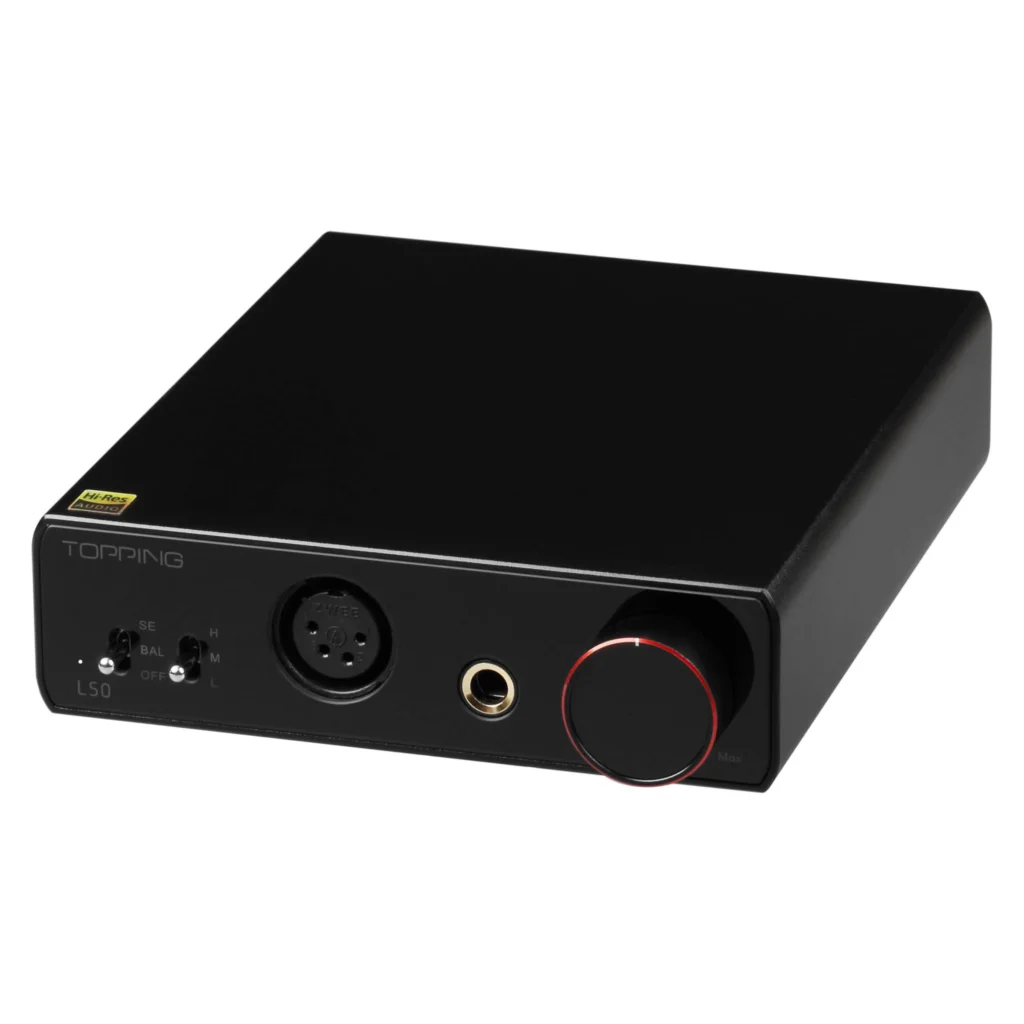
Topping L50 is an analogue headphone amplifier with both RCA and balanced line inputs. It is easy to misunderstand because the four-pin XLR headphone socket and rear output sockets suggest functions that are more limited than their appearance implies. The official manual makes the important distinctions: headphone amplification is single-ended, and the rear connections provide off-state passthrough rather than a normal adjustable pre-out. Those details should lead the buying decision.
Research-based review. This assessment draws on manufacturer documentation and the original published evaluations linked below. Audio Review has not performed a hands-on test of this model.
Balanced input and balanced output are separate questions
Topping’s manual explicitly describes balanced and single-ended inputs with single-ended outputs. The two headphone sockets provide convenient connector formats. Their presence does not establish two different amplifier topologies or an automatic power increase from choosing XLR.
Use the input that matches the source and the cable that matches the headphone correctly. A balanced line route can be useful between compatible equipment, but it should not be confused with how the headphone is driven. Do not buy an unnecessary cable merely to occupy the larger front socket. Check the exact wiring and output arrangement if adapting anything unusual. The L50’s practical attraction is the ability to accept different line sources and drive suitable headphones in a straightforward way. Understanding that role is more useful than assuming that a professional-looking connector guarantees an inherent sonic upgrade.
The rear outputs work when the amplifier is off
The official routing table shows corresponding input passthrough when the L50 is switched off and no rear output when it is on. Topping’s support page confirms this behaviour. The front volume control does not turn those sockets into a normal adjustable speaker preamplifier output.
Plan the speaker route before buying. If active monitors are connected through passthrough, another device must provide appropriate level control. Start with conservative monitor gain and establish which upstream control remains effective. Switching the L50 on then selects the headphone routine rather than providing simultaneous controlled speaker output. This can be convenient for a deliberately designed desk, but awkward if the owner expects the amplifier’s knob to govern both destinations. Test the entire sequence with the actual source. The right purchase is the one whose routing matches daily use without a surprise change in level or a missing volume-control stage.
Gain and power need the real headphone load
The manual provides three gain choices and separate output ratings by impedance. It lists 2.8 watts per channel into 32 ohms and 540 milliwatts into 300 ohms at its stated distortion threshold. Those are manufacturer conditions, not Audio Review measurements.
Choose the lowest gain that gives adequate clean level on quieter recordings and with any preferred EQ. A sensitive earphone may benefit more from usable adjustment than maximum output. A demanding full-size headphone should be assessed through its sensitivity and impedance together. Do not transfer one load’s wattage to every headphone or assume a higher gain sounds better. Check the source level as well, since an unusually low line signal can restrict what the complete chain delivers. A direct trial establishes whether the amplifier provides the intended headroom and control more usefully than a large headline number without its conditions.
USB is not an audio input
Topping identifies the rear USB connection as firmware-upgrade only. The L50 has no internal DAC and no direct optical or coaxial audio input. The specified power adapter supplies 15 volts AC, which is different from the DC power used by many small digital sources.
Connect a computer through a suitable DAC or existing analogue output, then feed the L50’s line input. Do not expect a USB cable alone to create a computer headset or power the amplifier. Keep the supplied transformer labelled and confirm its mains rating for the purchase region. A similar barrel plug on another adapter does not establish compatibility. Allow space for that transformer and for the rear cables when judging the installation. The small amplifier body is only part of the complete arrangement. A sensible setup avoids improvising power and connections simply to preserve the appearance of a compact matching stack.
Original listening accounts are not identical
Headfonia’s original L50 evaluation emphasises clean amplification and a quiet background with its tested headphones. Headfonics hears a relatively leaner, drier presentation while still finding it engaging. These are system-dependent listening accounts rather than a fixed tonal guarantee for every source and load.
Compare the amplifier with the existing output at similar loudness. Check clean level, audible noise in pauses and whether the volume adjustment is comfortable. If the old output already meets those needs, the main reason to change may be the L50’s input arrangement or handling rather than a dramatic sound transformation. Do not expect it to correct a headphone’s pad seal or preferred tuning by itself. If a difference is important, establish it with the actual headphone and source. Buying on a concrete requirement is more dependable than selecting whichever review adjective sounds closest to the desired result.
Value depends on routing and the complete package
The L50 is an established model, so its current European offer should be compared with newer and combined alternatives. Include the required DAC, line cables and correct adapter if any are missing. A low used price is less attractive when the power supply cannot be verified.
Check the input switch, gain controls, both headphone channels and the passthrough routine before judging condition. Ask about local service and return arrangements rather than assuming a matching brand stack guarantees convenient support. The L50 is strongest when balanced line inputs and its specific off-state speaker route fit the desk. It becomes less compelling if a remote, variable pre-out or integrated conversion is the real need. Those are functional differences, not merely premium extras. A simpler combined unit or another amplifier can be better value when it avoids workarounds and makes the everyday system easier to understand.
Alternatives to consider
Topping L70: L70 is relevant if a different control and connection package is wanted. Compare the exact preamplifier and headphone roles before selecting on the number of front-panel sockets.
Schiit Asgard 3: Asgard 3 is another analogue-amplifier comparison, with configuration details that need checking on the actual offer. Include the complete source and speaker route rather than treating every headphone amp as interchangeable.
FiiO K7: K7 is worth considering when the system still needs a DAC as well as amplification. A combined unit may be more straightforward than adding separate boxes solely to obtain a matching stack.
Topping L50 key specifications
- Role
- Analogue headphone amplifier
- Inputs
- Stereo RCA and balanced TRS
- Headphone sockets
- 6.35 mm stereo and four-pin XLR
- Amplification topology
- Single-ended headphone output
- Rear outputs
- Corresponding input passthrough when off; disabled when on
- Volume-controlled pre-out
- No
- Gain
- Low, medium and high
- Rated output at 32 ohms
- 2.8 W per channel at THD+N below 0.1%, manual conditions
- Rated output at 300 ohms
- 540 mW per channel at THD+N below 0.1%, manual conditions
- Power
- Supplied 15 V AC / 1 A adapter
- USB port
- Firmware upgrade only
- Remote and DAC
- Neither
- Dimensions
- 166 × 129 × 41 mm
- Weight
- 545 g
Verdict
Topping L50 can be a capable, practical analogue headphone amplifier for a suitable line source. Its broad input choice and gain range are useful, provided the owner understands the signal path and uses the correct supply.
Buy it for that defined role. The XLR headphone connector does not make the amplification balanced, the USB port is not for music input, and the rear passthrough is not a conventional variable pre-out. With those boundaries understood, the current price and the actual headphone match can be judged fairly against alternatives.
Documentation and original reviews
Topping official L50 product description · Topping official L50 manual and signal-routing table · Topping official L50 passthrough and USB clarification · Headfonia original L50 listening, matching and control evaluation · Headfonics original L50 listening assessment
Editorial record
Sources and updates
Product specifications and factual claims were checked against Official Topping L50 product page ↗. Scores and buying advice follow our category-specific editorial methodology.
- Published
- November 17, 2026
- Last updated
- November 17, 2026