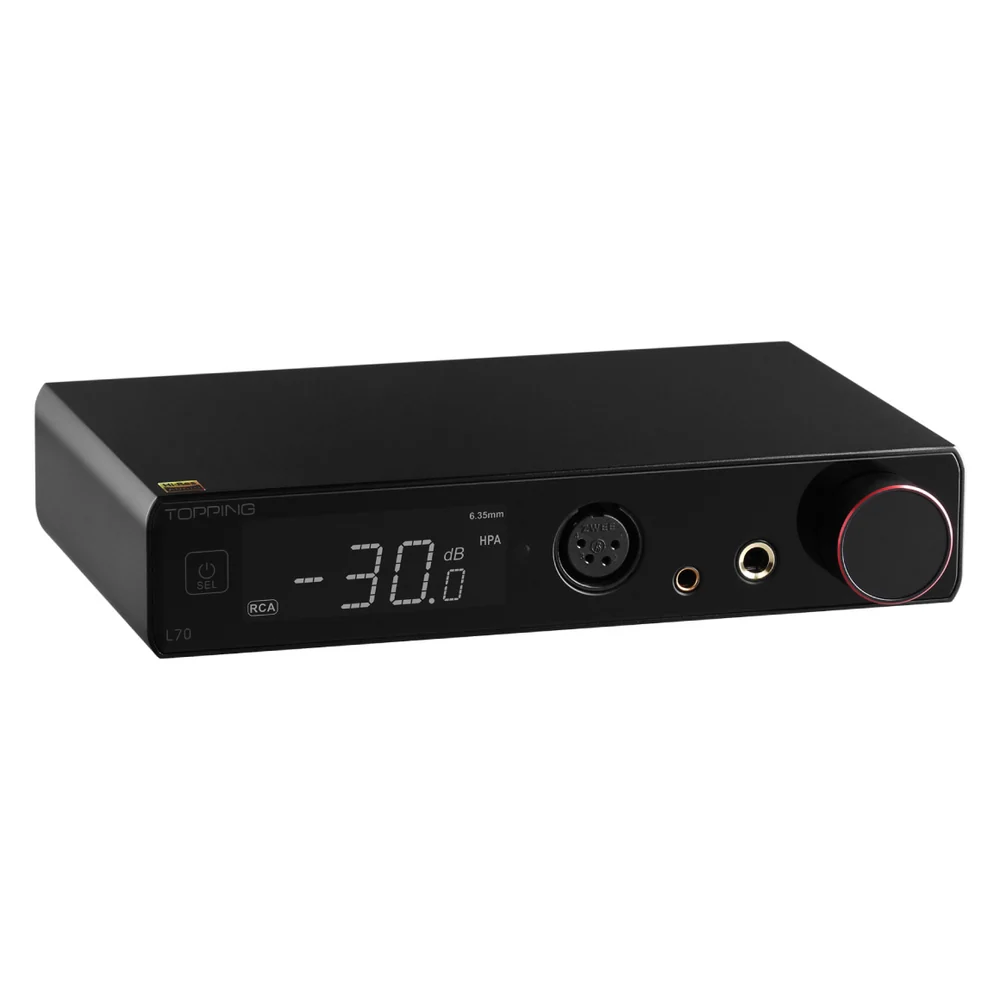
The Topping L70 is an analogue headphone amplifier with remote control, a visible level display and preamplifier outputs. It is intended to work with a separate DAC or another line-level source. Its digital control interface does not make it a digital-audio converter, and its main attraction is flexible, capable amplification in a relatively compact desktop package.
Topping L70 — A separate amplifier with a clear job
The L70’s format makes sense when a capable DAC is already available or when the owner prefers choosing the source and amplifier separately. The matching E70 series is an obvious visual partner, but the L70 does not require a same-brand converter. The relevant requirements are a suitable analogue output, appropriate level and a sensible connection. A good existing source can remain useful without buying a complete matched stack.
There is no built-in USB DAC, Bluetooth music receiver or optical input. The firmware interface should not be confused with computer-audio playback. A computer therefore needs a suitable DAC before the L70, and a turntable needs phono electronics before its line inputs. These distinctions should be clear while comparing prices, because an integrated DAC-and-amplifier product supplies a different set of functions for its total cost.
The front display and remote are practical benefits for a system that also uses active speakers or a power amplifier. They provide repeatable visible settings and operation from a seat. On a desk, the volume knob remains convenient. Plan the cable layout and decide which component controls level so that the finished system is understandable rather than a chain of overlapping volume settings.
Inputs and headphone connections
RCA inputs and balanced combination XLR/TRS inputs accommodate a range of analogue sources, including suitable studio equipment. The combination socket is a useful practical detail: the source’s balanced quarter-inch cable can be accommodated without immediately changing to an XLR cable. Check the signal wiring and level, especially when mixing domestic and professional equipment. A matching plug alone does not establish that the source is set appropriately.
The headphone sockets include 6.35 mm single-ended, 4.4 mm balanced and four-pin XLR balanced connections. They can be managed through the output settings, which are worth learning if several headphones remain connected. A separate stored level or selected output can simplify daily use, but confirm the actual behaviour after changing modes. Do not assume that plugging in one headphone automatically mutes every other device in every configuration.
Balanced headphone cables need the correct separate-return wiring. A simple adapter that combines the output returns is inappropriate for a balanced amplifier connection. Use a cable made for the headphone and intended socket, and avoid buying another cable solely because the larger socket looks more serious. An easy-to-drive headphone may already have all the level and low noise it needs from the single-ended output.
Power, gain and choosing the useful range
The manual lists 7.5 watts per channel into thirty-two ohms from the balanced outputs at less than 0.1 percent THD+N. It also lists different power figures for other loads and the single-ended path. Those conditions should remain attached to the headline number. The highest power is useful reserve for an appropriate headphone, not a reason to use high gain with every model.
Sensitivity and intended listening level matter alongside impedance. A low-impedance planar may demand more current than a high-sensitivity dynamic model, while a high-impedance headphone can place more emphasis on available voltage. The nominal impedance alone does not establish the required amplifier. Try the actual headphones and choose the lowest gain that provides comfortable adjustment and enough headroom for the material.
Sensitive in-ear monitors deserve a low-level check for hiss and useful volume range. Headfonics’ original L70 review found a low noise floor with its IEMs, which is encouraging evidence but not a promise for every earphone and source combination. Begin quietly after changing headphones. The same displayed setting can produce a very different level when sensitivity changes, even if the plugs look identical.
Volume control and daily operation
The L70 uses a relay-controlled resistor volume arrangement. The control system and display are digital, while the unit’s role remains analogue amplification. This is a useful distinction from a DAC with digital attenuation or a device applying digital equalisation. The presence of a numeric display does not mean the L70 converts the input to a digital audio stream for processing.
The remote supports source, output and level operations, with user settings available for convenient recall. Learn which state is being recalled and check the level before playback. A headphone-to-speaker transition should be a predictable daily action, especially if both systems remain physically connected. Clear output choices are more useful than leaving every output active and turning down whichever component happens to be nearest.
Relay clicks during level changes are part of the control mechanism and should be distinguished from noises reaching the headphone signal. During a demonstration, test small volume steps, input changes and muting as well as maximum output. The amplifier will spend far more time at ordinary levels than at the edge of its published power specification. A good low-level control experience is therefore a meaningful purchasing criterion.
Preamplifier use and system integration
The RCA and XLR line outputs allow the L70 to control a separate power amplifier or active speakers. They do not directly power passive speakers. Confirm the receiving component’s gain and input capability, then set a manageable level range. An unnecessarily high upstream level can leave little adjustment around a normal listening volume even when the system has ample technical headroom.
Trigger connections can coordinate compatible components and make a separate DAC-and-amplifier chain behave more conveniently. The trigger carries a control signal, not music. The manufacturer also provides a documented ground-lift facility for relevant connection problems. If hum appears, identify the source and follow the intended procedure rather than making arbitrary electrical changes. A quiet, understood signal path is more valuable than a larger collection of accessories.
A mixed desktop installation should be tested as a whole: computer playback through the DAC, headphone selection, speaker selection, standby and return to normal operation. Check that no unexpected source or output becomes active. These practical steps are easy to overlook in a sound-first demonstration, but they determine whether the L70 is pleasant to use for months and years.
Published listening assessment
Headfonics’ original L70 review praised clean drive, low noise and a largely neutral presentation, while finding some functions less intuitive to operate. Those are the reviewer’s observations with particular sources and headphones. Audio Review has not performed a hands-on or laboratory test. The evidence makes the L70 a credible candidate for a flexible headphone desk, with the interface worth trying before purchase.
A comparison should keep the same DAC, headphone and processing, with levels matched as closely as practical. A louder output can appear more detailed or dynamic in a quick switch. Circuit labels alone are also insufficient: NFCA describes Topping’s implementation approach, not a guarantee that every headphone will reveal the same subjective character. The useful question is whether the amplifier supplies the intended load cleanly and conveniently at the desired level.
If the existing amplifier already does that, a new one may bring a larger convenience benefit than a dramatic sound change. The L70’s remote, outputs and visible settings can still justify the purchase. If the problem is uncomfortable headphone fit or an unsuitable tonal balance, solve that problem directly rather than expecting additional wattage alone to change it.
Value and buying advice
The L70 is strongest when its separate-amplifier role is useful and the owner needs its connections or control facilities. It can be a sensible way to retain a good DAC while improving headphone handling and speaker-system integration. For a new single-headphone desk, compare an integrated alternative with the entire source cost included. The best-value arrangement is the one that completes the job with the least unnecessary complexity.
Check current European pricing, local support and the required interconnects. Test both sensitive and demanding headphones if the system will use them, and practise the output-selection routine. A well-configured L70 can serve several listening arrangements efficiently. Its value comes from those verified practical needs, with gain and level understood, rather than from treating its maximum power as a universal upgrade.
Alternatives to consider
iFi ZEN CAN 3: Compare its analogue adjustment approach and simpler control routine against the L70’s remote and output flexibility.
FiiO K7: A relevant integrated DAC-and-amplifier alternative if a separate source has not yet been purchased.
Topping L70 key specifications
- Role
- Analogue headphone amplifier / preamplifier
- Inputs
- Stereo RCA; balanced XLR/6.35 mm TRS combination
- Headphone outputs
- 6.35 mm single-ended; 4.4 mm and 4-pin XLR balanced
- Line outputs
- Stereo RCA and XLR
- Published balanced power
- 7.5 W/ch into 32 ohms, THD+N <0.1%
- Gain
- Low / high
- USB interface
- Firmware upgrade only
Verdict
The Topping L70 offers a strong combination of analogue drive, output flexibility and remote control for a desk with an existing DAC. Its interface takes some learning and its headroom should be matched sensibly to the headphones. Choose it when those controls and connections will be used, rather than buying on the power figure alone.
Primary documentation and independent reviews
Topping official L70 information · Topping official L70 manual · Headfonics original L70 review · Headfonics L70 comparisons and verdict
Editorial record
Sources and updates
Product specifications and factual claims were checked against Official Topping L70 product page ↗. Scores and buying advice follow our category-specific editorial methodology.
- Published
- November 8, 2026
- Last updated
- November 8, 2026