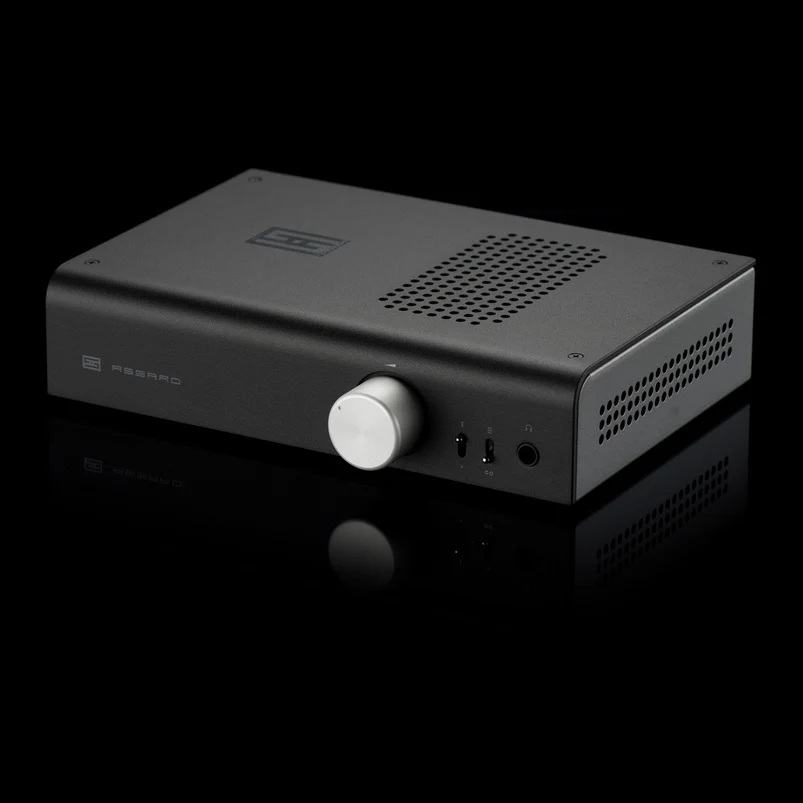
The Schiit Asgard 3 is a mains-powered headphone amplifier and preamp built around a straightforward single-ended system. It can accept an optional internal module, but the base amplifier is an analogue component rather than a complete digital hub. This review covers Asgard 3 specifically, not the earlier Asgard models or the later Asgard X.
Schiit Asgard 3 — Build, placement and daily use
The Asgard 3 is a substantial desktop component with a large volume dial and a full-size headphone socket. Its appeal lies in direct operation rather than a display or app. That makes it a good fit beside a listening chair or computer where reaching the control is natural. Someone who wants remote operation or a very small portable system is considering a different kind of product.
The official manual makes clear that the amplifier runs warm and needs its vents kept clear. Give it an open position rather than treating the top surface as a platform for another hot component. A sensible layout should also leave access to rear cables and the power switch. For a European purchase, confirm the actual unit’s mains voltage before use. That is especially relevant when looking at used equipment or cross-border listings, where an otherwise attractive price may describe a version intended for a different supply.
Analogue first, with optional modules
The base input is RCA line level. A suitable DAC, CD player or other analogue source can therefore feed the amplifier directly. The modular slot can provide a different role when the correct optional card is installed, including the DAC or phono arrangements described in the manual. A used Asgard 3 should never be assumed to include a card simply because another listing or review sample did.
Check exactly what is installed and whether it meets the intended source requirement. An amplifier-only unit does not accept USB audio through a passive adaptor. A normal RCA line input also does not provide phono equalisation for a raw cartridge signal. A turntable needs a suitable phono stage unless the correct phono module is actually fitted. The modular concept is useful, but it is not a promise that every old card remains available or compatible with every later option.
Keeping an existing external DAC can be the most economical arrangement. It avoids paying for another converter and preserves whatever digital input selection the current system already has. An internal card may simplify a single-source desk, while a separate DAC can be easier to replace independently. Choose the structure around the sources you use instead of assuming fewer boxes always means a better system.
Single-ended headphones and gain
The headphone output is a conventional 6.35 mm single-ended connection. There is no balanced headphone socket to unlock through an accessory, and that is not automatically a limitation for a correctly matched headphone. Available drive depends on the amplifier design and load, not simply on whether the plug has four or five contacts. Use a suitable adaptor for a conventional 3.5 mm stereo cable and check headset wiring separately.
Low and high gain settings let the owner adapt the control range. Begin with low gain for sensitive headphones or earphones, then increase only when more range is required. A higher setting can make adjustment less comfortable without improving the recording. For demanding full-size models, consider sensitivity, impedance and the headroom needed for quiet material or EQ. No amplifier should be declared ideal for every headphone on the strength of a single power claim.
The Asgard’s direct controls are an advantage when the headphone collection is small and the routine is consistent. If several very different headphones are changed frequently, think about how quickly the gain and level can be reset. A comfortable listening system is one in which those changes are deliberate and predictable, rather than a repeated surprise whenever another headphone is connected.
Sound quality and the original assessment
Headfonia’s original Asgard 3 review found it versatile across several headphones and described a richer, more relaxed presentation than the Magni 3 used for comparison. It included favourable pairings with Sennheiser HD600 and other full-size models. Those impressions support a positive amplifier assessment, but they are not measurements and should not be treated as a guaranteed correction for a bright headphone.
The review sample also included an optional multibit DAC module. That matters when reading its source comparisons: results from that card do not automatically apply to an amplifier-only unit or a different later module. Our recommendation focuses on the Asgard 3 amplifier role, while leaving any installed card to be identified separately. Version clarity is more useful than combining observations from several configurations under one undifferentiated model name.
For an owner with a competent amplifier already, the change should solve a specific need. Better headphone drive, a more usable control range or a preamp function may justify it. An expectation of a dramatic tonal transformation is less reliable. Compare at matched levels and keep the source stable. Familiar music over a sustained session reveals practical comfort better than rapid changes between several components at different loudness.
Preamp operation with speakers
The manual provides RCA preamp outputs and states that plugging in headphones mutes them. That is a useful arrangement for an active-speaker desk: the same source can support headphones without requiring the speakers to be manually silenced every time. The receiving speakers or power amplifier still need appropriate gain settings, so start conservatively and establish a comfortable volume range.
These are line-level outputs, not speaker terminals. Passive speakers require a separate power amplifier, and a normal headphone amplifier does not become a speaker power stage because it can play headphones loudly. The Asgard also does not provide automatic subwoofer integration or room correction. If those functions are central to the speaker system, plan them elsewhere or choose a product intended for that job. Its preamp role is useful precisely when a simple analogue chain is enough.
Value, condition and the right buyer
As an older model, the Asgard 3 should be assessed on its actual condition, configuration and present price. Confirm the mains version, input module, controls and service arrangements. A second-hand example with a suitable external DAC already available can be an attractive way to build a straightforward headphone system. A listing priced near a newer and more flexible alternative is a different proposition, regardless of an enthusiastic review at the original launch price.
There is no Bluetooth receiver, network platform or digital display in the basic amplifier. For a focused analogue headphone desk, that simplicity can be welcome. For a buyer expecting one box to handle several digital sources and wireless playback, adding the missing functions can erode the value advantage. The Asgard 3 is strongest when bought for its established amplifier and preamp role, with adequate space and a clear source plan, rather than as a speculative platform for future modules.
Alternatives to consider
iFi ZEN CAN 3: A relevant analogue headphone-amplifier alternative with a different control and sound-adjustment approach.
FiiO K7: Compare this when a complete digital desktop unit is more useful than retaining a separate DAC and analogue amplifier.
Schiit Asgard 3 key specifications
- Model
- Asgard 3; distinct from Asgard X
- Amplifier design
- Current-feedback with Continuity output stage
- Base input
- RCA analogue line
- Headphone output
- 6.35 mm single-ended
- Other output
- RCA variable preamp
- Gain
- Low and high
- Optional module
- DAC or phono capability depends on installed card
Verdict
A convincing single-ended headphone amplifier and simple preamp when the source and headphone are well chosen. Buy the exact configuration deliberately: warmth, mains version, optional modules and current used-market value matter more than treating every Asgard generation as interchangeable.
Primary documentation and independent reviews
Schiit official Asgard 3 manual · Headfonia original Asgard 3 review · Headfonia Asgard 3 matching and conclusion
Editorial record
Sources and updates
Product specifications and factual claims were checked against Official Schiit Asgard 3 product page ↗. Scores and buying advice follow our category-specific editorial methodology.
- Published
- November 8, 2026
- Last updated
- November 8, 2026