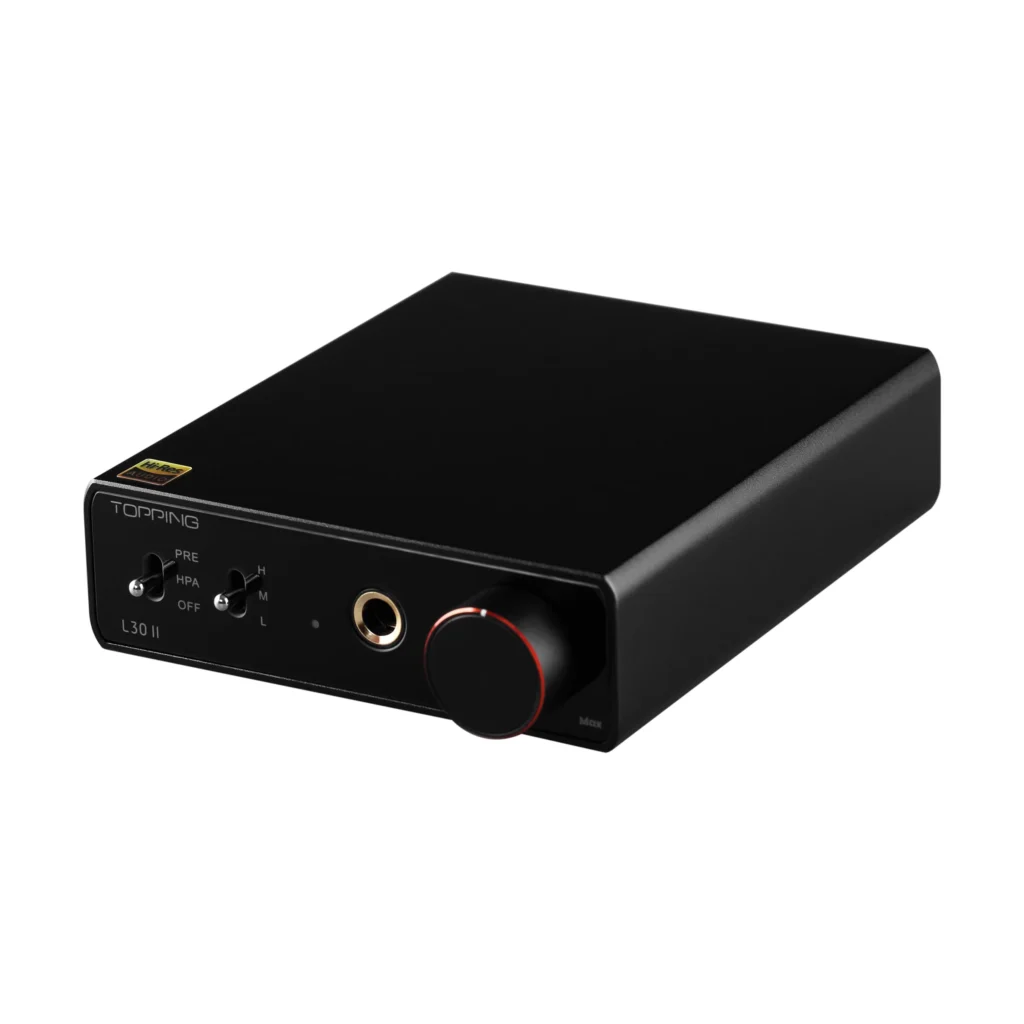
Topping L30 II is a compact analogue headphone amplifier with a simple control layout and a useful preamplifier role. It is not a USB DAC, even though it is often pictured beside a matching converter. The practical attraction is flexible gain and headphone drive from an existing RCA line source. The important details are the actual headphone load, source level and supplied AC power adapter rather than a single headline wattage.
Research-based review. This assessment draws on manufacturer documentation and the original published evaluations linked below. Audio Review has not performed a hands-on test of this model.
It needs an analogue source
Topping’s manual shows one stereo RCA input, a headphone jack and an RCA preamplifier output. There is no USB, optical or coaxial audio input. A computer therefore needs a suitable analogue output or a separate DAC before the L30 II.
Map the connection before buying a matching stack. If an existing interface already has clean line outputs, another DAC may be unnecessary. If the source is a turntable, a suitable phono stage must provide the appropriate line-level signal first. The amplifier does not perform cartridge equalisation. A convenient matching case is a secondary benefit, not an electrical requirement to use another product from the same brand. Choose the upstream device for its connections and controls. The L30 II is most economical when it fills a clear amplification gap rather than duplicating a headphone function that already works well.
Gain is about control as well as maximum level
The documented gain settings are -14, 0 and +16.5 decibels. This range is intended to accommodate different source levels and headphone sensitivities. The middle setting is unity gain, while the low setting can provide more useful control with sensitive earphones.
Begin with the lowest gain that gives adequate clean level on quieter recordings. Turn the volume down before changing headphones or gain, then reassess the control range. A higher setting is not a quality upgrade and should not be selected merely because it exists. If the knob stays very close to minimum, lower gain can make daily adjustment easier. If a demanding headphone lacks level, check the source output and the correct connection before assuming the amplifier has failed. The aim is a practical range for the headphone actually used, including quiet passages and louder programme material, rather than reaching a particular knob position.
Power ratings must keep their load conditions
The official manual rates 2.7 watts per channel into 32 ohms and 560 milliwatts into 300 ohms at its stated distortion threshold. These are manufacturer laboratory figures. The larger 3.5-watt headline refers to a different, 16-ohm load.
Do not apply one figure to every headphone. Impedance and sensitivity together determine how much voltage and current are useful for the intended listening level. A high rating provides potential headroom; it is not a target to use or a promise of identical output into any load. Check the exact headphone and avoid assuming that a low impedance alone makes it easy to drive. Equally, a high-impedance dynamic headphone may work well without being the hardest case. A direct trial with quiet recordings and the preferred EQ is more useful than selecting equipment from wattage alone.
The pre-out adds a separate system role
The output switch selects headphone or RCA preamplifier operation. In PRE mode, the volume control governs the analogue signal sent onward to compatible active speakers or a power amplifier. Those RCA sockets do not power passive speakers directly.
Decide how the system should behave when switching between speakers and headphones. Check downstream gain and begin at low level during setup. If a DAC also offers adjustable output, choose a deliberate arrangement for the two controls rather than changing both unpredictably. The L30 II has no remote of its own. An upstream remote-controlled DAC can provide another way to change system level, but that is a separate device and a separate operating choice. The pre-out is genuinely useful for a compact desk, provided its role and the location of everyday volume control are understood by everyone using the system.
Use the correct AC adapter
The official supply requirement is 15 volts AC, not an ordinary 15-volt DC adapter or the 5-volt supply used by a matching small DAC. Headfonics also highlights the substantial transformer and the need to identify the correct regional version.
Keep the supplied adapter labelled with the amplifier and confirm the mains rating when buying used or importing. A barrel plug that physically fits does not establish electrical compatibility. Plan somewhere for the transformer and allow sensible ventilation around the amplifier. If a supply is missing or damaged, obtain the appropriate replacement through the seller or manufacturer instead of improvising from a spare charger. This is a practical ownership consideration, not an optional route to a fashionable sound upgrade. The small front-panel box is only part of the space and wiring needed for the complete installation.
Published sound and the value decision
Headfonics’ original evaluation describes a balanced, approachable presentation with useful gain flexibility, while reserving criticism for some softness and the power brick. Those listening impressions are from its own combinations and should not be converted into a guaranteed tonal effect with every headphone.
Compare the L30 II with the source already owned at similar loudness. Listen for adequate level, low noise and clean behaviour on the actual headphone, rather than expecting an amplifier to correct an unsuitable pad seal or preferred tonal balance automatically. Current European price and support matter because this is an established model in a changing market. Include the cost of a DAC and interconnects if they are still needed. A combined unit may be simpler, while a separate amplifier can be useful when a good analogue source already exists. Value follows that complete system decision.
Alternatives to consider
Topping L70: L70 is relevant if more connections and a different control arrangement are needed. Compare the actual requirements rather than assuming that a more expensive amplifier is necessary for every headphone.
Schiit Magni Unity: Magni Unity is a useful compact amplifier comparison. Check the exact configuration and any DAC option included in the offer so a complete system is compared with a complete system.
FiiO K7: K7 makes sense when the source still needs digital conversion as well as amplification. Compare its total cost and desk routine with a separate DAC and L30 II stack.
Topping L30 II key specifications
- Role
- Analogue headphone amplifier and preamplifier
- Input
- Stereo RCA line-level
- Headphone output
- 6.35 mm single-ended
- Pre-out
- Variable stereo RCA
- Output selection
- Off, headphone or preamplifier
- Gain
- -14, 0 and +16.5 dB
- Rated output at 32 ohms
- 2.7 W per channel, THD+N below 0.1%, maker conditions
- Rated output at 300 ohms
- 560 mW per channel, THD+N below 0.1%, maker conditions
- Power
- Supplied 15 V AC / 1 A adapter
- Dimensions
- 100 x 135 x 32 mm
- DAC
- None
- Remote
- None
Verdict
Topping L30 II is a sensible compact amplifier for a suitable RCA source, with gain options that can make it practical across different headphones. The preamplifier mode adds a useful desk-system role without turning it into a digital converter or speaker amplifier.
Confirm the supply, source level and headphone requirements, then compare the complete cost with combined alternatives. It can be a strong value purchase when it solves an actual output limitation. It is less necessary when the existing headphone socket already provides the clean level and control the owner needs.
Documentation and original reviews
Topping official L30 II product · Topping official L30 II manual, gain and load-dependent ratings · Headfonics original L30 II operation and listening evaluation
Editorial record
Sources and updates
Product specifications and factual claims were checked against Official Topping L30 II product page ↗. Scores and buying advice follow our category-specific editorial methodology.
- Published
- November 17, 2026
- Last updated
- November 17, 2026