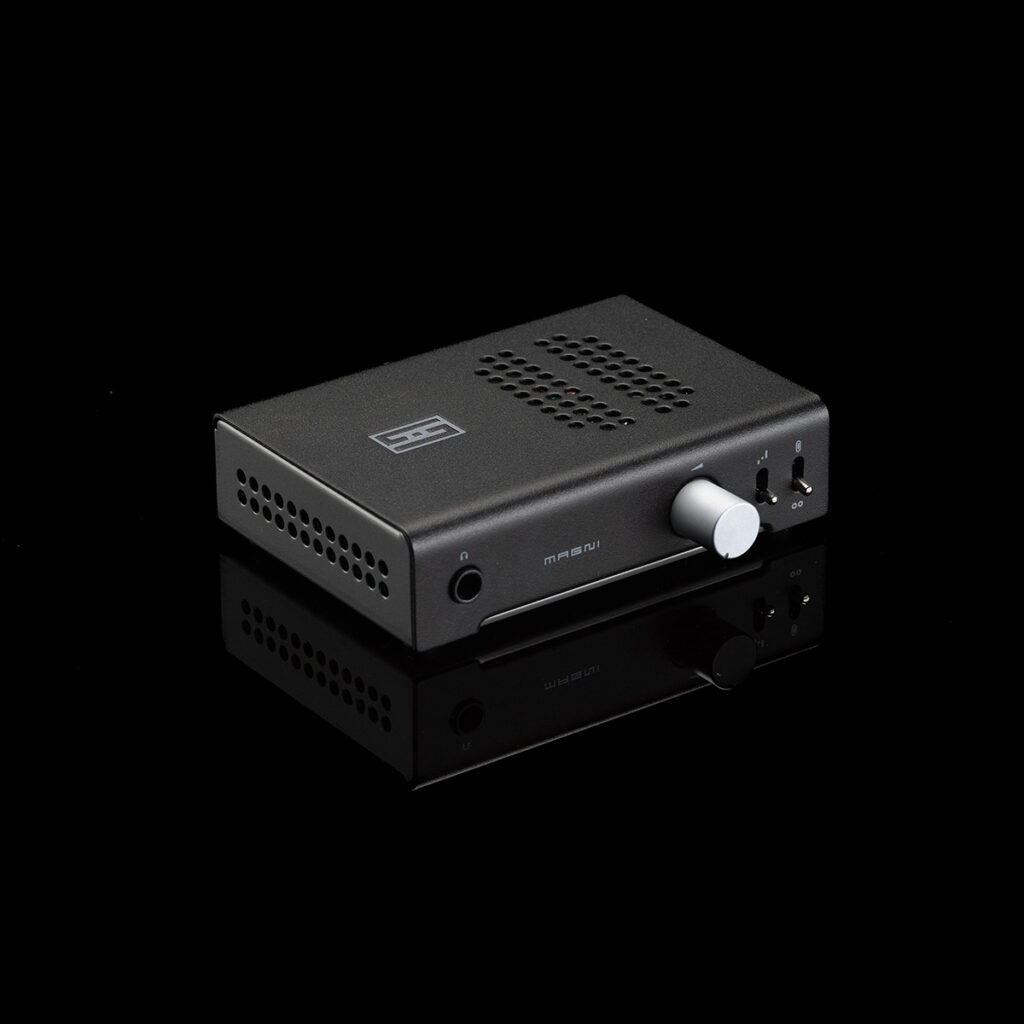
The Schiit Magni Unity is a compact headphone amplifier and preamp that can also become a USB DAC system when fitted with an optional internal card. Its appeal is a straightforward wired desk, with physical controls and a conventional headphone connection. The exact configuration matters because an amplifier-only Magni and one containing a DAC are not the same purchase.
Schiit Magni Unity — Design and a deliberately simple routine
The Magni Unity keeps the everyday interface direct: a volume dial, a headphone socket and switches rather than a screen full of menus. That can be a refreshing arrangement for someone who wants to sit down, select a source and listen. It also means the component belongs within reach. A buyer expecting remote control, wireless convenience or a visible file-information display should compare products built for those uses instead.
The small enclosure is desk friendly, but allow room for rear connections and the external power supply. The rear power switch may be less convenient if the box is pushed against a wall. Position it so that normal operation does not involve reaching blindly around cables. A neat desk arrangement is part of the product’s value: a compact amplifier is most useful when the whole system remains simple, rather than being surrounded by adaptors added to compensate for requirements it was never designed to meet.
Choose the amplifier and DAC configuration carefully
The basic Magni accepts an analogue RCA line input and supplies a headphone output plus RCA preamp outputs. An optional internal DAC adds USB-C audio. Schiit also offered a Mesh DAC option for Magni Unity, while the cited 2024 SoundStage Solo review evaluated the earlier ESS-card configuration. Its amplifier observations are useful evidence, but its DAC listening result should not be presented as a direct review of the later Mesh module. The retired Unity product URL now redirects to Magni 6; this review concerns Magni Unity, and the newer model’s power rating and connections should not be transferred to it.
For a buyer who already owns a suitable converter, the amplifier-only arrangement avoids paying for duplicated hardware. Someone starting with a computer may prefer the internal card for fewer boxes and cables. A separate DAC becomes more attractive when optical, coaxial or several digital inputs are required. Think through the actual source list before choosing: the optional USB card does not turn the Magni into a universal digital switcher.
The analogue input expects line level. A turntable still requires a phono stage before it, and an ordinary headphone or microphone socket is not automatically the right signal source. The optional DAC is also not a streaming player. A computer or other compatible host supplies the audio and music-service interface.
Gain and headphone compatibility
Schiit specifies three gain settings: negative 10 dB, unity gain and positive 15 dB. The negative setting is a practical feature for sensitive earphones because it can provide more usable travel on the volume control. High gain should be reserved for a headphone and recording that need it. There is no benefit in making the control more sensitive simply to use the most powerful-looking setting.
The manufacturer rates output at 2.5 W RMS per channel into 32 ohms, with its FAQ specifying less than one-percent distortion. That is useful capability through a normal single-ended connection, but it is not an Audio Review measurement or a promise for every load. Sensitivity, impedance and the desired headroom still need consideration. A difficult headphone should be assessed individually rather than assumed compatible because the amplifier has a generous wattage at one impedance.
The 6.35 mm output is appropriate for a conventional headphone cable, with a suitable adaptor for a normal 3.5 mm plug. Headset wiring requires care: a TRRS plug and an ordinary stereo TRS connection are different. If a connection causes protection muting, check the cable and adaptor rather than defeating the protection or repeatedly increasing volume. Correct wiring is more important than buying a cable advertised as an upgrade.
Sound quality and independent evidence
SoundStage Solo’s original review found the Magni effective with Audeze LCD-3, open-back Sundara and Meze earphones, and praised its compact, straightforward performance. Those results support the core amplifier concept. They do not prove that every headphone will produce the same result, nor do they establish a test of a later DAC revision. Our assessment treats the amplifier and the optional digital configuration separately where the evidence requires it.
For someone upgrading from a computer output, identify the practical problem first. Insufficient headroom, awkward control or missing preamp output are concrete reasons to add a desktop amplifier. If the existing output is already quiet and comfortably drives the chosen headphone, the improvement may be convenience more than a dramatic sonic transformation. A useful comparison keeps the music and level consistent rather than jumping between sources at different loudness.
An amplifier should not be expected to correct the basic acoustic balance of an unsuitable headphone. Comfort, fit and the recording remain central. If deliberate tonal adjustment is required, source-side EQ can be more predictable than buying successive amplifiers hoping one has the desired colour. The Magni’s focused role is attractive precisely because it does not require an elaborate story about what each component inside supposedly sounds like.
Preamp use and the power supply
The manual states that inserting headphones mutes the preamp output. That is useful for a desk shared with active speakers: headphone listening does not have to mean manually turning down a second system every time. The volume dial controls both headphone and preamp operation. Set the receiving speakers’ input gain conservatively during initial setup and establish a comfortable range on the Magni before normal use.
Passive speakers still need a power amplifier. The RCA preamp sockets are not speaker outputs, and using them does not supply bass management or room correction. The power supply is another detail worth checking: Schiit specifies an AC-output adaptor, not an interchangeable generic DC wall supply. For an EU purchase, confirm the correct supplied adaptor and mains arrangement. This is a configuration check for the actual product, not a reason to add expensive aftermarket power accessories.
Value and a sensible buying decision
The Magni Unity earns its place when a simple wired headphone and powered-speaker setup is the goal. An existing DAC can be retained, while the optional internal card offers a compact alternative for a single USB source. The choice should follow the source and control requirements rather than an assumption that a separate stack or integrated card is always superior.
Compare the complete European cost, including VAT, shipping, local support and the desired DAC option. A US base price for the amplifier alone is not directly comparable with an EU all-in-one price. For second-hand examples, confirm which card is installed and whether the power supply is suitable. The modular concept is useful, but future compatibility and module availability should be verified rather than assumed indefinitely. The Magni is strongest as a practical, affordable amplifier bought for the equipment you intend to use today.
Alternatives to consider
iFi ZEN CAN 3: Consider this when analogue headphone amplification and physical sound adjustment are central priorities.
FiiO K7: A useful comparison for a buyer starting from scratch who wants several digital inputs and a different output arrangement in one box.
Schiit Magni Unity key specifications
- Role
- Headphone amplifier and RCA preamp
- Analogue input
- RCA line
- Digital input
- USB-C only with optional DAC card
- Headphone output
- 6.35 mm single-ended
- Gain
- -10 dB, 0 dB, +15 dB
- Rated output
- 2.5 W RMS/channel at 32 ohms; manufacturer FAQ below 1% distortion
- Preamp muting
- Muted when headphones are inserted
- Dimensions
- 5 × 3.5 × 1.25 in
- Weight
- 2 lb (approximately 0.91 kg)
- Power consumption
- 2 W idle, 12 W maximum
Verdict
A strong, straightforward headphone amplifier with useful negative gain and a practical preamp role. Check the optional DAC revision and total EU price carefully; its simple wired approach is the attraction, while wireless use and multiple digital inputs call for a different setup.
Primary documentation and independent reviews
Archived official Schiit Magni Unity manual (September 2026) · SoundStage Solo original Magni review with earlier ESS card
Editorial record
Sources and updates
Product specifications and factual claims were checked against Official Schiit Magni Unity product page ↗. Scores and buying advice follow our category-specific editorial methodology.
- Published
- November 8, 2026
- Last updated
- November 13, 2026