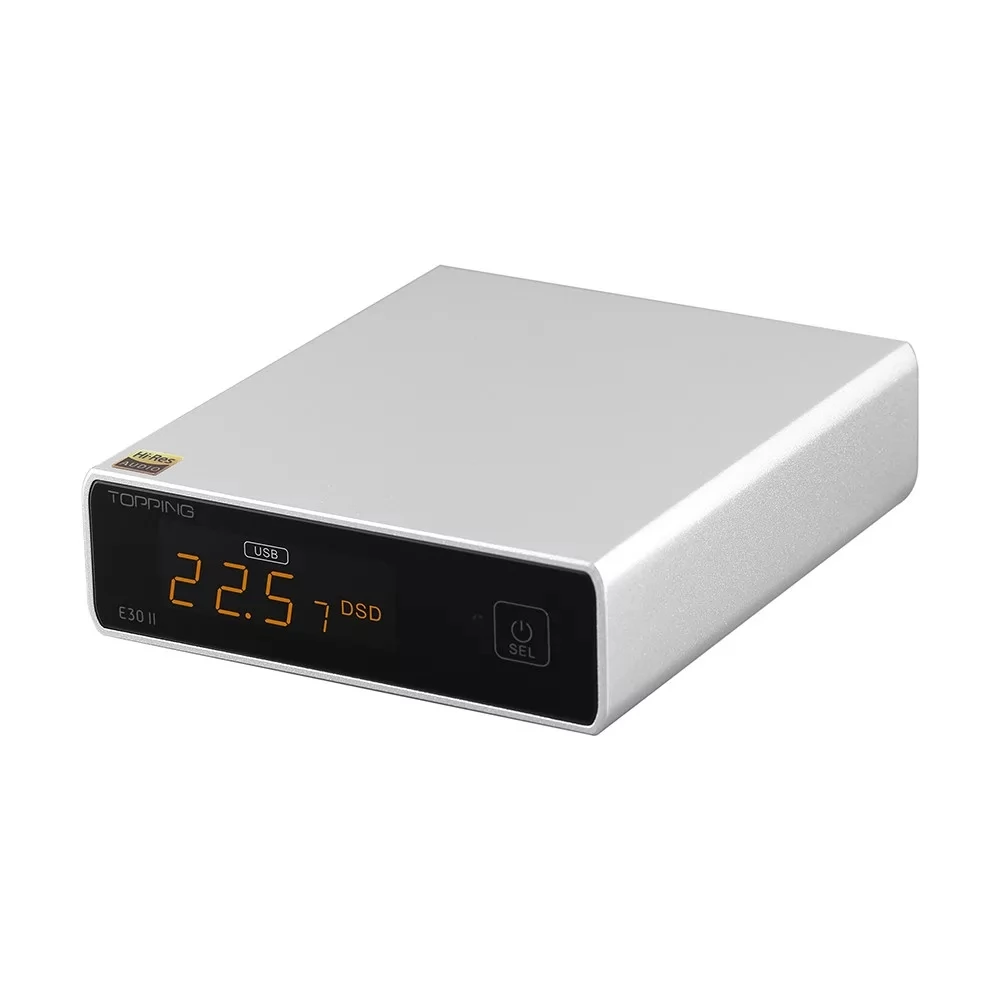
Topping E30 II is a small digital-to-analogue converter with remote control, designed to feed an amplifier, headphone amp or active speakers. It does not include a headphone output. That distinction is the starting point for a sensible purchase: the E30 II can organise several digital sources in an RCA system, but it cannot replace every part of that system. This review concerns the dual-chip E30 II rather than E30 II Lite.
Research-based review. This assessment draws on manufacturer documentation and the original published evaluations linked below. Audio Review has not performed a hands-on test of this model.
Map the connections before choosing the box
The official manual lists USB, optical and coaxial digital inputs with stereo RCA analogue output. There is no analogue source input or speaker-power stage. The separate power connection is part of the setup rather than an optional accessory for a special operating mode.
Write down each source and where the signal should go. A computer can use USB, while a compatible digital transport can use an S/PDIF connection. The RCA output then feeds a suitable line input or headphone amplifier. Passive speakers still need a power amplifier, and ordinary headphones should not be connected directly to the RCA sockets. A turntable needs its own suitable phono stage and analogue route unless a separate digital conversion arrangement is deliberately being used. This simple signal map prevents a small DAC from being expected to provide functions that its rear panel never offered.
Fixed DAC and variable PRE are different routines
Topping’s manual distinguishes fixed DAC output from PRE mode with adjustable volume. In fixed mode, the remote cannot reduce the output level. The remote also selects inputs and offers mute and other operating adjustments.
Choose one clear place to control listening level. With an integrated amplifier, a fixed DAC output can make the amplifier’s volume control the everyday interface. With compatible active speakers, variable output can be useful, but initial setup should begin with conservative downstream gain and low volume. Avoid changing modes casually while music is playing. Record the chosen arrangement so another user knows which control matters. Two volume controls are not inherently wrong, but they should be managed deliberately. The practical advantage of remote operation is greatest when the entire system behaves predictably from the listening position rather than requiring several devices to be adjusted every time.
The input limits are not identical
The official input table supports higher PCM and DSD formats over USB than over optical or coaxial. S/PDIF is specified for two-channel PCM up to 24-bit/192 kHz. Those maximum figures describe compatibility under the required conditions, not a guarantee that every host or app exposes every mode.
For ordinary music, begin with a familiar supported format and confirm the selected output device in the operating system. Add unusual high-rate playback only if the files and workflow require it. If using a television’s optical output, select a compatible stereo PCM setting rather than expecting this DAC to decode a surround bitstream. The absence of HDMI means it also does not provide an ARC control link to the television. Check remote-volume behaviour in that arrangement before buying. A high-resolution badge is less useful than a source connection that works reliably with the material actually played.
Power and desk placement are part of ownership
The manual specifies a separate 5-volt DC input. The USB data connection should not be assumed to provide all required power by itself. Headfonics’ original evaluation also notes the separate data and power cabling in practical use.
Plan those cables and a suitable power source before deciding how tidy the installation will be. The small body can sit unobtrusively, but it still needs room behind it for plugs and a clear path to the remote receiver. Do not substitute the supply from a similarly sized Topping headphone amplifier, since those products can have entirely different electrical requirements. Keep the original accessories identified with their device. If noise appears, investigate the actual source, grounding and cable route before assuming that a more expensive power accessory is mandatory. A reliable ordinary installation is a stronger starting point than speculative component changes.
Published sound impressions need proportion
Headfonics’ original review finds a fuller low end and a relaxed upper presentation, while reserving praise for ultimate resolution and complex passages. That is a subjective account from its own system. It does not establish that the E30 II will impose the same audible character in every level-matched comparison.
Judge an upgrade against the output already owned. Match levels carefully and listen for actual problems such as noise, clipping, unstable playback or an inconvenient control range. If the existing source is already clean and suitable, remote input selection may be the main benefit. That is a valid reason to buy a DAC. The presence of two converter chips is not itself proof of a dramatic improvement, nor does a named chip define the complete analogue output stage. Spend on the feature or performance gap that can be identified, rather than expecting a universal transformation from changing one small box.
Current value versus a complete DAC/amp
The E30 II is an established product, so compare the actual European offer and local support with current alternatives. A separate amplifier, interconnects and appropriate power arrangement belong in the total cost if the intended system is for headphones.
Check whether a combined DAC/amp would deliver the required controls in less space. A separate stack can be useful when components will be reused independently, but it is not automatically better sound or better value. For a used DAC, confirm remote operation, all required inputs and the supplied cables. Check the model marking so Lite and standard versions are not mixed in a price comparison. The E30 II is most convincing when its three-input, RCA-output role is exactly what the system needs. It becomes less compelling when the buyer immediately needs balanced outputs, analogue sources, wireless streaming or direct headphone drive.
Alternatives to consider
Schiit Modius E: Modius E is relevant when a separate DAC with a different output arrangement is wanted. Compare actual connections and volume-control requirements before paying for a format or feature the system will not use.
Topping E70 Velvet: E70 Velvet is a more ambitious separate-DAC comparison. The additional cost should solve an identified input, output or control requirement rather than being justified only by a higher position in the range.
FiiO K7: K7 is the more relevant kind of product when headphones must connect directly. Compare a complete DAC/amp with the total cost and desk space of an E30 II plus a separate amplifier.
Topping E30 II key specifications
- Model covered
- E30 II, not E30 II Lite
- DAC configuration
- Dual AK4493S
- Digital inputs
- USB, optical and coaxial
- Analogue output
- Stereo RCA
- Output level
- 2.1 Vrms at 0 dBFS, manufacturer specification
- Modes
- Fixed DAC or variable PRE
- USB support
- PCM up to 32-bit/768 kHz; native DSD512 with suitable host
- Optical/coaxial support
- PCM up to 24-bit/192 kHz
- Power
- Separate DC 5 V / 1 A
- Dimensions
- 100 x 125 x 32 mm
- Headphone output
- None
- Remote
- Supplied
Verdict
Topping E30 II is a practical small DAC for an RCA-based system with several digital sources and a useful role for remote control. The fixed and variable output modes add flexibility, provided the owner chooses the intended volume-control arrangement deliberately.
Buy it after mapping the complete signal and power routes. It is not a headphone amp, a surround decoder or a network player. When those boundaries fit the system, it can make playback simpler; when they do not, a different product can be a more economical and coherent purchase.
Documentation and original reviews
Topping official E30 II product and DAC configuration · Topping official E30 II and Lite manual with mode and input tables · Headfonics original E30 II operating and sound evaluation
Editorial record
Sources and updates
Product specifications and factual claims were checked against Official Topping E30 II product page ↗. Scores and buying advice follow our category-specific editorial methodology.
- Published
- November 17, 2026
- Last updated
- November 17, 2026