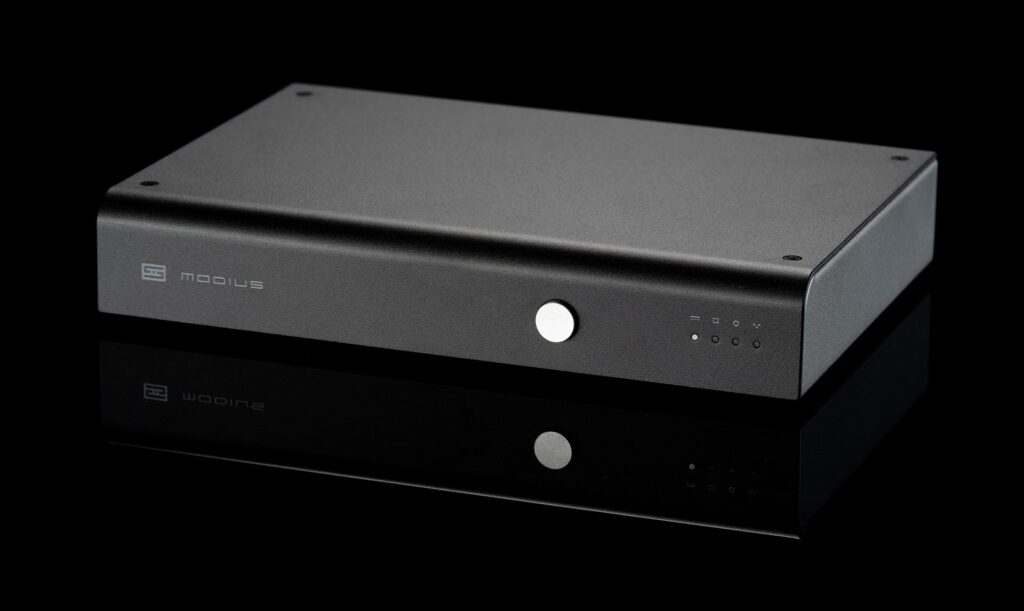
The Schiit Modius E is a dedicated desktop DAC with fixed analogue outputs and several wired digital inputs. It is intended to feed an amplifier or preamplifier, not to replace one. This review concerns the ESS revision identified as Modius E, rather than the earlier AKM-based Modius.
Schiit Modius E — A focused converter for separates
The Modius E makes most sense in a system where amplification and volume control already exist. Its job is to accept digital sources and provide a clean, consistent analogue connection to the next component. The uncomplicated front panel reflects that role. There is an input selector and status indication rather than a headphone socket or volume dial. Someone choosing it as a first desktop component should budget for the rest of the chain before judging the apparent price advantage.
Its wider enclosure may fit neatly with other Schiit separates, but visual matching is not a requirement for electrical compatibility. Choose the DAC because its inputs and outputs suit the system, not because every box needs the same brand name. Cable access and shelf space are still important. A low-profile component can require more depth than expected once USB, power and analogue plugs are attached, particularly when several sources remain connected permanently.
Inputs and a practical source plan
The official Modius E manual lists USB-C, optical, coaxial and AES digital inputs. The USB connection carries data and power, while the other inputs provide routes for compatible transports. AES is useful when a source genuinely offers it; it is not a reason to add a converter merely to occupy another socket. For most computer systems, a direct compatible USB connection is the simplest starting point.
Optical or coaxial can accommodate a suitable CD transport or television. With a television, choose a supported stereo PCM signal and check the available output menu. This DAC is not an HDMI ARC receiver or surround decoder. Its connections do not provide automatic television-remote control of an existing amplifier. The electrical path and the everyday control experience should both be considered, because a technically compatible system may still involve more remotes than a household wants.
There is no Bluetooth receiver or independent streaming platform. A separate phone adaptor or streamer would add those functions, but that extra cost and complexity should be part of the original comparison. If wireless playback is the central requirement, a different DAC may fit the plan more directly.
Fixed outputs and volume control
The analogue connections are RCA and balanced XLR. The manual says both can be used at the same time and are independent. That can be useful for a speaker amplifier and a separate headphone amplifier sharing the same digital sources. It does not provide two independent volume controls. Each receiving system still needs appropriate level adjustment and a deliberate switching routine.
Do not connect the fixed outputs to active speakers and assume the DAC will manage everyday volume. Use speakers with suitable control or an intervening preamplifier. Likewise, headphones require a headphone amplifier, and passive speakers require a speaker power stage. These distinctions are ordinary parts of a separates system, but they prevent a plain DAC from being mistaken for a complete desktop hub.
Choose RCA or XLR according to the receiving equipment and cable run. A balanced connection can be useful where supported, but it does not automatically establish a more enjoyable result in every short domestic system. Avoid a collection of adaptors designed only to use a particular socket. A correctly wired, straightforward connection is a better starting point than an elaborate chain that makes faults harder to isolate.
Sound quality and the available evidence
Audio Science Review’s published measurement index identifies a separate Modius E test and lists a SINAD result of 111 dB. That is original measurement evidence for the E revision rather than a result borrowed from the earlier Modius. The index does not by itself establish every detailed test condition, so we do not turn it into an invented set of laboratory findings. It supports treating this as a competent converter, while the system connections remain central to the recommendation.
Wall of Sound also evaluated the Modius E in a specific multi-component system and found its value favourable relative to its original price, while reporting differences between source arrangements. Those are subjective observations in that chain, not proof that every owner needs a USB conditioner or costly digital interconnect. A direct, stable connection should be the baseline before buying extra hardware to address an unconfirmed problem.
For a listener replacing a functioning DAC, identify what is missing first. Additional inputs or a balanced line connection are tangible changes. Expecting a new converter to fix unsuitable loudspeakers or an uncomfortable headphone is less reliable. Compare familiar recordings at matched levels, and avoid changing the amplifier and DAC together if the goal is to understand the contribution of each. The E suffix identifies a revision; it is not a guarantee that an existing owner will hear a worthwhile upgrade.
USB power and troubleshooting
The manual explains that USB-only operation can use the data connection for power. When using the other digital inputs without a USB source, the separate power input needs a suitable 5 V supply. That is an important setup distinction: an optical or coaxial cable carries the audio data but does not power the DAC. If every front indicator is dark, checking power is a better first step than altering playback software.
At a computer, confirm that the DAC is selected as the output device and that the application is using the intended route. A USB-C cable must support data, and a physically matching charging lead is not enough. Keep initial setup simple with one source and one output before adding another amplifier. Once the reference path works, additional connections can be introduced in a controlled way. That makes a compact separates arrangement much easier to maintain over time.
Buying an older revision sensibly
The Modius E is now most relevant to remaining-stock and used-market comparisons, so condition and complete cost matter. Confirm the E revision, the available cables and power arrangement, and whether the seller provides a clear return or service route. Do not compare an old US launch price directly with a current EU price that includes VAT and support. A good second-hand offer can make sense; a price close to a newer, better-equipped alternative is less compelling.
The strongest buyer already owns a suitable amplifier, wants several wired digital sources and prefers fixed outputs. A person starting from nothing may get a simpler arrangement from a combined DAC and headphone amplifier. Someone needing wireless playback or direct active-speaker volume should compare those functions explicitly. The Modius E remains a useful focused converter when the system is planned around its strengths, rather than purchased in the hope that missing controls can be ignored.
Alternatives to consider
S.M.S.L DO100 Pro: Compare another published separate DAC against the required sources and line-output behaviour.
iFi ZEN DAC 3: A different approach when a USB headphone system and adjustable output are needed rather than several wired digital inputs.
Schiit Modius E key specifications
- Revision
- Modius E; ESS version
- Inputs
- USB-C, optical, coaxial and AES
- Outputs
- Fixed RCA and balanced XLR line
- Simultaneous outputs
- RCA and XLR independently usable, per manual
- Volume control
- Not included
- Power
- USB data connection or separate 5 V input as documented
- Role
- Standalone digital-to-analogue converter
- Front-panel control
- Input selector with source indicators
Verdict
A competent and focused converter for an existing separates system, with useful wired inputs and independent RCA and XLR outputs. Fixed level, absent wireless functions and the condition and price of an older revision are central to whether it is the right purchase.
Primary documentation and independent reviews
Archived official Schiit Modius E manual (November 2025) · Audio Science Review original measurement index, Modius E entry · Wall of Sound original Modius E system evaluation
Editorial record
Sources and updates
Product specifications and factual claims were checked against Official Schiit Modius E product page ↗. Scores and buying advice follow our category-specific editorial methodology.
- Published
- November 8, 2026
- Last updated
- November 13, 2026