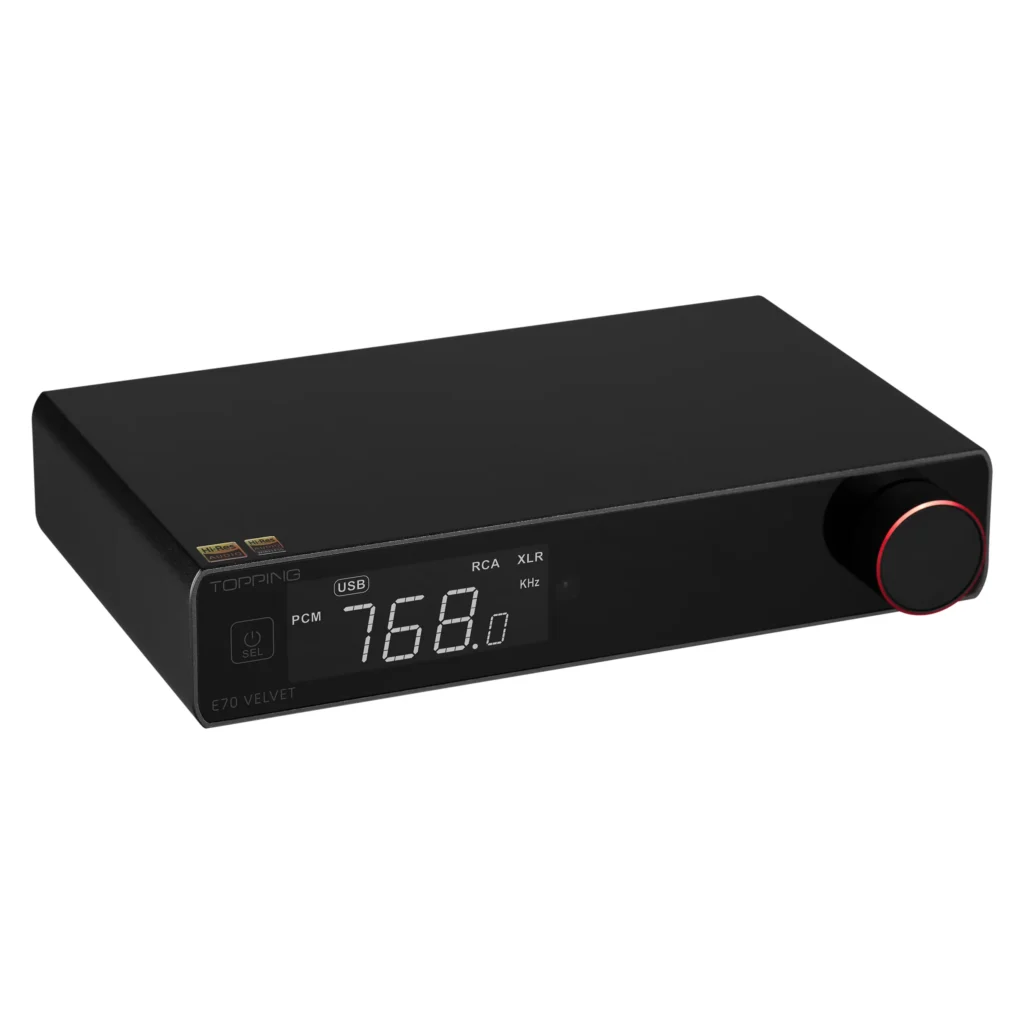
The Topping E70 Velvet is a compact digital-to-analogue converter with balanced and single-ended line outputs, Bluetooth reception and optional volume control. It suits a system that already has a headphone amplifier, integrated amplifier or active speakers. The matching appearance of the L70 should not obscure that distinction: the E70 Velvet itself has no headphone amplification.
Topping E70 Velvet — Design and choosing the correct model
The front display and single main knob give the E70 Velvet a simple everyday interface. It can operate on a desk or supply a conventional hi-fi system from a shelf, with a remote useful for the latter. Its small footprint is attractive, but allow space behind it for several cables. A compact case does not mean the complete installation has the same depth once USB, optical and analogue leads are attached.
The Velvet version should be distinguished from the original E70. Their similar appearance and name can make retailer listings confusing, while the conversion implementation differs. Check the full designation on the invoice and follow support instructions for the exact model. A firmware file or setting intended for a similarly named product should not be assumed appropriate. The purchase should be based on the actual unit rather than a photograph shared across several listings.
The appeal is a focused digital source with useful line control. There are no analogue inputs for a turntable and no front headphone socket. If the goal is one box for a computer and headphones, a combined DAC and amplifier may be more economical. The E70 becomes more attractive when good amplification already exists and only the conversion and switching role needs filling.
Digital sources and format support
USB, optical and coaxial inputs cover common wired sources, while Bluetooth adds a convenient phone route. The USB path supports the highest advertised PCM and native DSD formats; optical and coaxial have lower limits. Use the current manual’s input table when matching a source. The ability to decode a high-rate file over USB does not mean a television’s optical output can send it in the same form.
For television sound, select a compatible stereo PCM output. This is not a Dolby or DTS surround decoder, so a multichannel bitstream is not the same as ordinary stereo input. The DAC also lacks HDMI ARC or eARC. A television connection can work well through optical, but the required volume-control routine should be understood before replacing an HDMI-equipped sound system. The TV remote may not control every separate DAC arrangement in the same way.
On a computer, select the E70 in the player and system settings, then test normal material before exploring extreme formats. The displayed rate describes the input signal, not proof that every application has avoided resampling. Exclusive playback can be useful for a dedicated session, while shared system audio may be more convenient when calls and notifications must remain available. Choose the workflow around actual use rather than chasing a particular display number.
RCA, XLR and the right output level
Stereo RCA and XLR line outputs provide flexibility with integrated amplifiers, headphone amplifiers and active speakers. Balanced cabling can be useful where the connected equipment supports it and interference is a concern. It should not be assumed audibly superior in every short, quiet domestic connection. The receiving circuitry, cable route and gain structure are part of the complete result.
The manual provides different output-level modes. Its table lists approximately 2.1 volts RCA and 4.2 volts XLR at full scale in the nominal four-volt mode, with 2.5 and five volts in the higher mode. Those choices should match the receiving amplifier’s input headroom. A higher voltage is not inherently a better signal for a component that already reaches full output comfortably with the lower setting.
DAC mode fixes the output at maximum level, while PRE mode allows volume adjustment. Confirm the mode when connecting active speakers or a power amplifier directly. A fixed output is suitable when another component controls level; a direct controlled system needs the appropriate variable mode. Start with a sensible level, test mute and standby behaviour and keep one main volume-control point clear. These practical checks are more useful than leaving several controllers at arbitrary settings.
Bluetooth and convenience
Bluetooth reception supports LDAC and several aptX-family codecs alongside standard options in the manual. The phone or computer must support the chosen codec as well. A Bluetooth version label alone does not establish which mode is active, and different source devices may negotiate different formats. Test the intended phone and ordinary reconnection after standby rather than assuming every household device behaves identically.
This is a Bluetooth receiver, not a self-contained network music player. It does not browse a library or connect independently to every streaming service simply because a phone can send it audio. A separate network transport may be useful for a particular music workflow, while USB or optical can remain a more straightforward wired route. Add another source only when it solves an actual convenience or format requirement.
The trigger connections can coordinate compatible equipment, helping a DAC-and-amplifier pair behave more like one system. They do not carry music. The remote, display brightness options and input selection are also everyday facilities worth trying during setup. A reliable routine matters more than a collection of unused technical possibilities, especially if several people share the system.
Published sound assessment
Headfonia’s original E70V review described clean, natural and balanced reproduction, and found the Velvet version competitive in its price class. It evaluated both active-speaker and headphone-system use. Those are the reviewer’s observations, not Audio Review listening or laboratory results. They support the E70 Velvet as a credible source candidate without proving that an AKM implementation must sound a particular way in every system.
The AKM conversion arrangement is part of the design, but the Velvet name should not be treated as a guarantee of a deliberately warm tonal balance. A DAC’s job in a straightforward system is to deliver an appropriately clean signal to the next stage. Headphones, speakers, fit and room response can have much larger effects on the final balance than replacing one competent converter with another. Identify what the existing source does poorly before assuming a different chip resolves it.
For comparison, keep the same amplifier and transducers and match the actual output level. Switching from RCA to XLR or selecting the higher voltage mode can make a casual demonstration louder. That can be mistaken for more detail or stronger dynamics. A useful audition checks noise, reliable operation and a comfortable overall result at normal volume, with the signal path and any processing kept consistent.
Value and system planning
The E70 Velvet is most persuasive when its connections and preamplifier role have a clear job and amplification is already owned. It can provide a tidy interface between a computer or transport and active speakers, or pair with an analogue headphone amplifier. For a new headphone setup, include that amplifier’s cost and desk space before comparing with an integrated product. A two-box solution is flexible, but its flexibility should be useful.
Current European pricing and retailer support matter more than an old launch-price comparison. Check what interconnects are required, how the computer will connect and which component controls volume. A DAC offering inputs that will never be used is not automatically a better purchase than a simpler one. Conversely, the E70’s conventional wired inputs can be worthwhile when several existing sources need bringing together.
The sensible buyer wants a capable digital source and a clear daily workflow, with realistic expectations about the scale of any sound change. Start from correct levels and quiet connections, then judge whether the E70 solves the intended problem. Its appeal is the complete balance of conversion, useful outputs and convenience rather than the promise that premium specifications alone transform familiar music.
Alternatives to consider
RME ADI-2 DAC FS: Compare if integrated headphone outputs and extensive adjustment justify a larger budget.
FiiO K7: An integrated DAC and headphone-amplifier approach when a separate analogue amplifier would otherwise be required.
Topping E70 Velvet key specifications
- Role
- Stereo DAC / digital preamplifier
- Conversion
- AKM AK4499EX-based implementation
- Inputs
- USB, optical, coaxial, Bluetooth
- Outputs
- Stereo RCA and XLR line outputs
- USB support
- Up to PCM 32-bit/768 kHz and native DSD512
- Volume
- Fixed DAC or variable PRE
- Headphone amplifier
- Not included
- Mains
- 100–240 V AC, 50/60 Hz
Verdict
The Topping E70 Velvet is a strong compact source for an existing amplifier or active-speaker system, with useful wired inputs, Bluetooth and balanced outputs. It rewards correct level and volume-mode setup. Buy it for a clear digital-source role, with separate headphone amplification included in the budget where needed.
Primary documentation and independent reviews
Topping official E70 Velvet information · Topping official E70 Velvet manual · Headfonia original E70V review · Headfonia listening and connection evaluation
Editorial record
Sources and updates
Product specifications and factual claims were checked against Official Topping E70 Velvet product page ↗. Scores and buying advice follow our category-specific editorial methodology.
- Published
- November 8, 2026
- Last updated
- November 8, 2026