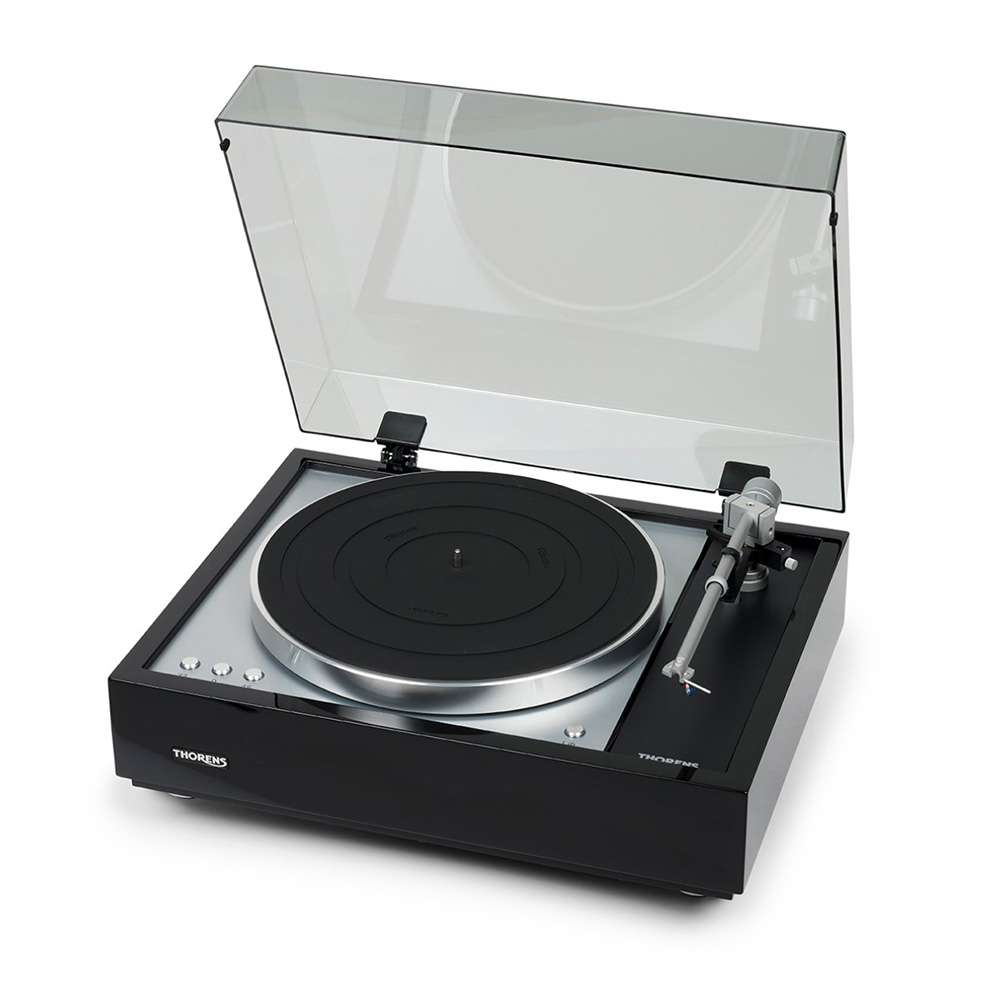
Thorens TD 1601 addresses a practical concern that many expensive record players leave to the owner: lifting the arm at the end of a side. It combines that convenience with the suspended platform shared with TD 1600. The current TP 160 version must be distinguished from earlier TP 92 examples. The broad model name alone does not identify the exact arm and cartridge being bought or the combination assessed in an older review.
Research-based review. This assessment draws on manufacturer documentation and the original published evaluations linked below. Audio Review has not performed a hands-on test of this model.
Automatic lifting is not automatic record playing
Thorens describes an electric cueing lift and a contactless end-of-side mechanism that raises the arm and stops the platter. It does not describe a complete automatic start, arm positioning and return-to-rest sequence. That distinction matters when a listing loosely calls the deck semi-automatic or automatic.
Ask the dealer to demonstrate the entire routine with a record. Check what the owner does before playback and after the automatic end function operates. Someone who simply wants protection from an unattended run-out groove may find this arrangement ideal. Someone expecting one-button playback from rest may need another model. Understanding the sequence also helps place the deck sensibly on a shelf: the arm must remain accessible, and manual handling is still part of use. A useful convenience should fit the actual listening habit rather than merely adding a feature to the specification list.
Current TP 160 and earlier TP 92 versions
The current manufacturer page identifies the TP 160 arm with a detachable SME-type headshell and knife-edge bearing. Older product pages and original tests describe TP 92. Thorens’ brochure also explains that an arm retrofit can be arranged through the company.
Confirm the version in writing and request a photograph of the actual unit. A used deck may have been changed, while an unsold older package may still carry the earlier arm. Neither circumstance is automatically bad, but both affect price and which evaluation applies. Ask for the cartridge model, alignment work and any setup records as well. A detachable headshell makes cartridge changes more manageable; it does not remove the need to match tracking force, geometry and electrical loading. Buy the configuration that suits the intended system rather than paying a premium because a seller uses photographs of a newer version.
Published sound evidence needs its configuration
Hi-Fi Choice’s original TD 1601 test used TP 92 with a Clearaudio MC Essence cartridge. It reports lively dynamics, well-defined bass and an open upper range. HiFi-Advice’s later TP 160 evaluation is of the shared TD 1600 platform, so it informs the arm discussion without becoming a separate hands-on test of a TD 1601 TP 160 package.
That division is useful when planning an audition. Listen to the exact cartridge and arm on offer, with a phono stage representative of the intended system. Try familiar records containing dense bass lines, exposed voices and louder ensemble sections. Ask whether the sound remains clear and engaging over a whole side. Differences between cartridges and phono loading can be substantial, so an attractive description of an older combination cannot guarantee the same balance from a current package. The evidence supports a shortlist and a targeted audition rather than an unconditional sonic promise.
A suspended chassis still requires installation care
The platform uses three conical springs beneath the subchassis, a belt-driven aluminium platter arrangement and an external linear supply. The design attempts to isolate the record-playing parts while controlling unwanted movement. It should still be placed on a stable, level support.
Try ordinary movement around the intended location before settling the installation. If footsteps or furniture vibration disturb playback, address the support rather than assuming a more expensive cartridge will solve it. Have a dealer check suspension behaviour when buying used or after shipping. The electric cueing arrangement also allows normal operation without directly manipulating a lever on the moving arm platform, which is a relevant convenience. It does not justify pressing hard on the cabinet or ignoring setup. Keep the transport materials and follow model-specific packing instructions for any move; a suspended deck should not be shipped as though it were a fixed household appliance.
RCA and XLR are cartridge connections
The documented outputs include RCA and balanced XLR, with Thorens describing the balanced option for a suitable moving-coil system. A matching phono stage is still required. The external motor power supply does not perform cartridge equalisation or supply a line-level music output.
Map the route from the chosen cartridge to the amplifier before ordering cables. Check gain, input loading and grounding against the relevant manuals. If the existing phono stage uses RCA, that can remain a perfectly sensible system choice; changing connector format is not an upgrade by itself. Do not confuse a cartridge-level XLR output with an ordinary balanced line source. A successful installation should be quiet, correctly loaded and convenient to switch between sources. If hum appears, establish the grounding and placement issue systematically rather than treating the socket style as proof that the problem cannot exist.
When the convenience earns its premium
The TD 1601 is most compelling when the owner wants a configurable vinyl source and values the end-of-side lift enough to pay for it. Current European quotations should identify the arm, cartridge, cover, supply, setup and support. A launch-era price or a bare deck is not an equivalent comparison.
On a used example, check the lift and stopping function as well as the arm and cartridge condition. Ask about service history and transport preparation. A worn stylus or unresolved mechanism issue can outweigh a tempting discount. For a listener who always sits close to the deck and cues every side manually, the TD 1600 may be the more rational allocation of money. For someone who wants to finish a side without hurrying back to raise the arm, this feature may deliver more everyday benefit than another small and uncertain change in materials or accessories.
Alternatives to consider
Dual CS 529: CS 529 is relevant when automatic operation is an important buying criterion. Compare what happens at the start and end of a record as well as the available cartridge setup; the Thorens lift function is not the same as a fully automatic routine.
Thorens TD 1500: TD 1500 offers another modern suspended Thorens route. Compare the total installed price and arm-and-cartridge package, then decide how much the TD 1601 convenience is worth in daily listening.
Technics SL-1200G: SL-1200G is a useful contrasting premium direct-drive choice. Consider controls, support, cartridge flexibility and long-term handling alongside a level-matched audition of the complete systems.
Thorens TD 1601 key specifications
- Drive
- Belt
- Suspension
- Three conical springs
- Speeds
- 33 1/3 and 45 rpm
- Speed selection
- Electronic
- Current arm configuration
- TP 160; older TP 92 versions also exist
- Cueing
- Electric lift
- End-of-side function
- Contactless lift and platter stop
- Automatic arm return
- No
- Outputs
- RCA and balanced XLR phono-level
- Supply
- External TPN 1600
- Dimensions
- 454 x 180 x 369 mm
- Weight
- 11 kg
- Tonearm effective mass
- 14 g for the TP 160
- Cartridge
- Not supplied in the standard Thorens TP 160 package.
Verdict
Thorens TD 1601 brings a useful degree of convenience to a serious suspended vinyl system. The appeal is strongest for an owner who values automatic end lifting but still wants to choose the arm, cartridge and phono electronics with care.
Verify the exact version, demonstrate the operating sequence and budget for a complete installed package. Published tests support the model family while also showing why configuration matters. The TD 1601 should be chosen as an appropriate record-playing system, not on the assumption that its lift makes it a fully automatic deck or that every review describes the same hardware.
Documentation and original reviews
Thorens official TD 1601 TP 160 features and dimensions · Thorens official TD 1600 and TD 1601 TP 160 brochure · Hi-Fi Choice original TD 1601 test with TP 92 and Clearaudio cartridge · HiFi-Advice original current TP 160 platform evaluation
Editorial record
Sources and updates
Product specifications and factual claims were checked against Official Thorens TD 1601 product page ↗. Scores and buying advice follow our category-specific editorial methodology.
- Published
- November 17, 2026
- Last updated
- November 17, 2026