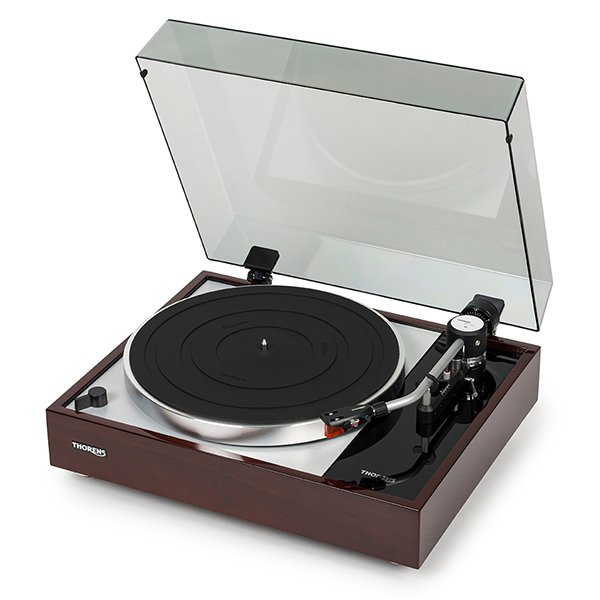
The Thorens TD 1500 combines a traditional suspended-subchassis layout with modern motor control and a flexible TP 150 tonearm. The supplied Ortofon 2M Bronze makes it a substantial ready-defined cartridge package, while RCA and XLR phono sockets provide connection choices. The balanced route needs careful interpretation, because Thorens specifies a suitable moving-coil cartridge for true balanced operation.
Thorens TD 1500 — A suspended design with a clear purpose
The platter and arm board are supported on three conical springs, separating them mechanically from the motor and outer plinth. That is a different approach from a rigid unsuspended deck with damped feet. The suspension aims to control how vibration reaches the playing assembly, but the turntable still needs an appropriate support. A flexible shelf or a cabinet directly excited by loudspeakers should be addressed as part of installation.
Thorens makes the springs adjustable from above through openings in the platter. That is a practical improvement for setting the assembly correctly, but it does not make adjustment something to approach without guidance. The arm, cartridge and cables form part of the moving assembly’s behaviour. Follow the current procedure and check that the final arrangement moves freely rather than being pulled sideways by a stiff cable or an overlooked transport fitting.
The conventional rectangular form and cover make the TD 1500 approachable in everyday use. It is still worth checking lid clearance, arm access and the route for rear connections. A suspended deck should be installed where it can remain stable and accessible, not squeezed onto furniture that makes every small adjustment difficult. Its mechanical design is useful when the whole installation respects it.
TP 150 arm and supplied cartridge
The TP 150 offers a removable headshell, height adjustment and azimuth adjustment. Thorens specifies an effective mass of fourteen grams. These facilities make the arm adaptable to different cartridges, but compatibility still depends on more than mounting holes. Cartridge mass, compliance and electrical requirements should be considered together. An expensive cartridge is not automatically a sensible match simply because it can be attached to the headshell.
The standard Ortofon 2M Bronze moving magnet is a meaningful part of the package, with a nude Fine Line stylus. That should be included in any price comparison with a deck supplied without a cartridge or with a less ambitious one. Factory installation helps with the initial alignment, while tracking force and the rest of the setup should still be checked after transport. Use the actual cartridge’s current instructions rather than a setting remembered from a different 2M model.
A removable headshell can make a second cartridge practical, especially for a collection with different record types. Each combination needs its own setup checks and an appropriate phono stage. Keep a record of tracking force, arm height and electrical settings when using more than one. The headshell’s convenience is most useful when it supports repeatable setup rather than encouraging unverified swapping.
RCA, XLR and the balanced distinction
The TD 1500 offers both RCA and XLR phono outputs. These are cartridge-level connections, so they still need an appropriate phono stage before an ordinary line input. An XLR socket on an integrated amplifier is not necessarily a balanced phono input. Check the purpose and gain of the receiving connection rather than matching connectors and assuming the signal levels are suitable.
Thorens explicitly associates true balanced operation with a suitable MC cartridge. The supplied 2M Bronze is an MM cartridge, so the standard package should not be advertised as automatically providing the full balanced MC arrangement. The conventional MM route is a straightforward way to use the supplied package. A later move to MC involves choosing a mechanically compatible cartridge and suitable phono gain as well as the balanced cable.
Balanced transmission can help reject interference in a properly implemented chain. It should be judged on the actual system rather than treated as a promise that every quiet RCA installation is missing musical information. If hum occurs, inspect grounding, routing and the receiving stage systematically. Correct setup is more productive than buying several new components at once and hoping that one happens to remove the problem.
Motor control and manual playback
The belt-driven platter is supported by electronic monitoring of the DC motor’s speed through an incremental encoder. The purpose is to maintain consistent rotation while retaining the suspended belt-drive arrangement. Electronic speed selection is convenient for ordinary 33 and 45 rpm records. This is not a three-speed archival player, so a collection centred on historical 78s requires a different plan.
The arm is fully manual. The listener cues it, returns it after the side finishes and handles the record changes. Buyers who need automatic return should treat that as a separate requirement rather than assuming a modern motor-control system provides it. Manual playback can be enjoyable when vinyl is an intentional activity, but the correct product is the one whose daily routine suits the owner.
A demonstration should show the suspension, cueing mechanism and ordinary record handling as well as sound. Check that the deck is properly set up on the intended support and that the cartridge clears the record safely when raised. Keep the packing and transport instructions, because a suspended assembly should be secured correctly for a move. Mechanical care is part of preserving performance, not an optional concern reserved for much more expensive turntables.
Independent sound and measurement evidence
Hi-Fi News’ original review praised the TD 1500 package’s combination of substantial low-frequency presentation, clarity and musical flow. It also tried other cartridges, so specific listening conclusions need to remain attached to the configuration being discussed. Audio Review has not conducted its own listening test. The published assessment supports a serious audition of the supplied package rather than an assumption that every future cartridge will produce the same balance.
The accompanying laboratory report measured fine absolute speed accuracy and low rumble through the groove, while also identifying a flutter component in the spectrum. That is a more balanced picture than selecting one impressive number and ignoring the rest. These are the publication’s measurements on its sample. They should not be presented as Audio Review results or compared casually with figures obtained by unrelated methods.
For an audition, use familiar records in good condition, a suitable MM phono stage and consistent playback level. Listen to exposed voices, sustained instruments and complex passages, not only music chosen to demonstrate bass. A clean stable source cannot repair a damaged groove or an eccentric pressing. Test several records before attributing an isolated problem to the suspension or motor-control system.
Value and ownership priorities
The TD 1500 makes the strongest case for a listener who wants a suspended deck and values an adjustable arm with a worthwhile supplied cartridge. That is a coherent platform for a long-term analogue system. The premium is less persuasive if the owner primarily wants automatic functions, wireless playback or a simple USB recording route. Those jobs are better included in the system brief before purchase rather than added as a collection of afterthoughts.
Compare complete European package prices, including the phono stage and proper installation. A cartridge-free alternative can appear cheaper until a suitable cartridge is fitted, while a simpler deck may leave more budget for speakers or room improvements. Local setup support is especially useful if suspension adjustment is unfamiliar. Ask what the retailer checks and how future cartridge service will be handled.
Routine ownership includes suitable stylus and record care, setup checks after moving and eventual consumable replacement. The suspension is an engineering feature to maintain correctly, not a reason to keep adjusting the deck without a goal. The TD 1500 is most attractive when it can be installed well, used regularly and judged as a complete source within a balanced system.
Alternatives to consider
Denon DP-3000NE: Compare a substantial direct-drive platform if suspension is not a central preference.
Pro-Ject X1 B: A different adjustable belt-drive route for developing a cartridge and phono-stage system.
Thorens TD 1500 key specifications
- Drive / operation
- Belt drive / manual
- Suspension
- Three conical springs; adjustable from above
- Tonearm
- TP 150; 14 g effective mass; VTA and azimuth adjustment
- Cartridge
- Ortofon 2M Bronze MM
- Platter
- Die-cast aluminium, approximately 1.4 kg
- Outputs
- RCA and XLR phono; true balanced operation requires suitable MC cartridge
- Speeds
- 33 / 45 rpm
- Weight
- 7.9 kg
Verdict
The Thorens TD 1500 is a strong shortlist choice for a listener seeking a modern suspended turntable with an adjustable arm and a worthwhile supplied MM cartridge. Its balanced outputs are a development option requiring suitable MC equipment. Choose it with proper installation, a matching phono stage and acceptance of fully manual playback.
Primary documentation and independent reviews
Thorens official TD 1500 information · Hi-Fi News original TD 1500 review · Hi-Fi News listening continuation · Hi-Fi News TD 1500 laboratory report
Editorial record
Sources and updates
Product specifications and factual claims were checked against Official Thorens TD 1500 product page ↗. Scores and buying advice follow our category-specific editorial methodology.
- Published
- November 8, 2026
- Last updated
- November 8, 2026