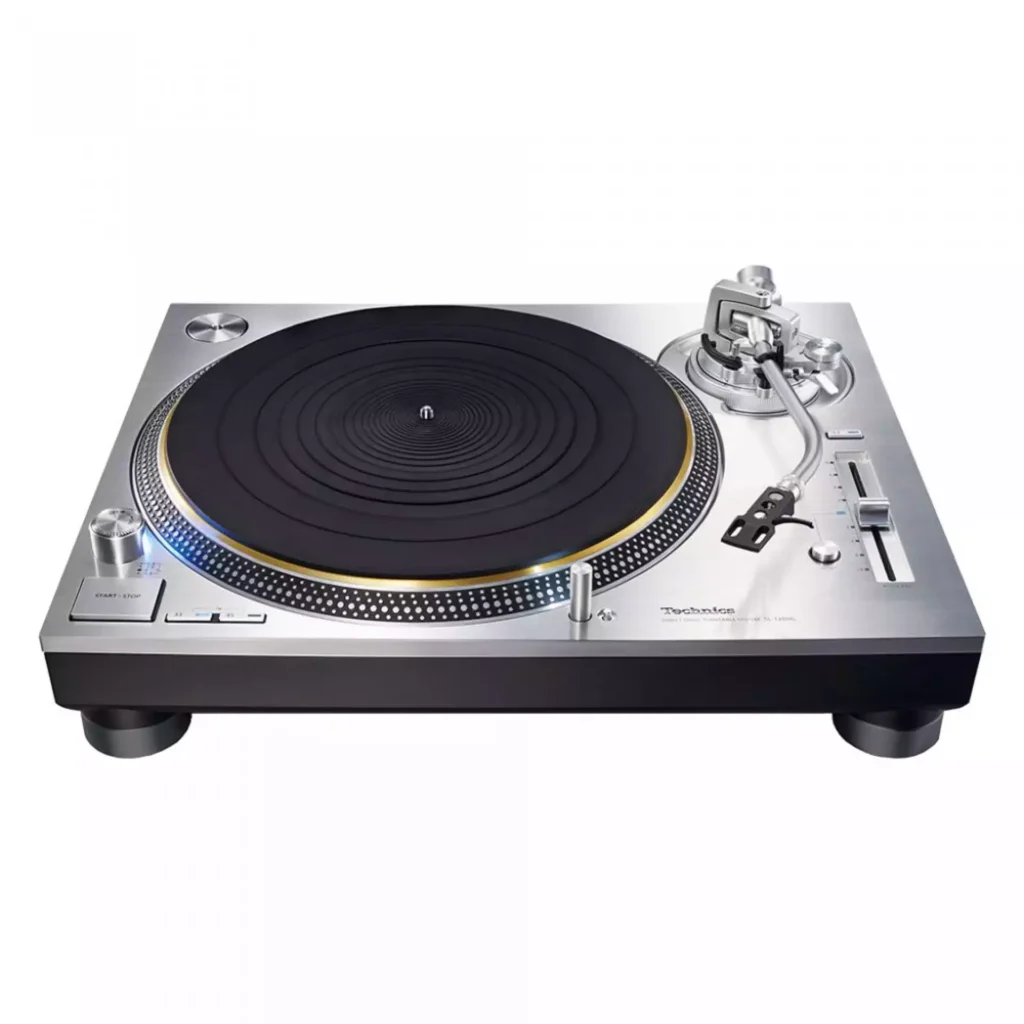
The Technics SL-1200G uses a familiar layout to deliver a considerably more ambitious turntable than its outline might suggest. A substantial multilayer body, brass-and-aluminium platter and magnesium tonearm form the basis of a flexible manual source. Its strongest appeal is the combination of refined mechanical handling and cartridge choice, provided the total budget includes a suitable cartridge and phono stage.
Technics SL-1200G — Construction beyond the familiar outline
The SL-1200G’s shape is recognisable, but its construction deserves to be judged on its own terms. Technics uses a coreless direct-drive motor, a three-layer platter and a four-layer body. The brass-and-aluminium platter is damped with rubber, while the arm uses magnesium. These are meaningful product distinctions from simpler models sharing similar controls, although the materials alone cannot establish the final sound of a complete cartridge system.
At approximately eighteen kilograms, the deck needs a suitable support and careful handling. Check the furniture rather than assuming an existing shelf is appropriate because the footprint is familiar. The rear connections and opening cover also need space. Decide where records can be placed while changing sides, and make sure the cueing lever is comfortable to reach. Daily usability is a real part of the value of an expensive turntable.
The standard hinged cover and direct controls can be more convenient than the removable covers and sparse controls of some specialist alternatives. That preference is personal rather than a universal advantage. A useful dealer demonstration includes touching the controls, adjusting the arm and changing a record, because those interactions will be repeated far more often than reading the specification sheet.
Direct drive and speed control
The motor drives the platter directly, eliminating a belt from the drive path. The SL-1200G uses a twin-rotor coreless design and electronic motor control. Its three speeds cover 33⅓, 45 and 78 rpm, with pitch adjustment available. Those facilities make it adaptable to a broad collection, but the correct stylus and, where required, equalisation must still be chosen for historical records. A third speed is only one part of 78-rpm compatibility.
The published wow-and-flutter figure describes the manufacturer’s specified test condition, not an Audio Review measurement. Independent reviews can add useful evidence, but measurements made with different methods should not be treated as directly interchangeable. A smartphone application and a laboratory test record do not automatically produce equivalent numbers. The useful conclusion is whether the turntable is operating correctly and consistently in the assembled system.
Motor settings should begin with the manufacturer’s normal setup. A single reviewer’s preferred torque adjustment is a system-specific experiment rather than a requirement for every owner. Establish a reliable baseline before making changes, and keep a record of the original settings. If a particular record produces pitch variation, test other pressings and inspect the record’s centring before assuming the drive system needs adjustment.
The arm and cartridge matching
The S-shaped arm combines a detachable headshell with accessible height adjustment. That makes it appealing to an owner who wants to use more than one cartridge or who values straightforward installation. The available balance weights and permitted cartridge masses still matter. Include the headshell and mounting hardware when calculating the load, rather than checking the cartridge body alone and assuming it will balance correctly.
A removable headshell makes changing a prepared cartridge convenient, but each combination needs its own setup checks. Tracking force, alignment and anti-skate should be verified, and an unfamiliar cartridge may require a different arm height. Keep a written record for each headshell if several are used. That is particularly useful when one cartridge handles ordinary LPs and another is intended for a different record type.
The standard deck does not include a cartridge. Dealer packages can therefore differ significantly in both price and intended performance. Choose the phono stage together with the cartridge, considering gain, loading and noise. A moving-magnet package can work well with a suitable MM input, while a low-output moving coil needs appropriate additional gain. A normal amplifier line input cannot replace the cartridge equalisation and amplification stage.
Published sound evidence with the configuration identified
Stereophile’s original SL-1200G review praised its construction and handling. In stock form with the reviewer’s chosen cartridge, it described solid, agile and neutral reproduction while preferring aspects of a different reference system. The reviewer then changed several aspects of the setup, including the mat and headshell, before offering more enthusiastic listening comparisons. Those configuration changes are important context for the conclusions.
The review supports the SL-1200G as a serious and adaptable platform, but its modified-system observations should not be advertised as guaranteed stock-package behaviour. Audio Review has not performed a hands-on test, and this assessment does not depend on accepting every accessory claim in the source. A buyer can begin with the supplied equipment, a compatible cartridge and correct setup, then investigate a specific problem if one remains.
For an audition, compare the configuration actually being purchased. Ask which mat, headshell, cartridge and phono settings are in use, and keep playback levels comparable. Include sustained notes, exposed voices and rhythmically dense music. Listen for a convincing overall result over time rather than selecting only the demonstration with the greatest apparent bass weight. The same deck can be partnered with materially different cartridges, so the package deserves a complete description.
Installation and practical ownership
The substantial chassis and adjustable feet provide a useful foundation, but the support still needs to be level and stable. Keep the turntable away from direct loudspeaker vibration where practical and assess footfall sensitivity in the actual room. Heavy furniture on a flexible floor can still transmit movement. Address the observed mechanical problem rather than assuming that a heavy deck makes placement irrelevant.
Record and stylus care remain ordinary responsibilities. Clean records, suitable cleaning methods and careful cueing help protect the collection and cartridge. The arm is manual and must be returned after a side finishes, so buyers wanting automatic return should make that requirement explicit when comparing alternatives. The SL-1200G’s convenient controls do not make it an automatic player.
Retain the packing and follow the transport instructions for the platter, counterweights and arm. A source intended for long ownership may eventually move house or need servicing, and its weight makes casual transport a poor idea. Local dealer support can be valuable when it includes setup, cartridge service advice and a clear route for maintenance. Direct drive removes belt replacement, while the stylus remains a consumable part of the system.
Value and model identity
This review concerns the original SL-1200G, rather than a later GME edition or another model with a similar name. Check the exact designation, regional mains version and supplied accessories on the invoice. A review of one edition should not silently borrow the features of a different one. For a used unit, condition, arm bearings and cartridge history deserve inspection as well as the familiar appearance.
The strongest buyer values the turntable as a durable, flexible platform and expects to use it regularly. The premium is harder to justify for occasional background listening or where the rest of the system has a major unresolved limitation. Compare the complete European price with cartridge, phono stage and setup included. An expensive deck cannot compensate fully for poor speaker placement or a noisy phono path.
The SL-1200G is especially appealing when cartridge experimentation is part of the interest, because its handling and adjustments make that practical. An owner seeking a settled factory cartridge package may find a different approach equally satisfying. Choose after an audition of a representative system, with a realistic maintenance budget and an appreciation of the daily manual routine.
Alternatives to consider
Denon DP-3000NE: A relevant premium direct-drive comparison with its own arm and cartridge-handling approach.
Technics SL-1500C: Consider a lower-cost, more convenience-focused system if the G’s platform exceeds the intended use.
Technics SL-1200G key specifications
- Drive / operation
- Coreless direct drive / manual
- Speeds
- 33⅓, 45 and 78 rpm
- Tonearm
- Magnesium S-shaped arm; detachable headshell
- Arm-height adjustment
- 0–6 mm
- Platter
- Brass / aluminium with damping rubber; approximately 3.6 kg including mat
- Phono output
- RCA and earth terminal; external phono stage required
- Weight
- Approximately 18 kg
- Model scope
- Original SL-1200G; not GME
Verdict
The Technics SL-1200G is a persuasive premium direct-drive platform with excellent practical flexibility and substantial construction. Its complete value depends on cartridge matching, phono electronics and regular use. Audition the stock or dealer-supplied configuration actually being purchased, keeping modified-review conclusions in their proper context.
Primary documentation and independent reviews
Technics European SL-1200G product information · Technics official detailed mechanical specifications; select local mains version · Stereophile original SL-1200G review · Stereophile review continuation and setup changes
Editorial record
Sources and updates
Product specifications and factual claims were checked against Official Technics SL-1200G product page ↗. Scores and buying advice follow our category-specific editorial methodology.
- Published
- November 8, 2026
- Last updated
- November 8, 2026