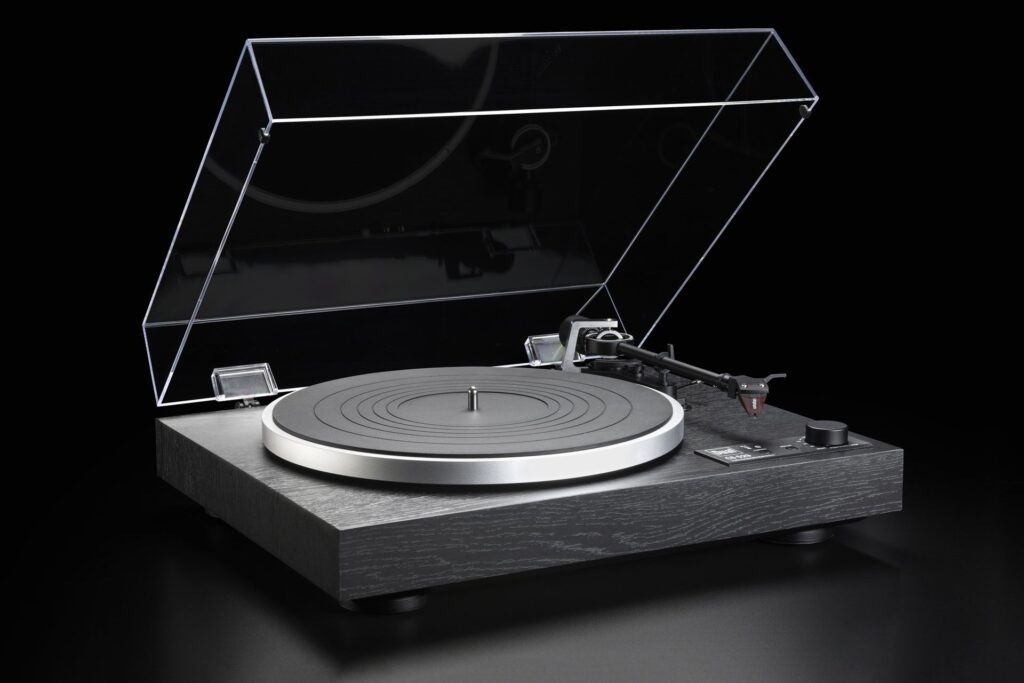
The Dual CS 529 makes a clear case for convenience in a serious record-playing system. It combines automatic arm operation, a fitted Ortofon 2M Red, a switchable phono stage and Bluetooth facilities for both audio and control. Its appeal is a complete everyday experience, with a few format and connection details worth understanding before the automatic label decides the purchase.
Dual CS 529 — Automatic operation as a useful feature
The CS 529 can start a record and return the arm after the side finishes, reducing the need to stay beside the turntable. That is useful for a listener who enjoys records while reading or working nearby. It can also reduce the anxiety of manual cueing for someone returning to vinyl after years away. The owner still chooses the record, checks the size and speed settings and handles the disc carefully.
Dual’s manual specifies that the automatic function is not available for ten-inch records. This is an important qualification for collectors of unusual formats. A normal twelve-inch LP or seven-inch single fits the intended automatic routine, while a ten-inch disc calls for the documented manual approach. A headline description such as fully automatic should not be read as automatic recognition of every possible record size.
The mechanism is disengaged from the playing parts during playback according to Dual’s documentation. A start or return sequence can still make mechanical sounds, which should be distinguished from noise during music. A dealer demonstration should show both beginning and ending a side. Ease of operation is a major reason to choose this model, so those functions deserve testing just as carefully as the first musical passage.
Bluetooth audio and remote control
Bluetooth serves two distinct jobs. It can transmit the audio to a suitable receiving speaker, headphone or system, and it can support app-based control from a phone or tablet. Controlling the arm through an app does not mean the phone is receiving the record’s audio. Understanding those separate connections makes setup easier and avoids expecting a record to appear automatically in a phone’s music application.
Dual lists Bluetooth 5.2 with aptX HD audio in its brochure. The actual codec used depends on the receiving device as well as the transmitter. A receiver that does not support the same codec will not gain it merely because the turntable advertises it. Test the intended speaker or headphone and check reliable reconnection after standby. Ordinary operation matters more than choosing a product from a codec logo alone.
The manual calls for the line setting when using Bluetooth audio. Follow that setup rather than assuming any output mode works identically. Wireless transmission also introduces conversion and a codec into the audio route, while the wired phono path offers a different arrangement. Both can be useful for different occasions. A convenient headphone session does not require the entire main system to be rebuilt around wireless playback.
Cartridge, arm and phono stage
The factory cartridge is an Ortofon 2M Red moving magnet. It gives the CS 529 a defined starting package rather than leaving the buyer to choose a cartridge before playing a record. The arm uses a twin-gimbal bearing arrangement and an interchangeable headshell. Tracking force and anti-skate still need to be set according to the current instructions, even with a factory-mounted cartridge.
The internal phono stage can be switched to provide a line-level connection or bypassed for a suitable external phono input. When the internal stage is active, use an ordinary line input rather than applying another phono stage afterwards. Double equalisation and gain produce the wrong result. The selector setting should be part of the installation handover, especially if the owner later changes amplifiers.
A removable headshell offers a useful service and cartridge-change route, but different cartridges may need different force, alignment and electrical settings. Do not assume that fitting another headshell makes every previous adjustment correct. A more expensive cartridge should be selected for mechanical and phono-stage compatibility. Begin with a properly adjusted supplied cartridge and consider changes only when the desired improvement is clear.
Construction, support and daily handling
The CS 529 uses an MDF body, a damped aluminium platter and rubber-mounted elements in its support structure. Its conventional cover and front controls make it approachable for a living room. Allow space for the lid to open and for the record-size selector to be reached. A turntable can be easy to use in principle yet awkward if squeezed under a shelf with poor access.
The support must still be level and stable. Automatic cueing is not a cure for a table that rocks or a shelf that vibrates with a nearby speaker. Keep powered speakers on separate supports where practical and assess whether footfall reaches the deck. The automatic sequence should be tested on the finished furniture rather than only on a dealer’s solid demonstration rack.
The three speeds cover 33, 45 and 78 rpm. A historical 78 may require a suitable stylus and equalisation, so the standard 2M Red should not automatically be used on every old disc. The record-size limitation also remains relevant when using the automatic start. A mixed collection deserves planning around its actual formats rather than assuming three speeds make every record immediately compatible.
Independent sound evidence
STEREO magazine’s original CS 529 test, available as an English reprint on Dual’s website, praised its organised, musical and spatial reproduction with the supplied 2M Red. It also found the internal phono stage useful and described the app operation as straightforward in its test. These are findings from that publication’s sample, not listening observations or measurements made by Audio Review.
The review supports the idea that convenience need not prevent an engaging result. It does not establish that the CS 529 is the best sound-first purchase for every buyer at its current price. Part of the budget buys automatic mechanics and wireless control, which are valuable only if the owner wants them. A listener comfortable with manual cueing and uninterested in Bluetooth should compare a simpler turntable as well.
An audition should use the connection intended for home: internal line output, external phono stage or Bluetooth. Those routes involve different electronics and can have different levels, so a casual switch is not necessarily a fair comparison. Use familiar records and a realistic volume, including voices and sustained notes. Evaluate whether the entire experience makes listening easier and more enjoyable rather than focusing on one short demonstration of bass weight.
Value, upkeep and the right owner
The CS 529 is strongest for an owner who wants automatic return, easy starting and a flexible connection package without surrendering cartridge serviceability. It can suit a household where several people use the turntable and some are uncomfortable handling a manual arm. The physical controls remain important because a phone should be an optional convenience rather than the only way to start a record.
Compare the complete European price with the cartridge and phono stage included. A cheaper bare deck may need additional electronics, while a similarly priced manual model may allocate more of its cost to a different mechanical approach. Local support for the automatic functions and a clear cartridge-service route can be worth a modest premium. Confirm the exact finish and package rather than using an old launch price as today’s reference.
Routine care still includes clean records, appropriate stylus cleaning and eventual stylus replacement. Keep the packing for transport and check the setup after moving the deck. There is no USB recording output, so a buyer whose main task is archiving records needs an additional recording solution. The CS 529 should be selected for its existing blend of sound, automation and everyday convenience, with its format limits clearly understood.
Alternatives to consider
Audio-Technica AT-LP70XBT: A lower-cost automatic and Bluetooth approach worth comparing when convenience dominates the brief.
Technics SL-1500C: Consider a different direct-drive ownership approach if full automatic start and app control are unnecessary.
Dual CS 529 key specifications
- Drive
- Belt drive with optically regulated DC motor
- Operation
- Automatic or manual; ten-inch automatic-start limitation
- Speeds
- 33 / 45 / 78 rpm
- Cartridge
- Ortofon 2M Red MM
- Phono stage
- Built in; switchable
- Bluetooth
- 5.2 aptX HD audio; separate app-control functions
- Weight
- 6.7 kg
Verdict
The Dual CS 529 is a well-considered choice for listeners who value automatic playback, a useful supplied cartridge and flexible wired or wireless connections. Its premium makes sense when those conveniences will be used. Confirm record-size limits and the chosen output mode, then judge it as a complete everyday system.
Primary documentation and independent reviews
Dual official CS 529 brochure and specifications · Dual CS 529 operating manual · STEREO original CS 529 review; authorised English reprint hosted by Dual
Editorial record
Sources and updates
Product specifications and factual claims were checked against Official Dual CS 529 product page ↗. Scores and buying advice follow our category-specific editorial methodology.
- Published
- November 8, 2026
- Last updated
- November 8, 2026