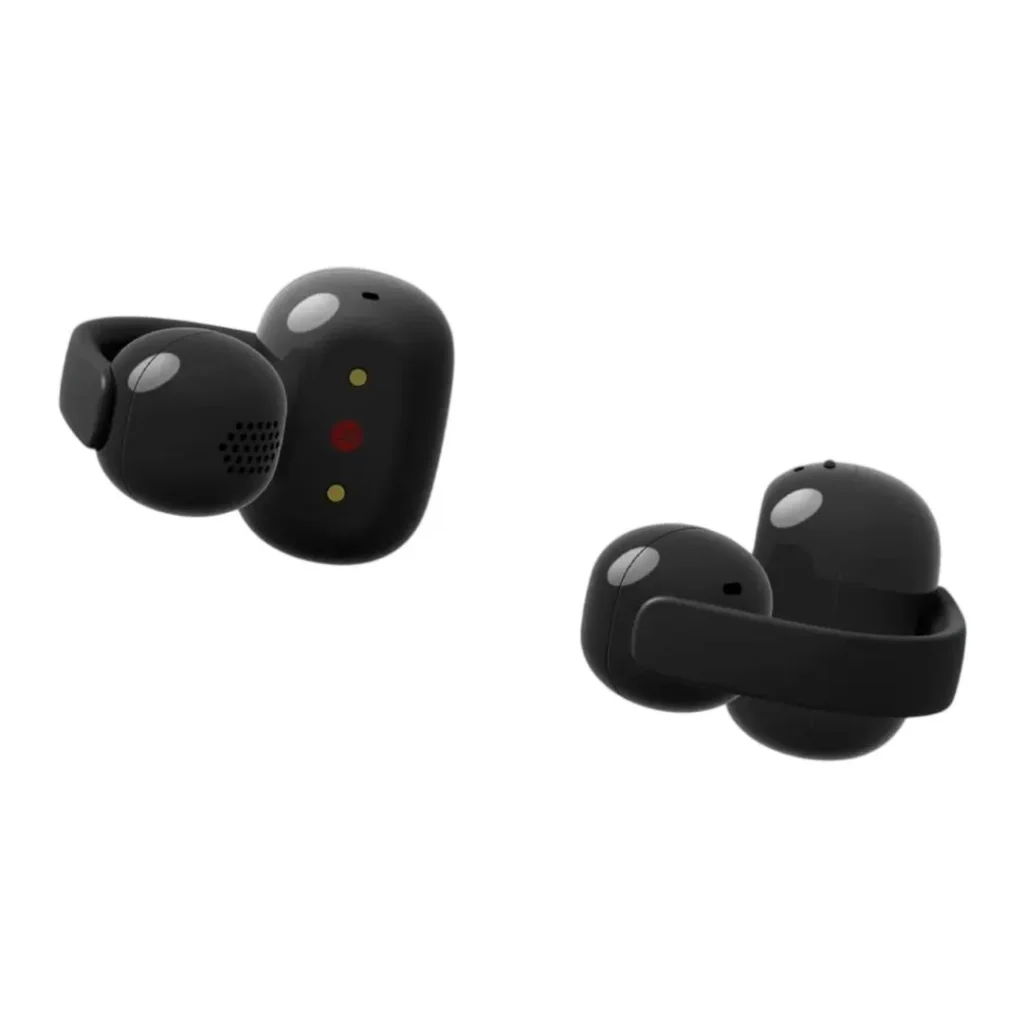
The Sony LinkBuds Clip are for people who want music alongside everyday life rather than a barrier against it. Their ear-cuff design leaves the ear canal open and positions a small speaker nearby. That can be convenient in a quiet office or at home, but it creates a different set of priorities from sealed noise-cancelling earbuds. The 2026 model deserves a fit-first assessment, with bass and noisy-environment limitations kept firmly in view.
Clip design and personal fit
An ear-cuff design avoids pushing a silicone tip into the ear canal, but it still makes contact with the outer ear. The shape, pressure and driver position therefore matter more than a photograph suggests. Try the included fitting cushions and check both sides separately. A comfortable fit on one ear does not automatically establish that the other will hold the speaker in the same position.
Use a normal conversation and a short walk as practical checks. The earbuds should remain secure without requiring constant repositioning, and controls should not move them every time you tap. Anyone who dislikes ear hooks has a good reason to investigate this format, but changing the attachment style does not remove individual fit variation. A suitable return policy is particularly valuable here.
Sound quality in the intended environment
SoundGuys finds the LinkBuds Clip convenient for open listening, while T3 is more critical of their sound value, especially bass impact and some processing modes. Both perspectives point towards a product whose appeal depends heavily on the listening situation. Quiet-room vocals and background music are a more convincing use case than trying to overpower a busy train.
Our recommendation consequently gives more weight to comfort and the open listening experience than to claims of flagship-like sound. A driver operating outside a sealed canal cannot be judged as though its acoustic conditions match an in-ear design. Even so, open-ear buyers should compare alternatives rather than assuming every bass limitation is unavoidable to exactly the same degree.
Why there is no commuter-style isolation
The Clip deliberately lets environmental sound reach the ear. It has no listening ANC, so there is no mode that turns it into a conventional noise-cancelling earbud for the journey home. Microphone processing for calls is a separate function and should not be mistaken for noise reduction in the listener’s ears.
This is useful when hearing a colleague or a doorbell is part of the reason for buying. It is less useful when the surroundings repeatedly cover the music. Rather than raising volume indefinitely, use a different headphone for a noisy journey. Open listening is a particular tool for a particular environment, and accepting that distinction makes the product much easier to evaluate fairly.
Listening modes and EQ
Sony provides Standard, Voice Boost and a leakage-reduction mode, alongside app-based sound adjustment. Treat these as separate tools. Voice emphasis can make spoken material easier to follow, but that does not establish that the same setting is pleasant for a singer or a full music mix. Start with the normal mode and make one change at a time.
The ten-band EQ is useful for modest personal adjustment, but it cannot create the acoustic seal of an in-ear model. If bass seems weak, first check driver position and fit. Large low-frequency boosts can consume available headroom without solving the underlying problem. A slightly different position may be more useful than choosing the most extreme preset, particularly when the two ears sit differently.
Calls and switching between devices
Multipoint is a practical feature for someone moving between a phone and laptop. Test the actual combination with a call, a meeting application and ordinary music playback. Pairing successfully to two devices is only the first step; the important question is whether the device you expect takes priority at the right time.
SoundGuys’ original use found calls workable while acknowledging that incidental background noise can still intrude. That is a more useful expectation than treating Sony’s voice-processing description as proof of perfect calls everywhere. For regular meetings, listen to a sample recording from your normal room and check how easily the other person understands you. Call quality and the ability to hear their reply are separate issues.
Bluetooth codecs and source choice
Sony’s help guide lists SBC and AAC, not LDAC. That matters because buyers familiar with the brand’s other headphones may expect its higher-bitrate codec by default. The Clip should be assessed on its fit, tuning and convenience rather than purchased for a feature that is not documented for this model.
Both Android and iPhone users can consider it without building the purchase around a specialised source device. In practice, a stable connection and a useful control layout are more important here than chasing a codec label. Check the app permissions and functions you want, install supported updates, and confirm the preferred settings remain available with the phone and laptop you actually use.
Battery life and charging expectations
Sony advertises up to nine hours from the earbuds and 37 hours including the case, with a short top-up providing additional listening time. SoundGuys measured seven hours and ten minutes under its own standardised conditions. These figures describe different conditions; the case total is not a claim that the earbuds play continuously for 37 hours.
Use a realistic charging routine based on your longest normal session. Keep the case charged before a day away from a socket, and account for changes caused by volume, selected functions and battery age. The useful ownership question is whether a normal work period fits comfortably within the available charge, rather than whether one particular test can be reproduced to the minute.
Sony LinkBuds Clip vs Bose Ultra Open Earbuds
The Bose Ultra Open Earbuds are the natural ear-cuff comparison. Try the physical attachment before debating small sound differences. A product that feels secure and unobtrusive on your ears may be the better daily companion even if another design receives stronger praise in a reviewer’s ears.
Compare both in a quiet setting and then in the environment you intend to use. Keep playback level similar and include speech as well as music. Neither should be chosen on the assumption that an open cuff becomes an isolating in-ear when conditions are difficult. The value comparison also needs actual local prices, because a discounted rival can change the decision substantially.
Ear hooks, exercise and everyday value
The Shokz OpenFit 2 offers a different attachment strategy. An ear hook may suit some users better, while others prefer avoiding contact around glasses. This is a practical comparison between fit concepts, not a reason to declare one shape universally more comfortable.
The Clip’s IPX4 rating applies to the earbuds and does not make the charging case water-resistant. Keep that distinction in mind when carrying it after exercise. For value, prioritise the situations in which openness is useful. If most listening takes place on noisy transport and only occasionally in a quiet office, a sealed pair may serve more of the day even if the cuff design is initially appealing.
Sony LinkBuds Clip key specifications
- Design
- Open-ear clip / ear-cuff style
- Model year
- 2026
- Bluetooth audio codecs
- SBC and AAC
- Noise cancellation
- No listening ANC
- Battery claim
- Up to 9 hours; 37 hours including case
- Quick-charge claim
- 3 minutes for approximately 1 hour
- Protection
- Earbuds IPX4; case not water-resistant
- App
- Sony Sound Connect
- Multi-device use
- Multipoint connection
Verdict
The LinkBuds Clip are an interesting comfort-led option for quiet work, home listening and an open daily routine. Their EQ, controls and multipoint give the design useful flexibility. The sound evidence is less convincing than the feature list might suggest, particularly for bass and noisy places. Buy them because the clip fit and open listening solve a specific need, after comparing Bose and Shokz, rather than because Sony’s name implies a miniature flagship experience.
Primary documentation and independent reviews
Sony Europe announcement and specifications · Sony official supported-codec guide · SoundGuys original LinkBuds Clip test · T3 original LinkBuds Clip review
Editorial record
Sources and updates
Product specifications and factual claims were checked against Official Sony LinkBuds Clip product page ↗. Scores and buying advice follow our category-specific editorial methodology.
- Published
- November 8, 2026
- Last updated
- November 8, 2026
Highly ranked reviews in this category
Selected by category rank and editorial score within earbuds. Check each product's design and intended use before adding it to your shortlist.