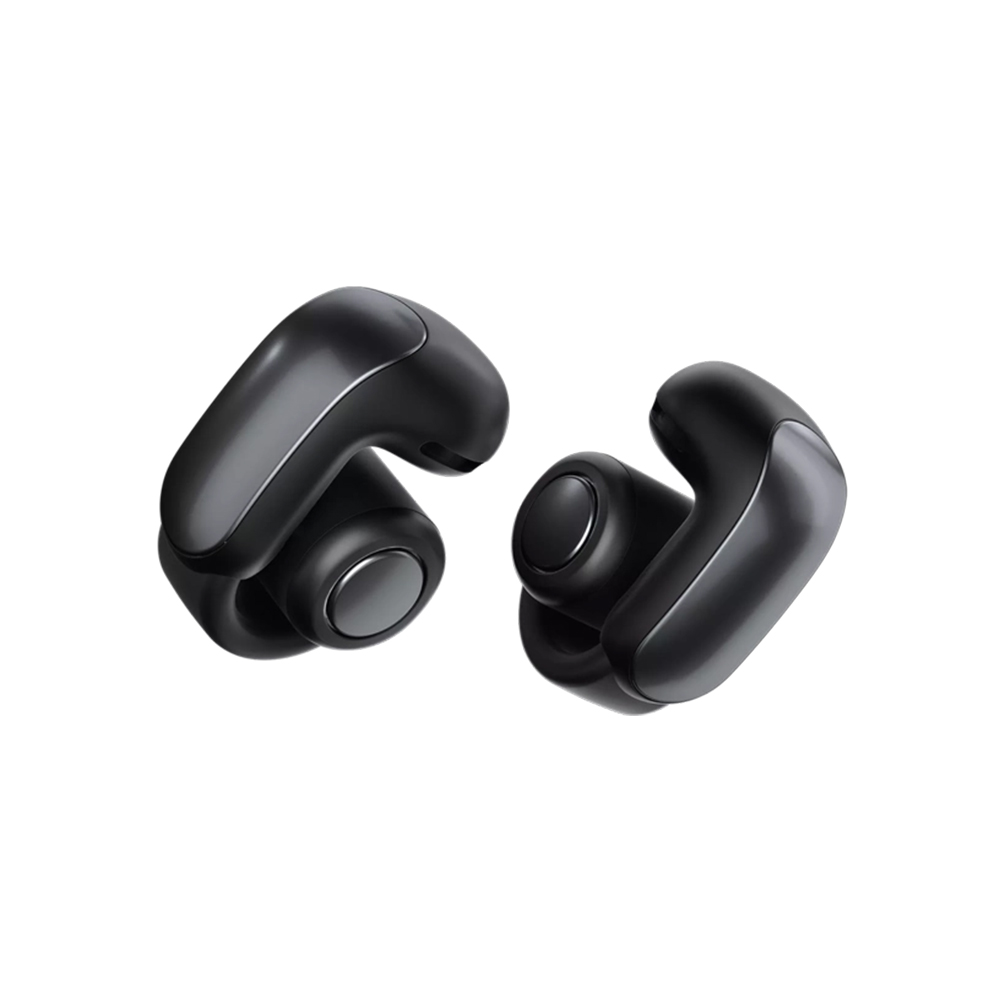
The original Bose Ultra Open Earbuds are designed around leaving the ear canal uncovered. Their cuff-like shape holds a small speaker beside the ear, creating a very different experience from sealed noise-cancelling earbuds. They make most sense for someone who finds conventional tips uncomfortable or wants music to coexist with the room, while accepting important sound and isolation compromises.
Bose Ultra Open Earbuds — The clip-on design
Bose uses a flexible connection between the small speaker section and a barrel that sits behind the outer ear. The assembly clips around the ear rather than entering the canal. This is an air-conduction design, not a bone-conduction headphone, even though it shares the goal of leaving the ear open.
The unusual shape has practical appeal when an ear hook conflicts with glasses or when a sealed tip creates discomfort. It also means the fit depends on the shape of the outer ear. A cuff that feels secure to one listener may place pressure in an awkward position for another.
SoundGuys’ original evaluation reports secure retention during activity but notes the unfamiliar sensation of having the assembly clipped to the ear. That is useful evidence for an audition: assess the contact points after an extended period, not only whether the product stays attached during the first minute.
This review concerns the original Ultra Open model. Bose has introduced a second generation, so verify the exact listing and do not apply newer specifications automatically to discounted original stock. The distinction matters for features, battery expectations and the price comparison.
Sound quality and the open-ear compromise
SoundGuys’ original review is critical of the sound relative to the premium price, while recognising the benefit of open awareness and a secure fit. RTINGS’ later testing also covers the original model, using a different assessment framework. These sources are useful together because open-ear value cannot be judged solely by the standards of a sealed earbud.
The unavoidable practical difference is that the room remains audible. A quiet kitchen, an outdoor path and a busy train will produce very different listening conditions. The musical signal competes with environmental noise, particularly when that noise masks low-frequency information. Turning up indefinitely is not a satisfactory way to recover it.
If deep bass weight and private immersion are the main goals, a well-fitting sealed model is a more appropriate starting point. The Bose design offers a different benefit: reduced physical occlusion and a more natural connection to nearby sound. Its sound should be judged against that specific purpose, without pretending the trade-off disappears.
During an audition, use both spoken content and music. A podcast that remains easy to follow in a quiet room may become difficult outdoors. A bass-led track may lose much of its intended weight when traffic is audible. Test at a comfortable level in a representative environment rather than evaluating only in the quietest possible shop.
Position also matters because the speaker sits outside the canal. Small changes around the ear can alter the balance. Establish a stable, repeatable position before deciding whether an app adjustment is useful. If the sound changes too much during ordinary movement, another open-ear shape may be a better match.
Immersive Audio and everyday listening
Bose Immersive Audio adds a spatial presentation option to ordinary playback. It is a feature to compare with standard stereo, not an automatic improvement to every recording. Some listeners may enjoy a more externalised impression, while others will prefer the original mix without additional processing.
The setting has a battery cost. The original official claim is up to 7.5 hours with Immersive Audio off and up to 4.5 hours with it on under specified conditions. This distinction is more useful than quoting one maximum without identifying the mode.
The open design can be convenient around the home when someone wants to hear a doorbell or a conversation. It is still possible for music to capture attention and mask a warning. Open ears should not be presented as a guarantee of safety, especially around traffic. Lower playback or pause when the surroundings require concentration.
There is no active noise cancellation to turn the product into a conventional travel earbud. This is a deliberate design choice. A buyer who wants one pair for quiet walking and noisy flights should decide which use matters most, or consider separate products for those very different requirements.
Controls, firmware and connections
The original model uses physical buttons on the barrel sections. That can be more deliberate than an exposed touch panel, although access depends on how the cuff sits on the individual ear. Check playback and volume operations during a fitting session rather than assuming the controls are equally easy in every position.
Firmware history matters here. Bose’s official release notes show that version 4.0.22 added multipoint in July 2024, allowing connection to two devices while streaming from one. Early reviews describing its absence should therefore not be treated as the current feature state of an updated unit.
Use the Bose app to check firmware and available settings before evaluating switching behaviour. Pairing with several devices is not the same as mixing their audio, and a call can change source priority. Test the phone-and-computer sequence that will actually be used.
The original earbud supports common Bluetooth use, with additional codec facilities requiring a compatible transmitting device. Those extras do not remove the acoustic consequences of the open design. Reliable connection and a comfortable fit have a more direct role in this product’s usefulness than a premium codec logo.
Calls, charging and durability
SoundGuys identifies microphone performance as a weakness of the original model. That makes it important to distinguish casual listening from a demanding work-headset role. If calls are central to the purchase, listen to a recording from the receiving end in both a quiet room and the usual outdoor conditions.
Its battery test exceeded the original 7.5-hour stereo claim, but that result belongs to the reviewer’s conditions rather than establishing a guaranteed minimum. The case provides additional charging opportunities, which should be considered separately from uninterrupted listening time. Spatial processing, volume and other features can change the outcome.
The earbuds carry an IPX4 splash-resistance rating. That does not approve swimming or extend automatically to the charging case. Keep the contacts dry before charging and avoid treating a water-resistance label as protection against every kind of liquid exposure.
For older stock, confirm warranty coverage and the condition of the batteries. A discount can improve the value case, but a used or long-stored pair with uncertain support is a different purchase from a new authorised unit. The model name alone does not describe those ownership risks.
Value and the right buyer
The Ultra Open is a specialist choice. It can be attractive to someone who has repeatedly rejected sealed tips and ear hooks, and who enjoys music in relatively quiet surroundings. Its distinctive retention method is the reason to shortlist it; a buyer satisfied with ordinary earbuds has less reason to pay for the compromise.
Compare current European prices against both competing open-ear designs and the second-generation Bose model. The original should be priced appropriately for its age and limitations. Do not assume that a luxury brand’s open product must outperform a cheaper sealed earbud in bass, privacy or noise control.
An extended fit trial or a practical return policy is particularly valuable. The correct purchase is the design that remains comfortable and audible in the intended setting. If that setting is usually noisy, the original Ultra Open is likely to be the wrong category, however appealing its physical design may be.
Alternatives to consider
Shokz OpenFit 2: An ear-hook open design to compare when a stable fit matters more than the Bose cuff shape.
Apple AirPods 4 with Active Noise Cancellation: A different unsealed approach for a compatible Apple routine, with a distinct fit and noise-control proposition.
Sony LinkBuds Fit: A sealed alternative to consider if useful isolation is ultimately more important than leaving the canal uncovered.
Bose Ultra Open Earbuds key specifications
- Type
- Original-generation open-ear air-conduction earbuds
- Fit
- Cuff-style clip around outer ear
- Noise cancellation
- None
- Battery claim
- Up to 7.5 hours stereo / 4.5 hours Immersive Audio
- Multipoint
- Two devices after supported firmware update
- Resistance
- IPX4 earbuds
Verdict
The original Bose Ultra Open Earbuds solve a specific comfort and awareness problem through a distinctive clip-on design. They are less convincing as a premium sound-first purchase, particularly in noise, and calls deserve testing. Choose them for a successful personal fit and the open experience, at a price that makes sense beside newer alternatives.
Primary documentation and independent reviews
Bose original Ultra Open official product information · Bose official original-model firmware history · SoundGuys original Ultra Open review · RTINGS original Ultra Open review
Editorial record
Sources and updates
Product specifications and factual claims were checked against Official Bose Ultra Open Earbuds product page ↗. Scores and buying advice follow our category-specific editorial methodology.
- Published
- November 7, 2026
- Last updated
- November 8, 2026