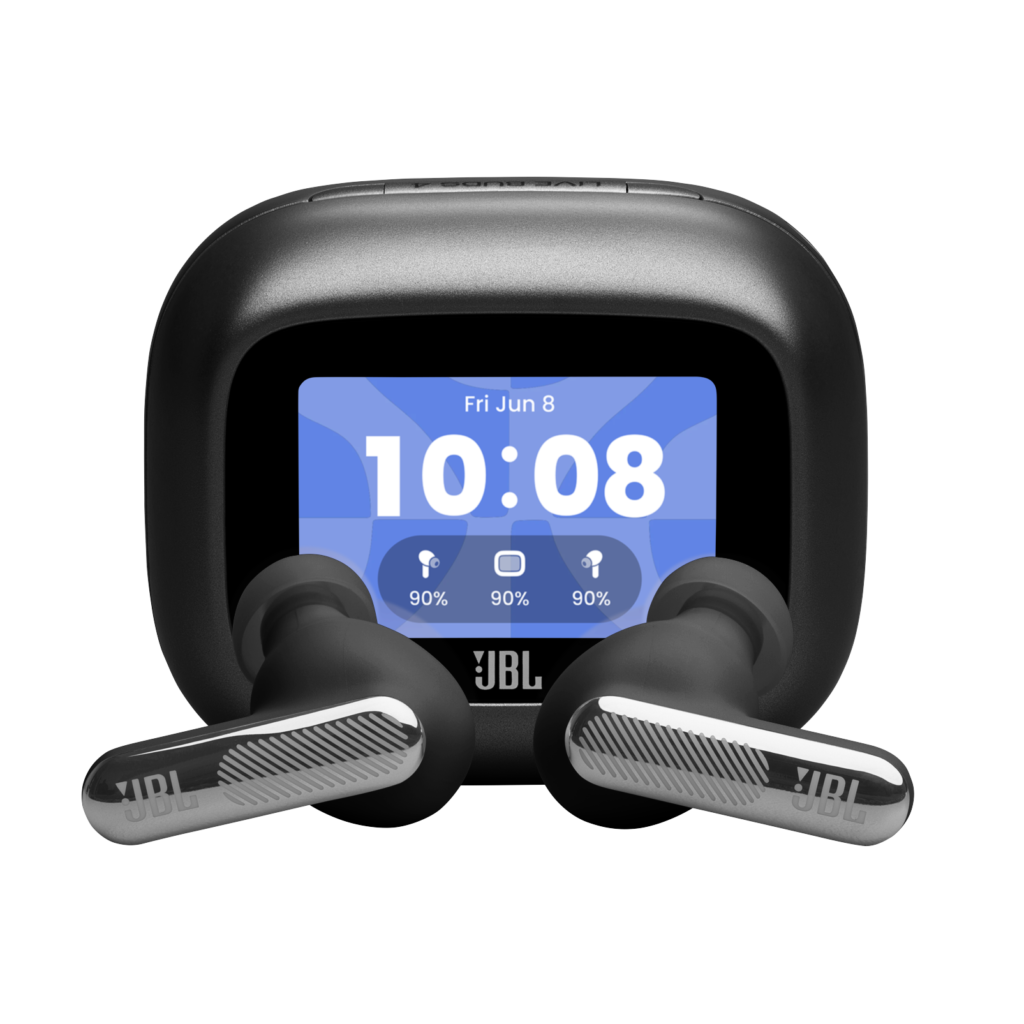
The JBL Live Beam 4 combines a familiar sealed stem earbud with an unusually capable touchscreen charging case. The 2026 update improves the case interface and revises the sound and noise-cancelling package, but its best reason for purchase remains everyday usability rather than novelty alone. It is a strong candidate for listeners who want lively music playback and extensive adjustment at a price below many flagship pairs, provided calls and ANC meet their particular needs.
Beam, Buds and Flex are different wearing styles
JBL’s Live 4 family contains several shapes, and the Beam is the sealed in-ear stem design. That distinction matters more than a shared family name. A Flex model sitting more openly in the outer ear will not produce identical isolation in every ear simply because some of the technology is related. Check the exact product and fitting style on the listing.
With the Beam, choose tips by seal and stability rather than using the factory-fitted pair automatically. A poor seal can reduce bass and undermine noise cancellation at the same time. Try both ears separately, then speak and move your jaw. A fit that remains consistent is a better foundation for evaluating sound than changing EQ to compensate for a tip that keeps loosening.
The touchscreen case in daily use
The revised Smart OS 3.0 interface provides access to playback, noise modes and sound adjustment without taking out the phone. This can be useful when a source is in a bag or on charge. Its value is clearest when there are a few functions you genuinely use repeatedly, rather than a large collection of tiny applications explored only once.
TechRadar finds the interface responsive but still often prefers the larger phone app. That is a sensible balance: the case adds another control route, not an obligation to stop using the phone. Check pocket comfort as well. A more elaborate case occupies space and requires charging, so the convenience of its screen should outweigh the extra bulk for your own routine.
Sound quality and tonal balance
The original TechRadar evaluation is notably positive about impact, detail and musical enjoyment, while recognising the bass-forward character. Our assessment treats that as a strength for energetic everyday listening, without assuming it is the most neutral option for every taste. A strong bass line should remain distinguishable from the singer and percussion rather than making every recording sound equally heavy.
Begin with familiar tracks and the normal mode before applying personalisation or EQ. Try acoustic material as well as dense electronic music, and keep the level similar during comparisons. If the default sound is already enjoyable, a mild adjustment is usually more useful than a dramatic curve. The aim is a setting that remains comfortable across a complete album, not just the most exciting first chorus.
ANC and awareness modes
TechRadar finds an improvement over the previous generation but does not place the Beam 4 alongside the strongest noise-cancelling flagships. That is an important qualification for frequent flyers or anyone buying chiefly for isolation. Useful ANC can reduce distraction without producing the near-silent impression suggested by an enthusiastic product description.
Test it in the setting that matters most: an office, a bus or a steady background hum. Keep the seal consistent and compare with ANC off. Ambient modes have a different job, helping conversations or announcements through rather than suppressing them. Check whether switching modes is easy enough to become habitual, and whether the controls you prefer are available from the buds, case or app.
LDAC and the battery trade-off
LDAC is available with compatible sources, but it is not supplied by an iPhone’s Bluetooth output. That should not prevent an iPhone owner considering the Beam 4; it simply means the purchase should be based on the features actually available from that phone. A higher-bitrate mode is one option in the system, not a prerequisite for enjoying its tuning.
It also changes endurance. Harman’s detailed specifications distinguish ordinary Bluetooth, ANC and LDAC conditions, with the longest figure belonging to ANC-off use. Do not combine the best numbers from incompatible settings. If a long journey matters more than a codec option, select the appropriate mode and keep enough charging margin rather than assuming the largest advertised total applies to every configuration.
Battery, case charging and realistic sessions
The advertised maximum is twelve hours from the earbuds with ANC off and forty-eight hours including case recharges. The case figure does not describe uninterrupted wear. Volume, selected features and battery age influence actual use, so a person relying on the buds for a long workday should check the relevant mode rather than simply memorising the largest total.
Build charging around the longest normal listening session. Top the case up before travel and confirm the earbuds are seated correctly when returned to it. The touchscreen can make status easier to inspect, but it is still worth checking charge before leaving. Reliable ownership is about avoiding an empty case at the wrong time, not trying to reproduce a laboratory maximum exactly.
Calls and spatial processing
JBL makes ambitious claims for its revised call processing, but TechRadar’s practical evaluation still finds speech less defined than expected and background noise noticeable. That prevents an unconditional recommendation for someone whose earbuds are primarily a work headset. Make a sample call from your usual environment and ask the other person about clarity, not just volume.
The same review is critical of the spatial sound mode. Treat it as an optional effect and compare it separately from ordinary stereo playback. A wider impression is not useful if vocals become artificial or the mix loses clarity. There is no reason a good earbud must be used with every feature enabled; a straightforward setting can be the more convincing one.
JBL Live Beam 4 vs Live Beam 3
The JBL Live Beam 3 remains the first comparison for value. Existing owners should ask whether the revised case interface and other changes solve an actual limitation. If the older pair already fits well, lasts long enough and provides the controls needed, replacing it simply for a new generation is difficult to justify.
For a new buyer, compare current offers rather than launch prices. A modest difference can favour the updated product, while a large clearance discount can keep the Beam 3 attractive. Include the same return policy and warranty in the comparison. This is particularly important with earbuds, where a favourable review cannot establish that either shape will seal comfortably in your ears.
Who should choose the Beam 4?
The Beam 4 is strongest for someone seeking a balanced package of enjoyable sound, extensive controls and everyday comfort. It is less clearly the right choice when one requirement dominates, such as the strongest possible ANC or consistently demanding outdoor calls. A specialist alternative can make more sense in those cases even if it offers fewer screen-based features.
For exercise, the IP55 earbud rating is useful, but fit should be checked during the movements you actually perform. For office use, test switching between work and personal devices. For travel, compare ANC and the chosen battery mode. These checks make the recommendation personal and concrete, rather than turning an attractive feature list into a claim that one pair is ideal for everyone.
JBL Live Beam 4 key specifications
- Design
- Sealed in-ear stem earbuds
- Model year
- 2026
- Drivers
- 10 mm dynamic
- Noise cancellation
- Adaptive ANC with ambient listening modes
- Bluetooth
- 6.0
- High-resolution Bluetooth
- LDAC on compatible sources
- Battery claim
- Up to 12 hours ANC off; 48 hours including case
- Protection
- Earbuds IP55
- Case interface
- Touchscreen with Smart OS 3.0
Verdict
The Live Beam 4 earns a strong recommendation for listeners who will use its combination of sound adjustment, comfortable sealed fit and flexible case controls. The core sound proposition is more persuasive than the touchscreen novelty alone. Its remaining ANC and call limitations deserve a practical trial, and the Live Beam 3 should be priced alongside it. Choose the new model when the whole daily experience justifies the difference, with spatial effects and high-bitrate modes treated as options.
Primary documentation and independent reviews
JBL UK official Live 4 announcement · TechRadar original Live Beam 4 review · Frandroid original Live Beam 4 test · Harman official detailed Live Beam 4 specifications
Editorial record
Sources and updates
Product specifications and factual claims were checked against Official JBL Live Beam 4 product page ↗. Scores and buying advice follow our category-specific editorial methodology.
- Published
- November 8, 2026
- Last updated
- November 8, 2026
Highly ranked reviews in this category
Selected by category rank and editorial score within earbuds. Check each product's design and intended use before adding it to your shortlist.