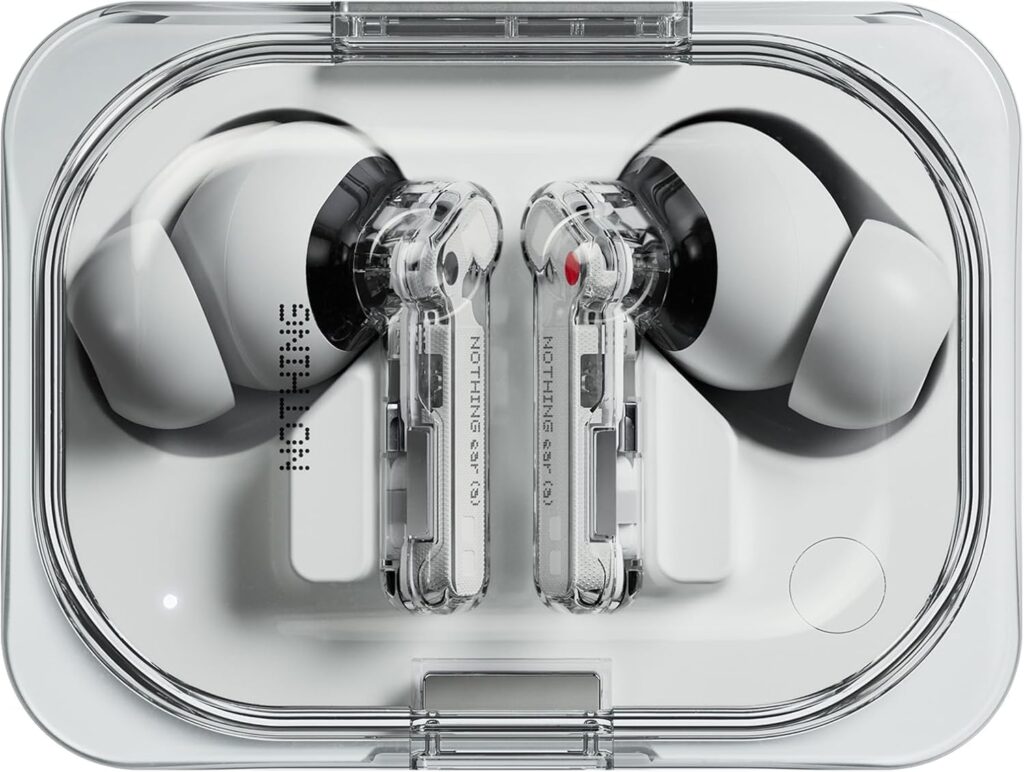
Nothing Ear from 2024 combines distinctive transparent styling with a feature set aimed at listeners who like to adjust their sound. Its strengths are broader than appearance: advanced equalisation, several codec options, noise cancellation and wireless charging make it a flexible everyday product. The naming requires care, because this model is distinct from Ear (2), Ear (a) and Ear (3).
Nothing Ear (2024) — Design and model identity
The official product information identifies an 11 mm dynamic driver with a ceramic diaphragm. That material is part of the engineering story, but it cannot establish sound quality on its own. The ear tips, processing and complete acoustic design have at least as much relevance to the result heard by the owner.
The transparent case and stems give the earbuds an individual appearance without making their operation unfamiliar. Pinch controls provide a deliberate physical gesture rather than requiring repeated taps on the earbud shell. Check their comfort and accessibility with your own fingers; a control that works well at a desk can be less convenient when moving.
Make sure a shop listing identifies the 2024 Ear model. The lower-priced Ear (a) shares aspects of the design and feature set, while later models have their own changes. A favourable price is less meaningful if the product name conceals a different version from the one being researched.
Sound quality and customisation
SoundGuys’ original review is positive about clarity and the range of sound adjustments. Its measurements identify a bass-emphasised default response, and its reviewer finds the advanced equaliser useful. RTINGS also characterises the default sound as warm. These accounts support a capable, adjustable earbud rather than a guarantee that the first factory setting will be every listener’s favourite.
The advanced equaliser is one of the clearest reasons to choose Ear over a simpler alternative. It lets an interested listener make targeted changes instead of cycling through a few broad presets. That freedom is useful only if the owner wants to spend time with it; someone seeking the simplest possible experience may be equally happy with a less configurable model.
Start with familiar voices and instruments before changing settings. If vocals sound obscured, first confirm the fit and review the bass enhancement level. Adding treble to compensate for excessive bass can create a tiring balance rather than solving the underlying preference. Make small adjustments and compare them at the same volume.
Personal Sound Profile offers another approach to adjustment. It should be treated as an optional listening preference tool. Run the setup in a quiet environment and compare the result against the standard sound. A personalised setting is useful if it makes music more convincing and comfortable, not merely because it produces an individual-looking graph.
Keep track of the noise-control mode when evaluating tuning. SoundGuys reports a change in bass balance with ANC switched off. A carefully chosen preset in one mode may not produce the same impression in another. For a commuter, the setting used on the journey deserves priority over the one used for a quiet-room demonstration.
Noise cancellation and fit
Nothing offers active noise cancellation and a transparency mode, with an adaptive setting intended to respond to the environment. The practical benefit depends on a stable seal. A gap around a tip can weaken bass and let outside sound through in ways that electronic processing cannot fully correct.
Use the app’s fit test as a starting point, then check the result while talking and walking. Tip size affects comfort as well as sealing. A larger tip may isolate more securely but become unpleasant over a long session; the best choice is the one that stays stable without requiring constant attention.
Noise cancellation is especially useful for persistent background sound. Irregular voices and sudden noises are a different challenge, so evaluate those separately. Avoid comparing manufacturers’ maximum decibel claims as though they describe an identical test across all audible frequencies.
Transparency is convenient for a short conversation without removing the earbuds. It does not make music inaudible to the listener’s attention or guarantee awareness of every environmental sound. When the surroundings matter, keep the playback level low and use the mode as an aid rather than an assurance.
Codecs and device compatibility
The official codec list includes SBC, AAC, LDAC and LHDC 5.0. The higher-bandwidth options require a compatible transmitting device and settings. An iPhone will normally use AAC, while Android support varies by phone and codec. Buying the earbuds alone does not add an unsupported format to the source.
Dual Connection allows two devices to remain connected, useful for moving between a laptop and a phone. It is not a two-source mixer. Test the actual switching routine if meetings are a major use case, including what happens when a call arrives during computer playback.
Higher-rate Bluetooth modes can affect power use and connection robustness. A stable connection at an ordinary codec setting can be preferable to interruptions at a more ambitious one, especially in a crowded station. The sensible configuration is the one that works reliably in daily use.
The app also provides control customisation and firmware management. Check current support for the phone before buying, particularly if using an older operating system. Optional ecosystem integrations should be evaluated against current device requirements rather than assumed to work identically on every handset.
Battery and charging
Nothing’s official claim is up to 8.5 hours from the earbuds with ANC off, falling to up to 5.2 hours with ANC on. The corresponding case-assisted totals are up to 40.5 and 24 hours. Those are different operating conditions, so presenting the larger figure as continuous noise-cancelling playback would be misleading.
For a long journey, the uninterrupted earbud figure matters more than the total available after repeated case charging. Music volume, codec selection, calls and other features can alter the result. Leave reserve rather than planning a whole travel day around the most favourable advertised condition.
The case supports USB-C and wireless charging. That is a useful convenience difference from Ear (a), especially if a charging pad is already part of the owner’s routine. Fast-charge headlines also need context: a case-assisted total is not necessarily the amount of uninterrupted playback obtained from a brief charge of the earbuds alone.
Durability and value
The documented ratings are IP54 for the earbuds and IP55 for the case. These indicate defined resistance conditions, not permission to swim or expose the product to any liquid. Normal wear can reduce resistance, and wet devices should not be charged. A sports routine also requires a secure personal fit beyond the rating.
The 2024 Ear is most attractive when its sound controls and broad connection options will actually be used. If the owner never opens an equaliser and only wants basic playback, the extra facilities may not justify paying more than for a simpler sibling. If careful adjustment is part of the hobby, they are a substantial advantage.
Compare current European pricing with both Ear (a) and later Nothing models. An older flagship can be excellent value at a suitable discount, but age also makes warranty coverage and new sealed stock worth checking. The recommendation depends on the real offer and the complete fit with the buyer’s phone, listening preferences and charging habits.
Alternatives to consider
Nothing Ear (a): A simpler sibling to consider when advanced equalisation and wireless charging are not essential.
Nothing Ear (3): Compare the later model directly at current prices rather than assuming either generation is automatically the better purchase.
Soundcore Liberty 4 NC: A useful alternative for buyers who place commute noise control and value ahead of the Nothing design.
Nothing Ear (2024) key specifications
- Driver
- 11 mm dynamic with ceramic diaphragm
- Bluetooth
- 5.3; SBC, AAC, LDAC, LHDC 5.0
- Noise control
- ANC and transparency
- Battery claim
- Up to 8.5 hours ANC off / 5.2 hours ANC on
- Case-assisted claim
- Up to 40.5 hours ANC off / 24 hours ANC on
- Charging
- USB-C and wireless
- Resistance
- IP54 earbuds / IP55 case
Verdict
Nothing Ear (2024) remains an appealing configurable earbud with capable sound, a useful advanced equaliser and convenient charging. Its codec options need a matching phone, and ANC-on endurance should be judged separately from the larger battery headline. Buy it when its flexibility matters and the current price compares well with both siblings and newer alternatives.
Primary documentation and independent reviews
Nothing Ear official EU specifications · SoundGuys original Nothing Ear review · RTINGS original Nothing Ear review
Editorial record
Sources and updates
Product specifications and factual claims were checked against Official Nothing Ear (2024) product page ↗. Scores and buying advice follow our category-specific editorial methodology.
- Published
- November 7, 2026
- Last updated
- November 8, 2026