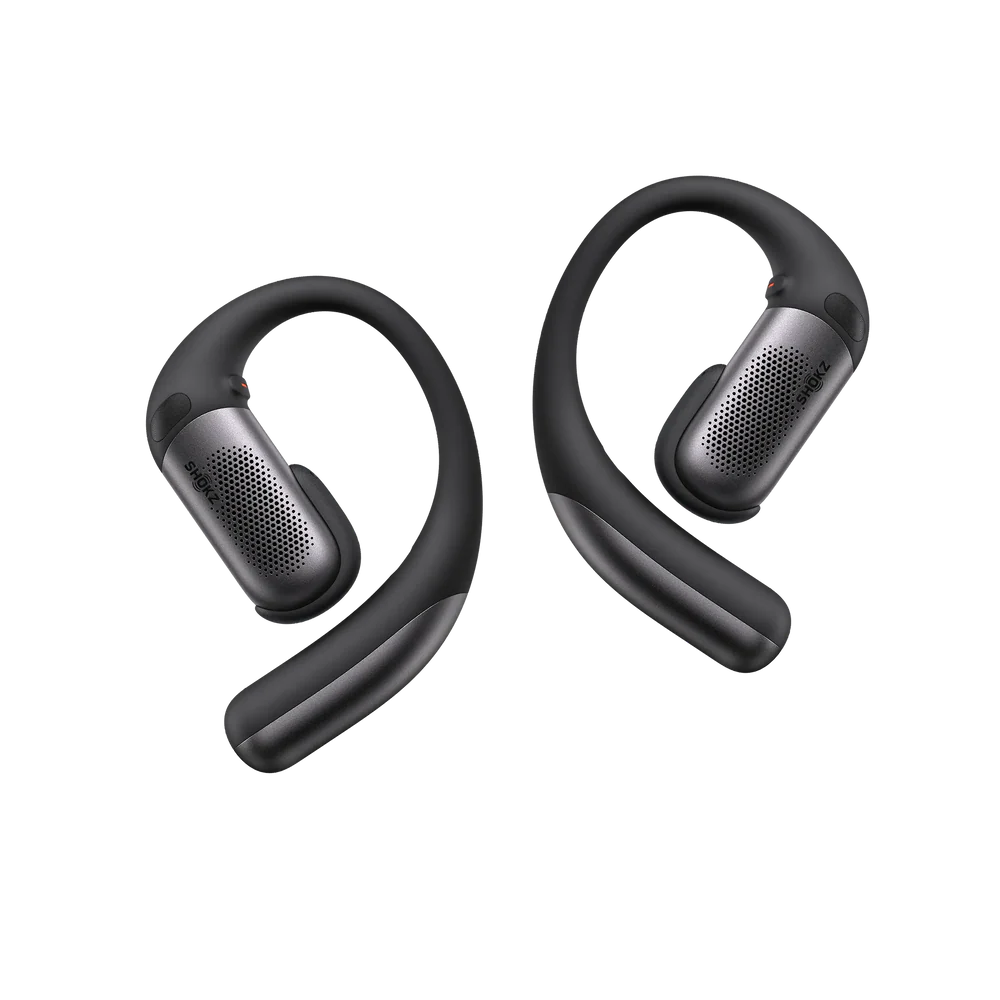
The Shokz OpenFit Pro attempts an unusual compromise: leaving the ear canal open while adding a selectable noise-reduction system. It is the 2026 flagship ear-hook model, with a more elaborate feature set than the OpenFit 2. Its usefulness depends on understanding that compromise. It can reduce some distraction in an open-ear routine, but it should not be bought as a replacement for the isolation of sealed ANC earbuds on a noisy flight or train.
Shokz OpenFit Pro — Design, hooks and physical controls
The ear-hook arrangement is designed around keeping a small speaker close to the ear without inserting a tip. Position matters: the same earbud can sound different when a glasses arm pushes it a little further away. Check the fit with the glasses, hat or other equipment normally worn, rather than making a decision from a brief trial with nothing else on the head.
Physical buttons are a useful everyday feature because a deliberate press is easier to distinguish from accidental contact than some touch gestures. Set up the functions you actually need and try them while moving. A control scheme that looks comprehensive in an app is only helpful if volume, pausing and track changes remain easy without repeatedly disturbing the fit.
What open-ear noise reduction can do
RTINGS finds only a limited reduction of midrange external sound and little assistance at the bass and treble extremes. SoundGuys also describes a narrower benefit than conventional sealed ANC, while reporting a pressure-like sensation for its reviewer. That subjective reaction is worth noting as an audition point, not treating as something every owner will experience.
The practical target is a moderately distracting office or gym where some awareness remains desirable. A loud transport environment is a different challenge. Try the feature on and off with music paused as well as playing, then decide whether its benefit is useful enough to justify the battery cost. The presence of a switch labelled noise reduction is not sufficient reason to leave it on permanently.
Sound quality and fit sensitivity
Published evidence supports an improvement in Shokz’s open-ear sound approach, but also preserves the familiar limitation in deep bass. The driver operates without a sealed canal, so low-frequency rumble is a different proposition from the impact available from well-fitted in-ear buds. A clearer or more substantial open-ear presentation should not be described as identical to a closed design.
For a personal comparison, use a quiet room and familiar recordings before trying EQ. Check that both sides sit consistently and that vocals remain central. If one side lacks bass or sounds further away, correct the position before making a large electronic adjustment. This gives a more useful starting point than changing presets repeatedly while the physical fit is still shifting.
EQ and spatial features
The app provides substantial equaliser adjustment, and Shokz promotes an Atmos-optimised listening mode. These are different tools. EQ changes tonal balance, while spatial processing aims to change the impression of placement or scale. Compare them independently so it is clear which effect is helping and which is simply making a familiar track sound different.
A wider presentation is not necessarily preferable for a podcast, and a bass-heavy EQ is not necessarily appropriate for calls. Establish a comfortable normal setting first. The product’s premium positioning is easier to justify if the extra controls become useful parts of the routine, rather than options explored once and then ignored. Avoid paying chiefly for features that will remain switched off.
Battery life with and without reduction
Shokz quotes up to twelve hours per charge and fifty hours including the case with reduction disabled. Enabling it changes those claims to six and twenty-four hours. That is a substantial distinction, not a minor footnote. RTINGS’ tested endurance is much closer to a work-session figure with the feature active than to the largest number on the product page.
Plan around the mode you will actually use. If reduction is essential throughout the working day, include a charging break rather than assuming the maximum off-mode figure applies. The case total also includes recharging intervals. For occasional open listening, keeping reduction off when it is unnecessary can be the more sensible routine, preserving endurance without giving up the basic reason for the design.
Calls, multipoint and latency
Multipoint is relevant to the office use case, especially for switching between a phone and computer. Test the actual meeting application and incoming-call behaviour before relying on it for work. A successful Bluetooth pairing says little about which source takes priority when two devices both want to play sound.
The original tests find useful microphone intelligibility, with environmental qualifications, while RTINGS flags latency as a poor fit for wireless gaming. Those are separate jobs. A good call microphone does not establish fast game audio, and a low-latency setting does not guarantee synchronisation with every source. Choose the OpenFit Pro for its open listening and communication role, with a different solution for timing-critical games if required.
Charging, protection and portability
USB-C and Qi case charging are welcome conveniences for an everyday product. Choose whichever route fits your existing charging location, and keep enough case charge for the longest normal day away from a socket. Quick-charge claims describe a particular use condition, so treat a short top-up as useful margin rather than a guaranteed replacement for a full charge.
IP55 gives documented dust and water resistance for the intended earbud use, but does not make the product a swimming headset. More importantly for ownership, the larger buds and case take more room than lighter open-ear models. Try the case in the bag or pocket you normally use; a feature-rich design is less convenient if it repeatedly gets left at home because it is cumbersome.
OpenFit Pro vs OpenFit 2
The Shokz OpenFit 2 is the essential comparison for existing owners. The Pro adds a more ambitious feature set, but it is also heavier and its headline noise-reduction benefit is limited. If the older model already fits well and the main use is quiet open listening, there is no obvious reason to replace it automatically.
For a first purchase, compare both fits over more than a few minutes. The product that stays comfortable may be the better choice even if it has fewer functions. If the Pro’s reduction genuinely helps your particular office, its premium has a clearer purpose. If the feature adds little or feels distracting, the simpler model becomes more attractive and leaves budget for a separate isolating pair when needed.
Ear-cuff alternatives and value
The Bose Ultra Open Earbuds change the attachment concept, using a cuff rather than a hook. That can matter for glasses wearers or people who dislike hardware behind the ear. Compare security and sound in your own ears instead of assuming the most expensive or newest design must fit best.
Value is strongest when the OpenFit Pro replaces several small daily inconveniences: buttons that work reliably, easy device switching, useful case charging and a comfortable open fit. It is weaker if the purchase depends entirely on expecting conventional ANC. The extra functions support a particular routine, but they do not remove the fundamental trade-off between an open canal and strong external-noise isolation.
Shokz OpenFit Pro key specifications
- Design
- Open-ear air-conduction ear hooks
- Model year
- 2026
- Bluetooth
- 6.1
- Codecs
- SBC and AAC
- Protection
- IP55
- Battery claim, reduction off
- Up to 12 hours; 50 hours with case
- Battery claim, reduction on
- Up to 6 hours; 24 hours with case
- Case charging
- USB-C and Qi wireless
- Earbud weight
- Approximately 12.3 g each
- Quick-charge claim
- 10 minutes for up to 4 hours of music
Verdict
The OpenFit Pro is a versatile open-ear flagship with thoughtful controls and a distinctive attempt at limited noise reduction. It is best approached as an office-and-fitness companion, with the reduction feature judged by actual benefit rather than its novelty. Compare comfort with the OpenFit 2, account for the large runtime change between modes, and keep expectations for deep bass and transport isolation realistic. Its premium is justified by useful daily functions, not by replacing every kind of earbud.
Primary documentation and independent reviews
Shokz UK current specifications and comparison · Shokz UK launch information · RTINGS original OpenFit Pro test · SoundGuys original OpenFit Pro review
Editorial record
Sources and updates
Product specifications and factual claims were checked against Official Shokz OpenFit Pro product page ↗. Scores and buying advice follow our category-specific editorial methodology.
- Published
- November 8, 2026
- Last updated
- November 8, 2026
Highly ranked reviews in this category
Selected by category rank and editorial score within earbuds. Check each product's design and intended use before adding it to your shortlist.