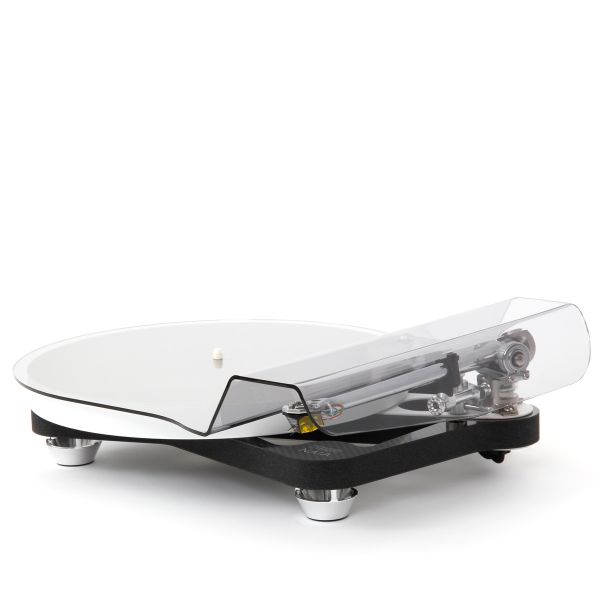
Rega Naia is a specialist turntable for a system already capable of justifying a major vinyl investment. Its lightweight appearance should not be mistaken for a simple entry-level construction. This is an expensive implementation of Rega’s low-mass approach, with a separate supply and a carefully developed arm. The interesting question is whether that complete package suits the listener, not whether the deck looks heavy enough to cost its asking price.
Research-based review. This assessment draws on manufacturer documentation and the original published evaluations linked below. Audio Review has not performed a hands-on test of this model.
A deliberate alternative to massive construction
Rega combines a carbon-fibre and foam-core skeletal plinth with ceramic components and its three-belt drive arrangement. The published dimensions and weight include the dustcover. The deck is much lighter than its visual and financial competitors might lead a new buyer to expect.
That changes the installation conversation. Choose a support for stability and placement rather than assuming the deck’s own weight will solve every vibration problem. Allow access to the arm and room to handle records without brushing another component. Keep loudspeakers from sharing a surface that visibly moves with bass. A successful installation should be comfortable to use repeatedly, not merely impressive in a product photograph. The Naia’s exposed structure also deserves a direct inspection before ordering: its appearance is part of the purchase, and an owner should like the physical object as well as its engineering story.
The arm name does not describe every material
The RB Titanium name refers to important bearing and spindle components; Rega identifies the arm tube itself as aluminium. Cartridge availability is package-dependent, and the original What Hi-Fi evaluation used an Aphelion 2 moving-coil cartridge. Its sound assessment therefore belongs to that combination.
Ask the dealer to identify the exact cartridge on the quotation and confirm its setup before collection. Do not transfer a tracking-force setting from another cartridge or assume that a package photograph establishes what is included. Cartridge replacement also becomes a meaningful long-term cost at this level. A buyer who frequently changes cartridges may prefer a different style of arm and adjustment routine. Someone who wants a professionally prepared combination and then many years of consistent use may find the Rega approach much more appealing. The right choice follows the intended ownership pattern rather than the prestige of a material name.
Resolution is the main published attraction
What Hi-Fi’s original Naia/Aphelion 2 evaluation highlights exceptional information retrieval, convincing textures and openness. It also finds the presentation less rhythmically insistent than a competing Vertere system and notes the visually unfinished character of the foam edges. Those reservations matter alongside the strong praise.
An audition should therefore include music that depends on timing and momentum, not only spacious acoustic recordings. Try a familiar vocal, a dense arrangement and a rhythm section whose interaction is easy to recognise. Ask whether the presentation keeps attention through a whole side. Detail is useful when it clarifies the performance; it should not become a checklist that replaces enjoyment. Match playback levels when comparing complete systems, and keep track of which cartridge and phono electronics are in use. A difference between demonstrations cannot automatically be assigned to the turntable base alone.
Phono matching is part of the purchase
Rega’s manual requires a suitable phono stage for the cartridge type. The separate Naia power supply controls the motor; it is not a phono preamplifier. Its XLR-style motor interconnect should not be confused with a balanced audio output to an amplifier.
Write down the entire signal route before paying: cartridge, phono stage, line-level amplification and speakers or headphones. For a low-output moving-coil package, confirm suitable gain and loading with the cartridge and phono-stage instructions. A spare line input on an amplifier does not perform that task by itself. Include cable routing, available shelf space and everyday switching in the plan. The best phono stage is not necessarily the one from the same brand, but it must be electrically appropriate and quiet in the actual installation. That assessment is more productive than buying the deck first and treating the rest as a minor accessory decision.
Electronic speed control, manual record handling
The official manual provides front-panel selection for 33 1/3 and 45 rpm and describes fine adjustment through the supply. It also advises keeping the supply away from the cartridge within the available connection length. The user still handles cueing and the record-playing routine.
For an owner moving from an automatic deck, that is a real change in convenience. Demonstrate the cueing action and the end-of-side routine before committing. Do not alter speed simply because a phone reading differs slightly on one attempt; establish a reliable reference and follow the manufacturer’s instructions if adjustment is necessary. Keep the original packing for transport and ask the dealer about the correct preparation before moving the deck. Expensive record players can be straightforward to enjoy once installed, but they reward a calm, repeatable routine more than frequent speculative adjustment.
Value belongs to the whole listening system
The Naia occupies a luxury part of the market. An old review’s launch price should not be treated as a current European quotation, and a bare-deck price is not directly comparable with an assembled cartridge package. Obtain a written list of included components, setup and local support.
Consider what the same total expenditure could improve elsewhere. Better placement, quieter phono amplification or more suitable speakers may matter more in a system that has not yet settled. Conversely, an owner with an extensive record collection and a well-developed system may reasonably place a high value on the Naia’s particular presentation. Warranty wording also needs reading rather than reducing it to a lifetime slogan: Rega excludes consumables and wear, and local terms can vary. Long-term support, cartridge maintenance and an accessible dealer are practical parts of the value calculation.
Alternatives to consider
Rega Planar 10: Planar 10 is the essential comparison within the same design family. Compare complete cartridge packages and retain enough budget for a suitable phono stage rather than assuming the more expensive deck must improve the whole system.
Rega Planar 8: Planar 8 offers another route into a light, skeletal Rega system at a different investment level. The relevant question is whether the additional Naia expenditure remains audible and worthwhile in the intended room and electronics.
Technics SL-1200G: SL-1200G presents a contrasting direct-drive ownership proposition. Compare adjustment, handling and the complete cartridge setup as well as listening preference; engineering philosophy alone cannot choose a winner for every owner.
Rega Naia key specifications
- Operation
- Manual
- Drive
- Belt, three Reference drive belts
- Speeds
- 33 1/3 and 45 rpm, electronic selection
- Tonearm
- RB Titanium
- Arm tube
- Hand-polished one-piece aluminium
- Plinth
- Graphene-impregnated carbon fibre with foam core
- Platter
- Ceramic
- Cartridge
- Optional; verify exact package
- Phono stage
- External or suitable amplifier phono input required
- Power supply
- Separate Naia supply
- Dimensions with cover
- 420 x 115 x 350 mm
- Weight with cover
- 4.65 kg
Verdict
Rega Naia is a serious shortlist candidate for an experienced vinyl listener seeking clarity and a natural presentation from a professionally assembled high-end source. The original published test supports that position while leaving room for alternatives with more emphatic rhythmic character.
Choose it after hearing the exact cartridge package and confirming the phono stage, support and total cost. Its distinctive construction is purposeful, but neither the material choices nor a high score removes the need for that system check. For buyers who want automatic convenience, frequent cartridge swapping or a less concentrated investment in vinyl, a different deck can be the better long-term choice.
Documentation and original reviews
Rega official Naia construction and specifications · Rega official Naia setup and power-supply manual · What Hi-Fi original Naia with Aphelion 2 evaluation
Editorial record
Sources and updates
Product specifications and factual claims were checked against Official Rega Naia product page ↗. Scores and buying advice follow our category-specific editorial methodology.
- Published
- November 17, 2026
- Last updated
- November 17, 2026