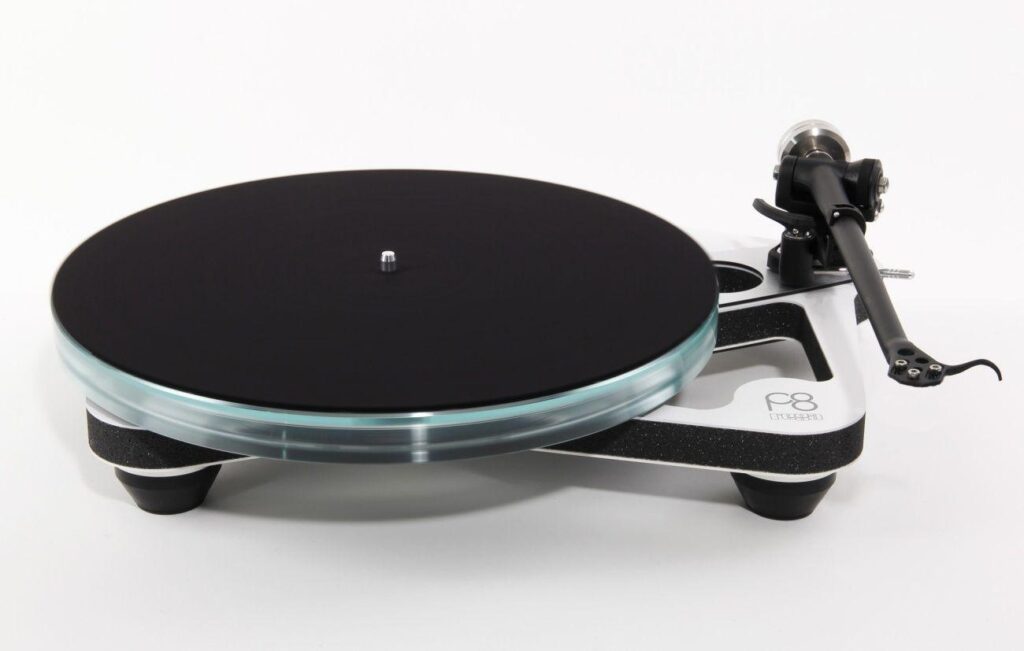
The Rega Planar 8 makes its engineering priorities visible. Its skeletal low-mass plinth, RB880 tonearm and layered glass platter are intended to create a focused analogue source, with a matched Neo supply handling the motor. It is a serious turntable for a dedicated system, and the cartridge and phono stage need as much attention as the striking deck itself.
Rega Planar 8 — The skeletal design in daily use
The compact structure removes much of the rectangular surround associated with a conventional turntable. It is distinctive enough to be a positive attraction or a reason to choose something else. The useful question is whether its form works in the intended space. Look at the actual platter and arm clearances, the route taken by the cables and the space needed to remove the single-piece cover before deciding where it will live.
Rega’s low-mass approach is not intended to make the turntable feel substantial through weight alone. The plinth uses a foam core and rigid laminate, with bracing supporting the relationship between the bearing and arm. The platter uses three layers of glass. These are design facts rather than proof that one construction philosophy must beat every heavy alternative. Judge the completed product through setup, operation and a meaningful audition, not by lifting it and equating mass with quality.
The removable cover is a practical difference from a familiar hinged lid. Make sure there is a safe place to put it during listening and check that the shelf allows comfortable access. A beautiful turntable becomes less appealing if every record change involves moving other equipment. The skeletal layout suits an owner who is comfortable with that deliberate, hands-on style of use.
RB880 and cartridge selection
The RB880 tonearm is a central reason to consider the Planar 8 rather than simply adding accessories to a cheaper deck. A factory-fitted cartridge can simplify alignment, but installation still involves checking tracking force and bias. Do not assume that a package leaves the shop ready for the journey home without transport protection or that the setup will survive a move without inspection. Keep the original packing and follow the current manual.
Rega’s current product page lists moving-magnet and moving-coil options, including Nd7, Nd9, Ania Pro and Apheta 3. That is a wider choice than the original launch packages. Confirm the exact cartridge supplied and the electrical requirements of the matching phono stage. A moving-magnet input that works with one package may be inappropriate for a low-output moving coil. The cartridge name belongs in the buying comparison, even when retailers lead with the turntable’s name alone.
The arm’s focused adjustment approach is most attractive to an owner who wants a settled combination. Frequent cartridge swapping can be more convenient with other arm designs and removable headshells. Before installing an unfamiliar cartridge, check body height, mounting and any required spacing with a competent dealer. A theoretically attractive cartridge is not a good upgrade if its practical fit or phono-stage compatibility has been overlooked.
Motor control and manual operation
The supplied Neo power supply provides electronic speed selection and fine adjustment. It is a welcome convenience for a record collection mixing standard album speeds, because the owner need not change the belt’s position for every speed change. It also needs its own place on the rack. Route the low-level signal cable thoughtfully and keep the setup accessible enough that cleaning or moving the deck does not strain connections.
The turntable remains fully manual in arm use. Cueing, returning the arm and stopping after a side finishes are the listener’s responsibility. That can encourage attentive listening, but it is not ideal for every household. Someone who wants a record to stop automatically while they work elsewhere should consider that requirement before paying for a more ambitious manual deck. Electronic speed selection and automatic arm operation are separate features.
There is no integrated phono stage, Bluetooth transmitter or USB recorder. The Planar 8 is therefore best understood as an analogue mechanical source to be partnered with appropriate electronics. Those omissions are not faults if the system already provides the required gain and amplification. They do increase the total cost for a buyer starting from scratch, so include the entire signal path rather than comparing bare turntable prices.
Support and maintenance
Choose a rigid, level support away from the loudspeakers. The Planar 8 is not a suspended turntable designed to isolate every movement of the floor, so a springy floor or resonant cabinet should be addressed before a cartridge upgrade. A suitable wall-mounted solution can be worth investigating where footsteps are a problem. The correct support depends on the room and wall construction, not simply on buying the most expensive shelf available.
Check setup after transport and after any cartridge work. Use the tracking force recommended for the actual cartridge, keep the stylus clean with an appropriate method and avoid treating groove damage as something a more expensive deck can repair. A record with an eccentric centre hole can produce audible pitch variation even when the motor is operating correctly. Diagnosing the record, support and cartridge separately is more useful than assuming every audible problem comes from the turntable’s design.
Long-term cost includes belts, cartridge servicing and professional setup if the owner does not want to do the work. Ask the retailer about service routes for the exact cartridge. Consumable wear and accidental stylus damage should not be confused with a manufacturing-defect warranty. A clear service arrangement makes ownership easier, especially when a premium moving coil is part of the package.
What the published review supports
What Hi-Fi’s original Planar 8 review tested the deck with the earlier Apheta 2 moving-coil cartridge. It praised clarity, expressive dynamics, control and a taut, agile presentation. That is valuable evidence for the named tested combination, but it is not a direct test of today’s Apheta 3, Nd9 or other factory options. Audio Review has not performed its own listening or speed measurements on this model.
The evidence makes the Planar 8 a credible high-performance audition candidate. Compare it with the phono stage and cartridge type intended for home use, and use records whose condition is understood. Listen to sustained instruments as well as dynamic material, and include recordings with dense arrangements. A good source should remain intelligible when music becomes busy, but different cartridges and output levels can complicate a casual demonstration. Ask for matched playback levels rather than letting the louder package win automatically.
The rest of the system should be ready for this level of source. If the speakers are poorly positioned or the phono stage is noisy, fixing those issues may be more rewarding than moving up a turntable range. The Planar 8 is most attractive when records are a primary format and the owner already has an appropriately capable system. It is less persuasive as an isolated luxury component surrounded by unresolved setup problems.
Value and the ownership decision
The purchase is about a coherent deck, arm and motor-control platform, with the cartridge chosen deliberately. Its premium is easier to justify for frequent listening than for a small collection played occasionally for atmosphere. Compare current European package totals and retailer setup support. A cartridge-free price, an MM package and an MC package may describe materially different completed systems despite sharing the Planar 8 name.
An audition should also decide whether the skeletal format suits the owner’s habits. A direct-drive alternative may offer more accessible adjustment or a more conventional cover arrangement, while a less expensive Rega could leave more budget for records and a phono stage. The Planar 8 earns consideration through its focused engineering and strong published package assessment. Its best buyer values that complete approach and accepts manual operation and careful installation.
Alternatives to consider
Rega Planar 3: A lower-cost starting point if the rest of the system still needs investment.
Denon DP-3000NE: Compare a substantial direct-drive platform with different adjustment and cartridge-handling priorities.
Rega Planar 8 key specifications
- Drive / operation
- Belt drive / manual
- Tonearm
- RB880
- Platter
- Triple-layer glass
- Plinth
- Tancast 8 foam core with laminate skin
- Motor control
- Matched Neo supply; electronic speed selection
- Current listed cartridge options
- Nd7 / Nd9 MM; Ania Pro / Apheta 3 MC; verify package
- Phono stage
- External
Verdict
The Rega Planar 8 is a compelling dedicated vinyl source with distinctive low-mass construction, an RB880 arm and included electronic speed control. Its value depends on a compatible cartridge, phono stage and support. Audition the exact package, and accept its manual operation and removable-cover routine before buying.
Primary documentation and independent reviews
Rega official Planar 8 information and current cartridge options · What Hi-Fi original Planar 8/Apheta 2 review
Editorial record
Sources and updates
Product specifications and factual claims were checked against Official Rega Planar 8 product page ↗. Scores and buying advice follow our category-specific editorial methodology.
- Published
- November 8, 2026
- Last updated
- November 8, 2026