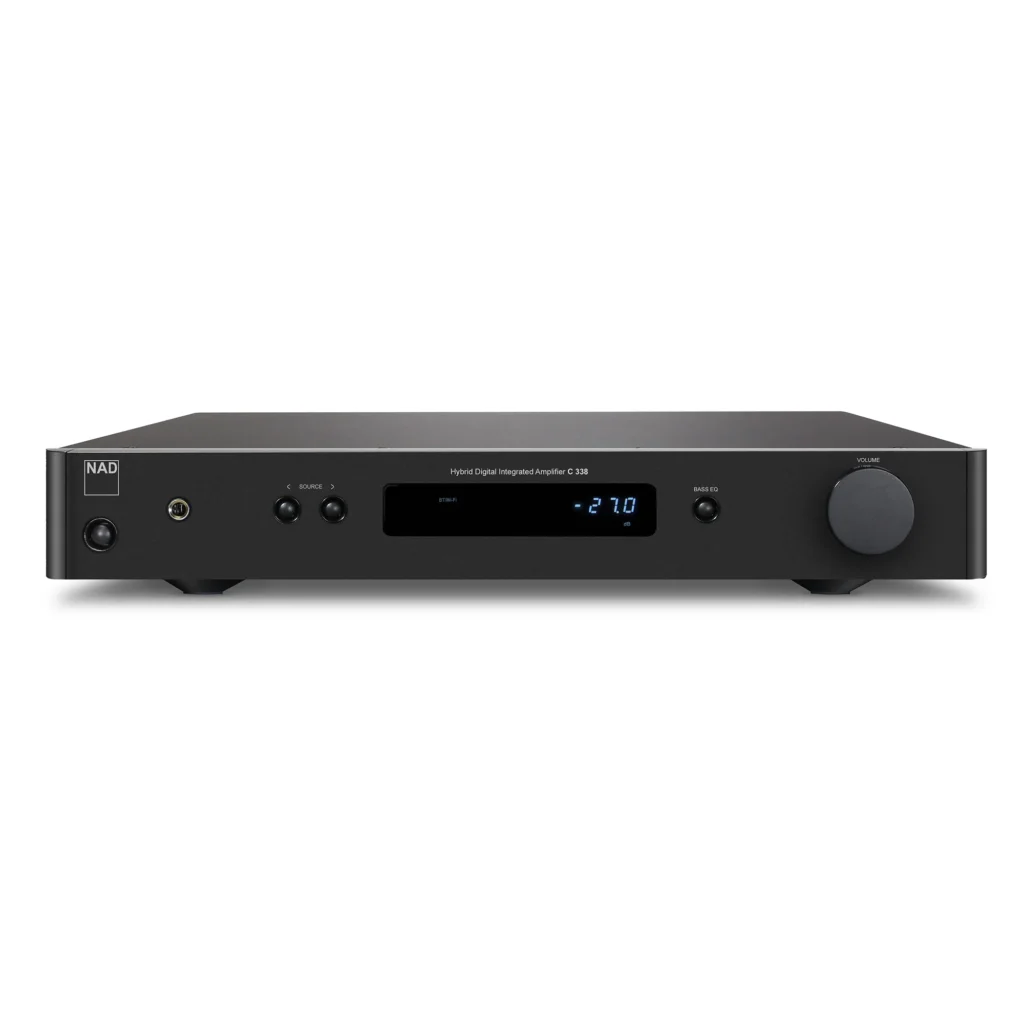
NAD C 338 combines a slim stereo amplifier, DAC, moving-magnet phono and built-in Chromecast playback. Unlike a Bluetooth-only integrated amplifier, it can receive supported music over the home Wi-Fi network. It is still an older platform with its own setup requirements, not a BluOS-equipped NAD or a television-ARC amplifier. This research-based review considers its documented source flexibility and original listening evidence while giving current-device setup the attention it deserves before an older connected product becomes the centre of a new system.
Research-based review. This assessment draws on manufacturer documentation and the original published evaluations linked below. Audio Review has not performed a hands-on test of this model.
An inviting balance with a qualified excitement factor
AVForums’ original evaluation hears warmth, sweetness and useful detail, with a convincing ordinary presentation across the analogue and digital routes. It is less positive about the final degree of rhythmic excitement and finds Bluetooth less substantial than the other tested inputs. Those observations support a comfortable mixed-source system, while making source choice and musical priorities worthwhile audition points.
Use the intended speakers with familiar vocal, acoustic and rhythm-led recordings. Match levels sensibly and compare the same passage through the source route that will actually be used. A relaxed balance can be appealing over long sessions, but should still communicate the momentum of favourite music. Another listener may value a more direct and energetic presentation. Published comparisons help identify what to examine without deciding the preference in advance. Judge the complete system from the normal seat and at the normal level, rather than expecting a particular amplifier character to override speaker placement or room behaviour. The strongest choice stays engaging through albums, not only a short demonstration.
Chromecast is built in, but verify the current routine
NAD’s official documentation provides Wi-Fi setup through Google Home and describes casting from compatible applications. The amplifier and control device need an appropriate shared network arrangement. The manual also warns that application screens can change over time, which is especially relevant to an older connected model.
Before committing to a used or remaining-stock unit, test setup, discovery, playback and return from standby with the actual current phone and intended services. Do not assume that a launch-period screenshot still describes today’s application exactly. Check how another household member takes over playback and adjusts volume. A working cast from one service does not establish support for every application or special audio format. This platform should not be described as BluOS, AirPlay or a guarantee of unlimited future service compatibility. Its convenience case is strongest for someone who already uses compatible casting applications and can confirm a straightforward daily routine. A different ecosystem may be preferable if it better matches the rest of the home.
Digital transports fit better than HDMI television expectations
Optical and coaxial inputs provide useful connections for compatible digital sources, alongside analogue line inputs. There is no HDMI television return connection or computer USB audio input. The presence of a network player does not change those physical boundaries.
Map the CD transport, television, computer and other sources before choosing the amplifier. A display with a suitable digital output can feed an appropriate stereo signal, but should not be described as an ARC-controlled surround system. Check source settings and synchronisation with internal television apps and external players separately. A computer may need another documented interface rather than an arbitrary USB lead. Avoid adding converters until the required route and its limits are understood. The existing input set can be efficient when it matches equipment already owned. It is less attractive when the purchase immediately requires several extra boxes solely to provide connections found on a newer integrated platform. The useful comparison is the complete working system, including its control routine.
Records need the correct phono path
The C 338 includes a moving-magnet phono stage, keeping a suitable record player within a simple integrated system. It should be distinguished from line-level inputs, and the cartridge and turntable output arrangement still need checking. A phono label is not universal support for every cartridge type.
Determine whether the record player already has an active phono stage. Use a line input for its line-level output or the amplifier’s phono input for an appropriate unamplified cartridge signal. Avoid applying amplification and equalisation twice. A low-output moving-coil cartridge requires suitable matching equipment rather than an assumption that the internal stage handles it directly. Attend to grounding and placement before attributing hum to the recording medium. Compare any proposed external stage with levels matched and a clear reason for the additional component. The included facility is most valuable when it makes the system simpler without creating a duplicated signal path. A careful connection usually matters more to a new record system than an unsupported claim that one input is inherently more musical.
Speaker and bass setup remain physical decisions
The official continuous rating is fifty watts per channel under defined load and distortion conditions. Bass EQ and an active-subwoofer output add options, while a dedicated headphone facility supports private listening. These features do not provide automatic room correction or remove the need for suitable speakers.
Check the loudspeaker requirements, listening distance and desired level before assuming a universal match. Begin with sensible stereo placement and an unexaggerated balance. Try Bass EQ on a familiar passage only after establishing a reference, listening for better support rather than simply more rumble. If external bass is planned, follow the documented connection and integration guidance instead of treating the output as a complete cinema bass-management platform. For headphones, assess usable volume range, background noise and tonal balance with the actual pair. Loudspeaker power figures do not describe that separate output. A compact all-in-one electronics box still depends on the room and transducers chosen around it, so they should receive an appropriate share of both the budget and attention.
An older network amplifier needs a complete value check
The approximately 435 by 70 by 285 mm enclosure is slim but full width. Its physical simplicity can be attractive where a large display and elaborate control interface are unnecessary. At the same time, age and the current software routine belong in the value calculation.
Allow cable clearance and ventilation, and test the remote, source selection and standby behaviour from the actual sofa. Check exact regional model, condition and local warranty for remaining-stock or used purchases. Include speakers and any required source interface in the final price. Do not use an original review’s old service catalogue or contemporary rival price as a permanent buying claim. A Google Cast household with records and digital transports may find the facilities well chosen. Someone needing HDMI, a different multiroom platform or an extensive local-library interface may prefer another starting point. A discount is meaningful when the documented system already meets the requirement and its current setup works reliably with the devices that will remain in use.
Alternatives to consider
WiiM Amp Pro: Compare the software platform, television route and analogue-source requirements. Include an external phono stage if the intended alternative configuration needs one.
Denon PMA-900HNE: A different network ecosystem to assess when integrated music-service control is important. Compare current complete prices and the facilities actually used.
NAD C 338 key specifications
- Role
- Streaming stereo integrated amplifier; passive speakers required
- Manufacturer continuous rating
- 50 W per channel into 8 / 4 ohms, stated conditions
- Network playback
- Chromecast built-in over Wi-Fi
- Bluetooth
- Separate wireless source route
- Analogue
- MM phono; line-level inputs
- Digital sources
- Optical and coaxial inputs
- HDMI / computer USB audio
- Not provided
- BluOS
- Not the C338 platform
- Private listening
- Headphone amplifier
- Bass adjustment
- Bass EQ; active-subwoofer output
- Dimensions
- Approximately 435 × 70 × 285 mm
- Setup
- Google Home / current manufacturer instructions; same-network requirements apply
- Net weight
- 4.85 kg
Verdict
C 338 remains an interesting mixed-source stereo amplifier with built-in casting, digital inputs and MM phono. Original evidence supports a warm, listenable presentation while qualifying ultimate excitement. Confirm present-day network setup, source connections and the intended speaker match. Its value follows that verified everyday fit rather than an assumption that every older streaming platform offers the same current experience.
Documentation and original reviews
NAD official C 338 features and technical specification · NAD official C338 operating manual, casting setup and rated-power conditions · AVForums original C338 source and listening evaluation
Editorial record
Sources and updates
Product specifications and factual claims were checked against Official NAD C 338 product page ↗. Scores and buying advice follow our category-specific editorial methodology.
- Published
- November 17, 2026
- Last updated
- November 17, 2026