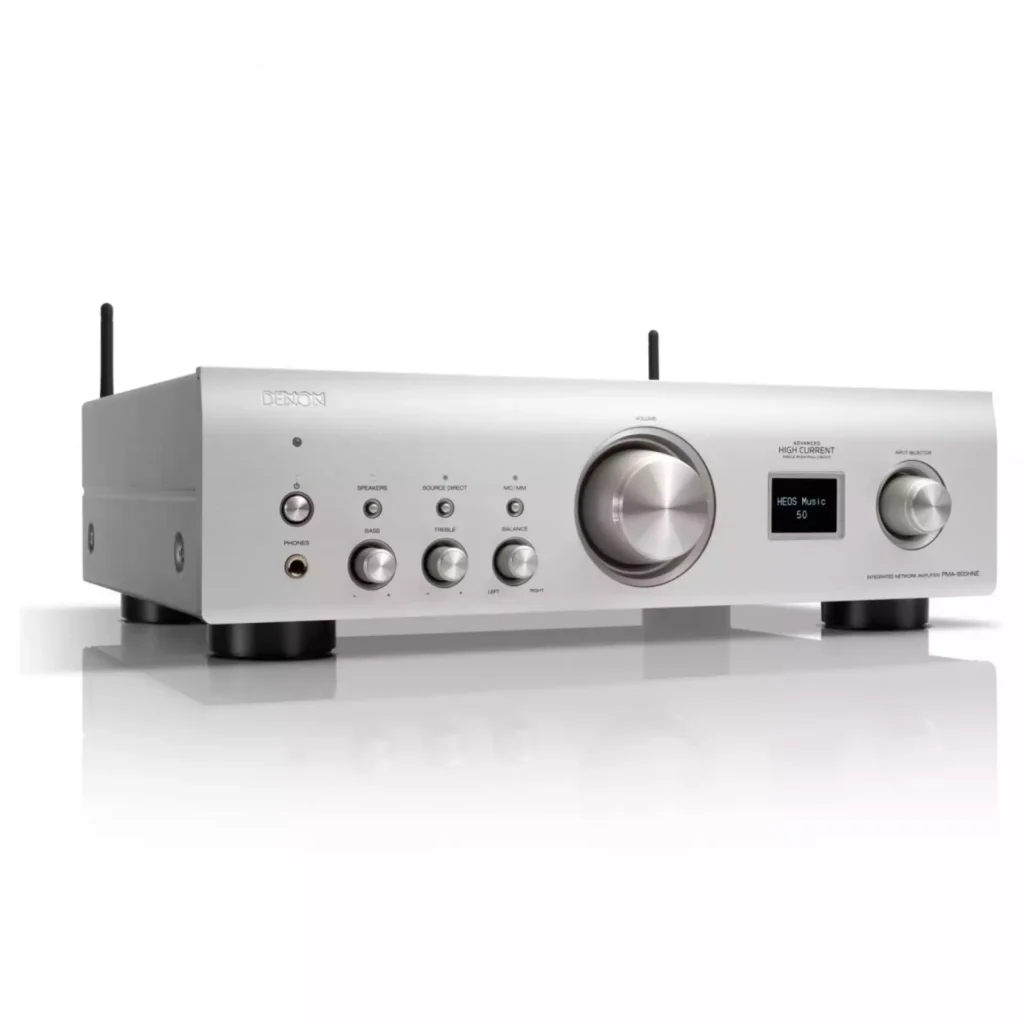
The Denon PMA-900HNE combines a conventional integrated amplifier with built-in HEOS streaming. It is aimed at a stereo music system that may include records, digital sources and a television, without becoming a multichannel AV installation. Its broad source access is appealing, although television control and computer connections need more planning than the feature count initially suggests.
Denon PMA-900HNE — Design and controls
The PMA-900HNE looks like a traditional hi-fi amplifier rather than a screen-led streaming hub. Direct source and volume controls make basic operation approachable, while the small display provides status rather than a large album-art interface. The phone or tablet therefore remains central to browsing a substantial streaming library. Try that division of tasks before buying if a phone-free listening routine matters.
Sound+Image’s original review found the amplifier convincing as a traditional hi-fi product with added network convenience, but criticised the tiny display and tapered controls. Those observations identify ownership details worth trying in person. A control that looks elegant in a photograph may feel less convenient when used daily, and display readability depends on the distance and angle from the listening chair.
Power and speaker selection
Denon’s full-bandwidth rating is 50 watts per channel into eight ohms at 0.07 percent distortion. The separately advertised 85 watts into four ohms is specified at one kilohertz and 0.7 percent distortion. Those are different test conditions, so the larger number should not be presented as an equivalent full-bandwidth rating. Honest comparison starts with the eight-ohm continuous figure and the actual loudspeaker requirements.
That rating can be entirely suitable for a moderate room and sensible speakers. It is less informative for a demanding low-impedance load played loudly at a distance. Speaker sensitivity, room size and preferred listening level matter more than choosing an amplifier by a single number. Leave headroom for musical peaks instead of designing the system around its maximum possible volume.
Speaker A/B terminals offer useful selection flexibility, but running two pairs simultaneously changes the amplifier load. Follow the manual’s impedance guidance. Another set of terminals does not establish independently powered zones, and a pair of speakers elsewhere should not be added without considering the combined demand and the lack of separate volume control.
Vinyl and conventional sources
The switchable MM/MC phono input is a notable advantage for a product in this role. It accommodates more cartridge types than an MM-only stage, although compatibility still depends on the cartridge’s output and recommended loading. A phono input labelled MC is not a universal guarantee for every moving-coil design. Confirm the cartridge match before deciding that an external stage is unnecessary.
A turntable with an enabled built-in phono stage already outputs line level and belongs on a line input. A bare cartridge uses the appropriate phono setting. This simple distinction prevents excessive gain and incorrect equalisation. Keep sensitive turntable wiring away from mains leads where practical, and investigate grounding and cable placement before assuming any hum is an amplifier fault.
The ordinary analogue inputs support established CD players and external sources. A headphone socket and subwoofer connection add flexibility for different listening times and rooms. The headphone output should be checked with the actual headphones, while subwoofer integration still needs placement, crossover and level adjustment. Neither connection removes the need to match the rest of the system.
Digital inputs and television use
Three optical inputs and one coaxial input give the PMA-900HNE unusually useful access to separate digital sources. A television, disc transport and another optical source can remain connected without constant cable changes. USB-A is for supported media storage, not a computer USB-B DAC connection. If direct laptop USB playback is a requirement, include a suitable external interface or choose an amplifier with that input.
There is no HDMI ARC socket. Television audio can use an optical connection with a compatible PCM output, but video switching and HDMI-based control are outside this amplifier’s role. Sound+Image noted input sensing and remote-learning possibilities that can help TV use, while also explaining that control interactions may need care. Test power and volume behaviour with the actual television instead of assuming optical gives exactly the same experience as ARC.
This is an important buying distinction rather than a minor missing logo. If several people use the television and expect one-remote operation, a model with a suitable HDMI return-audio implementation may be easier. If the television is a secondary source and ordinary stereo music is the priority, the optical route may be sufficient and the extra optical inputs become a practical strength.
HEOS and sound quality evidence
HEOS supplies the integrated streaming and multiroom platform. AirPlay 2 and Bluetooth provide additional access routes, with Bluetooth’s SBC limitation worth distinguishing from the network playback options. Check current service support in the European market and the app workflow for the music library actually used. An amplifier can have an extensive service list while still being less convenient for a particular household’s listening habits.
Wired Ethernet can simplify a fixed installation where a network socket is available. Wi-Fi avoids another cable where reception is reliable. The goal is stable playback and predictable control rather than assuming that one connection type automatically alters the tonal character of ordinary music. Keep firmware current and evaluate the services on that current version, since older reviews capture a particular point in time.
Sound+Image’s original listening evaluation praised the amplifier’s spacious presentation, musical coherence and ability to handle dynamic material. That supports a strong music-focused assessment, but it is the publication’s listening evidence rather than Audio Review’s own audition. Its multiroom functions were not fully exercised in that test, so the review should not be used as proof of every possible whole-home arrangement.
Value and the complete system
The PMA-900HNE is strongest when its network platform, digital inputs and phono stage all have clear jobs. It can replace a separate streamer and phono component in a traditional stereo setup, making the complete system easier to manage. A buyer using only one analogue input has less reason to prioritise this particular combination.
Compare current European prices with all required accessories and missing connections included. An ARC-equipped compact amplifier may be a better living-room controller, while an analogue amplifier and separate streamer offer more freedom to change software platforms. The Denon remains a persuasive middle ground for a listener who wants physical hi-fi controls and records alongside convenient streaming. Its limitations are manageable when recognised before installation, especially the absence of HDMI and a computer USB DAC input.
Alternatives to consider
NAD C 700 V2: A compact network amplifier to compare when television integration and a larger display are priorities.
WiiM Amp Pro: Consider a smaller app-led system if HDMI return audio matters more than MM/MC phono flexibility.
Denon PMA-900HNE key specifications
- Type
- Integrated network stereo amplifier
- Rated output
- 50 W/channel at 8 ohms, 20 Hz–20 kHz, 0.07% THD
- Separate 4-ohm rating
- 85 W/channel, 1 kHz, 0.7% THD
- Digital inputs
- Three optical, one coaxial, USB-A media
- Phono
- MM / MC selectable
- Network
- HEOS, Wi-Fi, Ethernet and AirPlay 2
- HDMI / USB-B DAC
- Neither
- Outputs
- Speaker A/B, subwoofer and headphones
Verdict
A convincing traditional streaming amplifier with useful digital inputs and unusually flexible built-in phono support. It suits music-led systems well, while the tiny display, SBC Bluetooth and absence of HDMI need to fit the intended use.
Primary documentation and independent reviews
Denon official PMA-900HNE product specifications · Denon official European PMA-900HNE specifications · Sound+Image original PMA-900HNE review via What Hi-Fi
Editorial record
Sources and updates
Product specifications and factual claims were checked against Official Denon PMA-900HNE product page ↗. Scores and buying advice follow our category-specific editorial methodology.
- Published
- November 8, 2026
- Last updated
- November 8, 2026