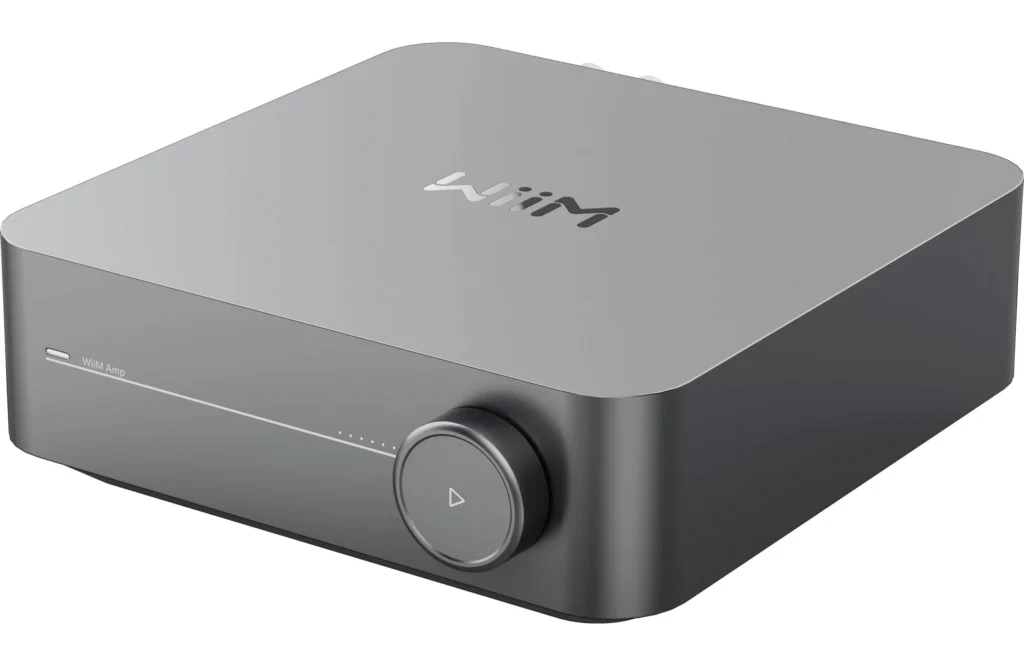
The original WiiM Amp combines network streaming and a stereo speaker amplifier in one compact component. It is attractive when a pair of passive speakers needs a simple music and television hub. Its name must be kept separate from Amp Pro and Amp Ultra, because similarly named products do not necessarily support the same TV formats or Apple integration.
WiiM Amp — One box for a pair of passive speakers
WiiM specifies 60 W per channel into eight ohms and 120 W into four ohms. These are manufacturer figures rather than independent bench results. They help identify the intended system scale but do not guarantee a particular listening level with every loudspeaker.
Match speakers using sensitivity, impedance behaviour, distance and desired volume, not a single wattage comparison. A compact amplifier can be convenient on a shelf, but still needs ventilation and sensible cable management. Connecting more speakers in parallel can alter the load and should not be improvised without checking the documented limits.
TV audio is stereo PCM on the original Amp
The official support guidance explicitly separates WiiM Amp from Amp Pro. The original Amp requires stereo PCM for HDMI ARC and optical TV audio, rather than accepting every Dolby or DTS soundtrack directly. Select the appropriate TV output setting before assuming a silent connection is a hardware fault.
HDMI ARC is the television audio-return connection, not a conventional HDMI input bank for switching consoles and disc players. Those sources normally connect to the television. The result is a stereo speaker system, not a discrete multichannel home-cinema receiver, even when the TV catalogue displays an Atmos badge.
Analogue sources need the correct signal level
Line input and optical input add flexibility alongside network music. A CD player with line output is a straightforward analogue source. A turntable without an internal phono stage requires a separate suitable preamplifier before the line input; a low-level cartridge signal is not interchangeable with ordinary line audio.
WiiM also documents sharing supported physical inputs within its multiroom system. That does not mean every external ecosystem receives every source in the same way. Check the actual destination products and expected delay, especially when television sound must remain synchronised with a picture.
The original model’s ecosystem can be a benefit
The original WiiM Amp supports AirPlay 2 in WiiM’s comparison table, while the Amp Pro differs. Buyers using Apple devices should not assume the more expensive or newer name automatically preserves every feature they rely on. Exact-model comparison is more useful than a simple upgrade hierarchy.
The WiiM Home app provides setup and ongoing control, with service availability dependent on current support and accounts. Test everyday tasks such as switching between TV and music, volume control and waking the system. These small routines matter more than rarely used file-format maxima.
For value, price the speakers, stands, cables and any needed phono stage as part of the system. We have not measured the amplifier into difficult loads or compared its sound with rivals. Its documented strengths are system simplicity and useful connections, not a proven sonic advantage from integrating functions.
What to expect in a real setup
Does original WiiM Amp decode Atmos from a TV? No. WiiM instructs users of the original Amp to set HDMI ARC or optical TV output to stereo PCM. Do not borrow Amp Pro specifications.
Can it replace a seven-channel AV receiver? Not for discrete surround-speaker playback. It is a stereo amplifier for a pair of passive speakers, with suitable subwoofer integration options rather than multiple main channels.
The original Amp as a complete stereo purchase
The original WiiM Amp should be evaluated with a pair of passive speakers and a realistic listening distance, not as an abstract power figure. Speaker sensitivity, impedance behaviour and the size of the room affect how much clean listening level is available. Leave ventilation space and begin with conservative volume and tone settings. If an existing speaker pair already needs unusually high output in a large room, a compact integrated solution deserves a direct suitability check rather than an assumption that a published wattage settles the matter.
Keep the generation clear when comparing features. This review concerns the original Amp, so a connection or platform feature discussed for the Amp Pro or Amp Ultra should not silently become part of the buying decision. Conversely, owners should not assume that a limitation of a later model applies to this one. Check the exact model name on the product, its manual and the retailer’s listing. Discounted stock and second-hand listings can make names especially easy to mix up.
Plan how television and music share the speakers
For a TV installation, getting a stable stereo signal is the priority. Configure the relevant television output for the format supported by the original Amp, then test both an internal TV app and an external playback device. An app and a games console can lead to different audio settings even though they use the same television connection. Check remote volume, standby and input switching during this exercise. A stereo amplifier does not acquire centre, height or rear channels through an HDMI cable.
For music, compare the convenience of the network route with the external sources you actually own. An analogue source may need its own phono stage, while a digital source needs a compatible output and format. Add speaker cable, any stands, and source accessories to the total cost. That is the fair comparison with powered speakers or an alternative integrated system. The original Amp can remove several small boxes from a straightforward setup, but its success depends on the whole chain remaining simple. A documented input plan and a few repeatable daily tasks reveal more about that simplicity than switching between demonstrations at unmatched listening levels.
Alternatives to consider
WiiM Amp Pro: Compare carefully for changes in TV-format support and Apple compatibility rather than assuming all original Amp features carry across.
Marantz MODEL M1: A different compact streaming-amplifier approach to investigate with the same speakers and complete-system budget in mind.
WiiM Amp key specifications
- Assessed version
- Original WiiM Amp
- Speaker channels
- 2
- Power claim, 8 ohms
- 60 W/channel
- Power claim, 4 ohms
- 120 W/channel
- TV connection
- HDMI ARC
- Original-model TV audio
- Stereo PCM
- Other inputs
- Line, optical, network; USB-disk support
- Apple integration
- AirPlay 2
- Control platform
- WiiM Home
Verdict
The original WiiM Amp is easiest to recommend as a clearly defined stereo hub. Its TV-format boundary is important, while AirPlay 2 may be a reason to choose it over a differently equipped sibling. Confirm speaker matching and daily control behaviour before deciding that an integrated box suits the room.
Primary documentation
Specifications and feature descriptions were checked against the following official documents on 6 November 2026. Compatibility advice is our interpretation of those documented capabilities; it does not establish measured sound quality. Regional bundles, software features and service availability can change, so verify the exact European model and current support information before purchase.
- WiiM original Amp official product information
- WiiM Amp and Amp Pro official input-format guidance
- WiiM Amp / Amp Pro official comparison table
Editorial record
Sources and updates
Product specifications and factual claims were checked against Official WiiM Amp product page ↗. Scores and buying advice follow our category-specific editorial methodology.
- Published
- November 7, 2026
- Last updated
- November 8, 2026