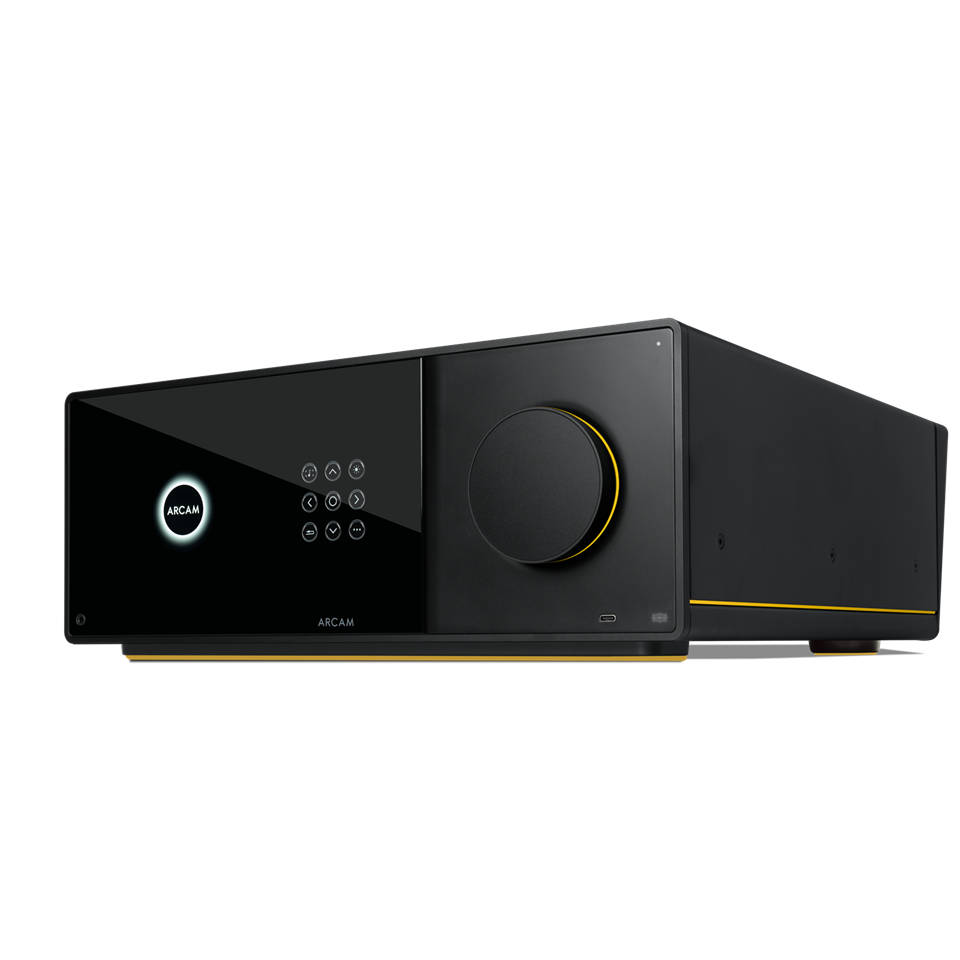
The ARCAM AVA25 is a 2026 Radia AV amplifier for buyers building a serious combined movie and music system. It sits above the AVA15, using nine Class AB power channels alongside sixteen-channel processing and a broad format set. That gives it substantial scope, but also makes careful planning essential. Its price buys an expandable control centre, not an unlimited number of internal amplifiers or every advanced room-correction licence automatically included.
A substantial amplifier for a substantial system
The AVA25 weighs about 21.5 kg and is nearly forty-six centimetres deep before allowing additional room for connected cables. That is a practical installation requirement, not merely a sign of premium construction. Check shelf loading, ventilation and access to the rear panel before choosing where it will live.
The large colour display and simplified front layout are useful for music sessions when the television is off. Consider brightness from the main listening position and how easily another household member can select a familiar source. A sophisticated AV component should make ordinary listening easier once configured, rather than requiring its owner to explain a complex sequence every time someone wants a playlist.
Nine power channels versus sixteen processed channels
A 5.2.4 installation uses five passive speakers at ear level and four height speakers, matching the nine internal power channels. The two active subwoofers provide their own amplification. Moving to seven ear-level speakers and four heights changes the requirement: eleven passive channels need power, so an external amplifier becomes part of the plan.
The sixteen-channel processing capacity provides expansion flexibility, but channel assignment and subwoofer allocation still have to fit the documented configuration. Draw the intended final layout and mark which outputs feed active subs or external power amplifiers. This simple exercise makes the real cost clearer than assuming the processor’s largest channel number is also the number of speakers it can drive directly.
Sound quality and original audition evidence
HEIMKINOWELTEN’s original audition uses the AVA25 in a 5.2.4 Monitor Audio Silver 8G system and reports strong spatial organisation, intelligible dialogue and convincing stereo reproduction. It is a retailer’s documented system audition rather than an Audio Review test or an independent amplifier bench measurement, so the speakers, room and correction remain part of the result.
That evidence supports a positive assessment of the complete-system potential, without proving that the amplifier alone creates every reported quality. For your own demonstration, ask for similar speaker demands and a known calibration state. Include quieter musical passages as well as action scenes. A premium amplifier should be judged by consistency, intelligibility and control at realistic levels, not just its ability to make an impressive loud burst.
Power figures without the shortcuts
The current v1.2 sheet specifies 120 watts per channel into eight ohms over 20 Hz–20 kHz with two channels driven at 0.5% THD. With nine channels driven at 1 kHz, the eight-ohm figure is 75 watts per channel. These are manufacturer ratings under different conditions, not our laboratory measurements.
The distinction explains why a stereo headline cannot be applied to every internal amplifier simultaneously. It also prevents a misleading comparison with an older specification using another distortion limit or bandwidth. Assess the speakers’ sensitivity, impedance behaviour, distance and bass crossover plan together. An active subwoofer can reduce low-frequency demand on the main channels, but it does not remove the need to choose speakers and listening levels sensibly.
Dirac Room Correction, Bass Control and ART
Room Correction is the included starting point, while Bass Control and Active Room Treatment are additional capabilities requiring licence planning. Dirac’s platform announcement confirms the Radia family’s ART direction, but a supported function should not be treated as a free entitlement in every purchase package. Confirm the current offer, compatible software and any prerequisite licence with the seller.
Begin with a stable physical setup and careful measurements of the actual seating area. With multiple subwoofers, integration matters more than simply making both produce sound. Save a useful reference filter and compare changes at matched level. The objective is coherent bass and clear transitions, not an attractive graph obtained by forcing every measured dip upwards. Good calibration complements placement rather than replacing every acoustic decision.
HDMI and immersive formats
Seven HDMI inputs and three outputs provide considerable flexibility, with two outputs assigned to the main zone and another to Zone 2. They are not three independent main-room processors. Check the intended TV, projector and second-zone arrangement against the actual routing options before buying long cable runs or extra displays.
The format set includes Dolby Atmos, DTS:X, AURO-3D and IMAX Enhanced, while the HDMI platform supports 4K/120, 8K/60, VRR and ALLM. Test the required combination with the actual sources and displays. The presence of every logo does not establish that each source outputs the desired track or that a television passes it correctly over eARC. The received-format screen is more useful than guessing from a service’s catalogue badge.
Streaming, analogue sources and external amplification
The network platform brings familiar service-based playback into the amplifier, reducing the need for a separate streamer in many installations. Set up the service used most often and test a complete daily routine, including returning from music to a film source. Use the connection that suits the system rather than assuming every wireless route delivers the same format or convenience.
Analogue inputs are line-level, so a turntable needs a suitable phono stage if it does not already include one. The main pre-outs are RCA rather than balanced XLR. That is usually straightforward for short rack connections, but buyers planning long analogue runs or a balanced separates system should account for it. Extra processing capacity does not remove the physical connection requirements of the chosen power amplifiers.
ARCAM AVA25 vs AVR21
The Arcam AVR21 already offers sixteen-channel decoding and seven internal Class AB amplifiers. The AVA25’s move to nine internal channels is therefore a concrete installation change, while the modern interface and new platform features are separate reasons to consider it. It would be misleading to present sixteen-channel processing itself as entirely new.
An existing owner should calculate whether keeping the AVR21 and its current external amplification already meets the goal. A new purchase can simplify a system or enable a required feature, but it also brings setup work and cost. Compare the exact missing functions and the final speaker layout before deciding to replace a functioning calibrated installation simply because a new range has arrived.
AVA25, AVA15 and other alternatives
The AVA15 is lighter and less expensive, with Class D amplification and a smaller processing and format provision. The AVA25 premium is more coherent when the additional formats, processing scope and system role will actually be used. Amplifier class should not be turned into an unsupported claim that one model has an inherently warmer or more musical signature.
The Marantz CINEMA 50 is another nine-amplifier direction to assess, with calibration, streaming and the intended external amplification included in the comparison. Price the completed system rather than only the chassis. Dealer commissioning, optional licences, rack space and cable requirements can change the value judgement more than a small difference in advertised power.
ARCAM AVA25 key specifications
- Model year
- 2026 Radia AV series
- Internal amplification
- 9 channels, Class AB
- Maximum processed channel count
- 16
- Stereo power, manufacturer
- 120 W/ch, 8 ohms, 20 Hz–20 kHz, 2 driven, 0.5% THD
- Nine-channel power, manufacturer
- 75 W/ch, 8 ohms, 1 kHz, 9 driven, 0.5% THD
- HDMI
- 7 inputs / 3 outputs; two main-zone, one Zone 2
- Video
- Up to 8K/60 or 4K/120; VRR and ALLM
- Immersive formats
- Dolby Atmos, DTS:X, AURO-3D and IMAX Enhanced
- Pre-outs
- 16 RCA; no XLR
- Weight
- Approximately 21.5 kg
- Width / depth / height
- 432 / 459.1 / 170 mm, per current v1.2 sheet
Verdict
The AVA25 is a persuasive centre for a carefully specified cinema-and-stereo installation. Its original audition evidence, modern operation and expansion options support a strong recommendation for the right system. The high cost, physical demands and licence structure prevent it being a casual default. Buy with a defined speaker layout, current documentation and a complete commissioning budget, while comparing the AVR21 you may already own and alternatives offering a different route to the same listening goals.
Primary documentation and independent reviews
ARCAM current AVA25 product page · ARCAM final AVA25 v1.2 specification sheet · HEIMKINOWELTEN original AVA25 system audition · Dirac official Radia platform announcement · ARCAM official AVR21 comparison specifications
Editorial record
Sources and updates
Product specifications and factual claims were checked against Official ARCAM AVA25 product page ↗. Scores and buying advice follow our category-specific editorial methodology.
- Published
- November 8, 2026
- Last updated
- November 8, 2026
Highly ranked reviews in this category
Selected by category rank and editorial score within av receivers. Check each product's design and intended use before adding it to your shortlist.