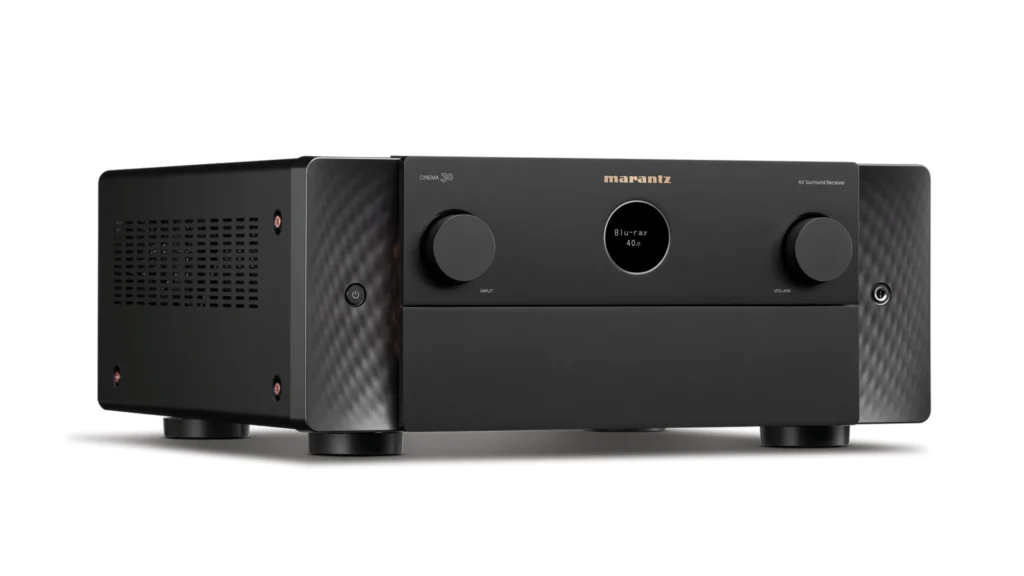
The Marantz CINEMA 30 aims to make a premium home cinema amplifier feel as considered as a high-end stereo component. It combines eleven powered channels with distinctive styling, substantial internal construction and an extensive connection set. Its attraction lies in that complete package, while its price requires a careful comparison against less expensive amplifiers with similar core channel capabilities.
Marantz CINEMA 30 — Construction and everyday design
The official European information highlights a toroidal power supply, monolithic symmetrical amplification and HDAM SA-2 circuitry. These are meaningful descriptions of the engineering approach, but a component list should not be substituted for a listening assessment. The important question is what the complete amplifier contributes to the intended system.
The porthole display and illuminated front-panel details give the CINEMA 30 a visual identity distinct from conventional receiver styling. What Hi-Fi?’s original review also praises the backlit remote and straightforward setup interface. Those details can make a complex system more pleasant to operate, particularly in a dark cinema.
Consider how information will be read from the main seat. A display that looks elegant at arm’s length may be less useful across a room, while on-screen feedback depends on the connected display and selected mode. The remote and normal household routine deserve attention during an audition.
The premium finish also has to live in a suitable cabinet or rack. Check depth with cables attached, ventilation and support rather than focusing only on how the front panel looks in the furniture. A sophisticated amplifier still needs a practical installation.
Channel capacity and system planning
The CINEMA 30 has eleven internal power-amplifier channels and can process up to 13.4 channels. It can therefore power a seven-speaker bed with four heights directly. A thirteen-speaker arrangement requires suitable external power amplification and the correct channel assignment; thirteen processing channels do not mean thirteen internal power stages.
Four independent subwoofer outputs allow flexible bass arrangements. These are line-level feeds, so suitable powered subwoofers or external amplification remain necessary. Their value lies in placement and integration options, especially across multiple seats, rather than a requirement to use every output.
The official EU power specification is 140 watts per channel into eight ohms across the audio band with two channels driven. It is not an all-channels-driven measurement. A sensible evaluation includes speaker sensitivity, listening distance and crossover settings alongside the rating.
The upgrade path is useful when the room genuinely has space for additional positions. Six height speakers or a wider bed layer should create meaningful spatial information rather than overcrowd a small room. Begin with the layout and work back to the required hardware, leaving funds for speakers and acoustic work.
Sound quality and calibration
What Hi-Fi?’s original review reports a controlled, enveloping presentation with powerful effects and a natural approach to voices. Its account also values the handling of quiet tension, not only explosive passages. That is encouraging evidence for a premium cinema system without claiming an Audio Review listening comparison.
For a buyer, the useful audition includes dialogue, subtle ambience and sudden action at the same sensible master level. A capable amplifier should preserve the relationship between them rather than simply making the loudest scene impressive. Speaker matching and room behaviour remain part of that result.
Audyssey MultEQ XT32 is included. Use a quiet room and a careful microphone pattern, then inspect the resulting distances, levels and crossovers. Even a successful automatic process should be followed by listening to familiar material, because target preferences and practical speaker limits can require attention.
Dynamic EQ and other processing choices can influence low-level listening. Compare them deliberately rather than assuming more enabled processing produces a more accurate result. If night-time listening is common, evaluate that routine separately from a demonstration at cinema-like volume.
For music, ordinary stereo and upmixed playback deserve their own comparison. The CINEMA 30’s many speakers create options, but an album does not need to be expanded into every channel to justify the purchase. Choose the presentation that serves the recording and remains enjoyable over a full session.
HDMI, streaming and optional Dirac
Marantz documents seven HDMI inputs and three outputs, with eARC, 4K/120 Hz and 8K/60 Hz support through suitable equipment. This is useful for a system with several consoles, a disc player and more than one display. Format compatibility still depends on the entire chain rather than the amplifier alone.
Test the required gaming resolution, refresh rate and HDR mode together. A working lower-bandwidth picture does not establish that the most demanding combination is available. Cable capability, source output and the television’s input settings all need to match.
HEOS and AirPlay 2 provide music routes without another dedicated streamer. A moving-magnet phono input also supports an appropriate turntable. Service availability and certifications can change with firmware, so confirm current support for any particular platform that is central to the purchase.
Dirac’s official ART announcement includes CINEMA 30. Its advanced facilities are optional licensed additions, so the intended correction package and suitable measurement equipment belong in the budget. Start with correct placement and the included tools rather than treating every software upgrade as compulsory.
The EU and UK model should also be distinguished from tuner-equipped versions in other regions. Exact mains, warranty and regional facilities matter more than a matching family name on an imported listing.
Value and the right system
The CINEMA 30 makes sense for someone building a premium eleven-channel system who values its design, controls and published sound performance together. It is less easy to justify if the system will stop at five speakers and most of the budget has already gone into the amplifier.
Compare it with the Denon X6800H class of hardware and the lower CINEMA models at actual European prices. Similar channel counts do not make complete products identical, but shared basic facilities mean that the premium should be tied to qualities the owner genuinely values.
A proper audition is useful for both music and cinema. Keep playback levels comparable, use the same speakers where possible and account for calibration differences. A warmer target or louder demonstration can otherwise be mistaken for an intrinsic advantage of the amplifier.
Long-term ownership includes the service route and access to firmware support. Buy through a reliable retailer, confirm the intended regional version and leave room in the installation for maintenance. Complex networked equipment is more satisfying when ordinary operation and support are straightforward.
The strongest purchase is a balanced system in which the CINEMA 30’s capabilities are used daily. Its premium is more defensible when it simplifies an ambitious layout and suits the listening preference than when it is bought as a substitute for careful speaker placement or room treatment.
Alternatives to consider
Marantz CINEMA 50: Compare the lower-tier channel arrangement and complete installed cost if eleven internal amplifiers are unnecessary.
Denon AVC-X3800H: A useful reality check on whether the planned room can be served by a substantially smaller hardware budget.
Anthem MRX 740 8K: An alternative calibration philosophy to compare, including the external amplification required for the desired layout.
Marantz CINEMA 30 key specifications
- Powered speaker channels
- 11
- Processing
- Up to 13.4 channels
- Rated output
- 140 W/ch, 8 ohms, 20 Hz–20 kHz, 0.05% THD, two channels
- Subwoofer outputs
- 4 independent line-level outputs
- HDMI
- 7 inputs / 3 outputs; eARC
- Video
- 4K/120 Hz and 8K/60 Hz with compatible equipment
- Calibration
- Audyssey MultEQ XT32; optional licensed Dirac facilities
- Construction
- Toroidal supply and HDAM SA-2; manufacturer specification
- Region
- EU amplifier version
Verdict
The CINEMA 30 is a persuasive premium eleven-channel amplifier with strong published evidence for control, immersion and dialogue quality. Its construction and operation add to the appeal, but the price should fit a balanced room and speaker budget. Include optional software costs and choose it for the complete experience rather than channel count alone.
Primary documentation and independent reviews
Marantz CINEMA 30 official European information sheet · Marantz official EU audio specification · What Hi-Fi? original CINEMA 30 review · Dirac official ART compatibility announcement
Editorial record
Sources and updates
Product specifications and factual claims were checked against Official Marantz CINEMA 30 product page ↗. Scores and buying advice follow our category-specific editorial methodology.
- Published
- November 7, 2026
- Last updated
- November 8, 2026