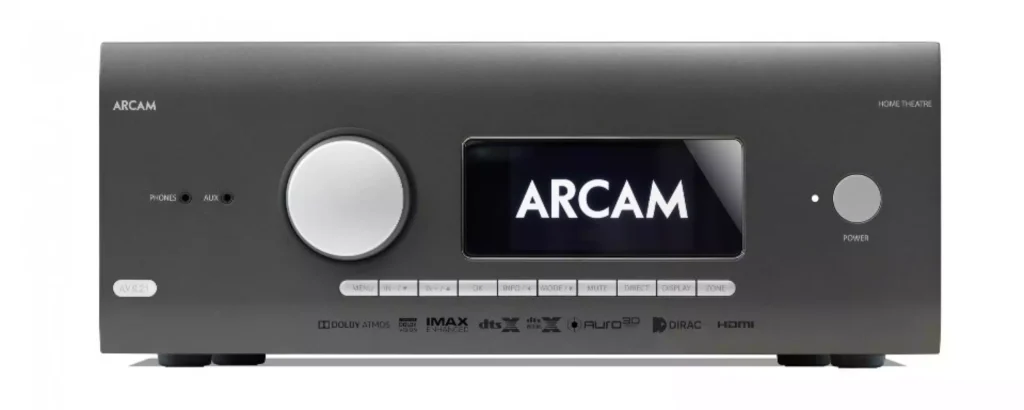
The Arcam AVR21 combines seven Class AB amplifier channels with a much larger immersive-audio processing platform. It is therefore both a usable receiver for a modest speaker system and a potential control centre for a larger cinema using external amplification. Included Dirac Live and comprehensive HDMI connectivity are central strengths, while the gap between decoded channels and powered speakers must be included in the budget.
Arcam AVR21 — Design and build
The AVR21’s restrained front panel is a good fit for a permanent installation where detailed setup happens less often than everyday source selection. It is a substantial component, and the cabinet needs room for cables as well as the chassis. Allow access to the rear panel and keep ventilation clear. An amplifier that is hard to reach can turn a minor wiring change into a disproportionate inconvenience.
The installation should be understandable after the initial configuration is finished. Name inputs clearly and record the speaker assignments, especially when external amplifiers are involved. A front-panel display and network controls are useful, but the owner should still know which source and listening mode are active. A complex system is successful when it removes friction from ordinary listening rather than requiring an installer for every small adjustment.
Seven amplifiers versus sixteen decoded channels
The seven internal power channels can support a conventional seven-channel floor layout or a five-channel bed with two heights. Larger immersive arrangements require external amplification. Arcam’s sixteen-channel decoding specification describes processing resources; it does not mean sixteen speakers can be powered by the receiver itself. That distinction is especially important when comparing its price with a receiver containing nine or eleven internal amplifiers.
The processing can support an ambitious 9.1.6 arrangement with suitable external amplification and configuration. Alternative output assignments can allocate resources to additional subwoofers, so the maximum main-speaker and subwoofer counts should not simply be added together from separate marketing examples. Use the manual to map the exact intended arrangement. A diagram of every speaker, subwoofer and amplifier is a more reliable buying tool than a headline channel number.
External amplification also introduces practical questions about gain, triggers and cabling. Decide whether the additional amplifier will power the main front speakers or the channels beyond the receiver’s internal complement. Check the available assignments rather than assuming every combination is possible. The AVR21 is attractive when this flexible architecture matches an existing separates system; it is a less simple route to an eleven-speaker installation built entirely from new equipment.
Dirac Live and the calibration workflow
Dirac Live Room Correction is included, while Bass Control is an optional paid addition. The basic correction is already a major part of the receiver’s appeal, particularly in a room where the speakers are good but the measured response is uneven. Bass Control addresses additional subwoofer integration needs and should be treated as a separate budget item. Check the exact supported licence and current firmware before purchasing software for a specific layout.
AVForums’ original AVR21 review reported a cohesive, natural and immersive presentation, crediting Dirac with a substantial contribution to the result. It also criticised the basic web interface and supplied microphone. Those are findings from that reviewer’s system, not Audio Review listening observations. They support the value of careful calibration while reminding buyers that having the software included does not make the entire setup process equally polished.
Use the appropriate microphone calibration information, a stable stand and a quiet measurement period. Save the measurement project before experimenting with targets, and compare changes at matched level. A wide sofa and a single listening chair may call for different measurement priorities. The useful result is a system that behaves well around the intended seats, not a response graph optimised for a location nobody occupies. If something measures unexpectedly, check wiring and speaker configuration before accepting the filter as a cure.
Amplifier power and sound suitability
Arcam’s specification sheet gives 110 watts per channel into eight ohms across 20 Hz to 20 kHz at less than 0.02 percent distortion with two channels driven. It separately gives 90 watts with all seven channels driven at 1 kHz and 0.2 percent distortion. These figures describe different conditions and should not be mixed. The commonly quoted 125-watt figure also uses a different frequency and distortion condition from the full-bandwidth rating.
That is enough information to make a sensible comparison, but not to promise a particular volume in every room. Sensitive speakers at a moderate distance place different demands on the receiver from low-sensitivity speakers several metres away. An active subwoofer and suitable crossovers can help the overall system, while the pre-outs allow a more demanding front pair to use an appropriate power amplifier. Choose additional power to solve an identified requirement rather than assuming it is necessary merely because pre-outs exist.
The positive independent sound assessment makes the AVR21 a credible audition candidate for both films and music. A useful audition includes quiet dialogue, a demanding action passage and familiar stereo material at realistic level. Check whether the preferred music mode retains the intended bass management and correction. Different modes can sound different because their processing and levels differ, so a quick comparison should not be mistaken for a controlled judgement of amplifier topology.
HDMI, streaming and older sources
Seven HDMI inputs and three outputs, including a zone path, provide broad source and display flexibility. Arcam specifies 4K/120 and 8K/60 input support, with current HDR formats and eARC. The complete chain still has to support the chosen signal. Test the actual console or PC, television and cable run, including refresh rate and audio format, before the installation is hidden in furniture or walls.
When two displays are connected, verify the intended output arrangement rather than assuming both will operate at the best capability of the newer screen. Television audio return should also be checked with the actual internal applications. A source connected directly to the TV can simplify a particular video requirement, but only if the television passes the sound format needed by the receiver. Ordinary switching and standby recovery deserve testing alongside the most demanding headline video mode.
Arcam lists Roon Ready operation, AirPlay 2, Chromecast and other network routes. Those options can cover much everyday music without a separate streamer, depending on the household’s service and library preferences. Wired Ethernet is attractive in a fixed system. Older analogue sources can also be useful, but a turntable needs the appropriate phono stage; a normal line input cannot directly replace cartridge gain and equalisation.
Value and complete system cost
The AVR21 is most persuasive when its included correction and large processing platform have a clear purpose. An owner retaining external amplifiers may value it differently from someone starting with a television and five speakers. Its seven internal channels can be enough initially, but a realistic expansion budget must include every additional amplifier, connection and installation requirement. Processing headroom alone does not create a finished cinema.
Compare the current European price and support with both simpler receivers and a processor-plus-amplifier system. Discounts can change the calculation, but do not remove the architecture’s trade-offs. If the final system is modest, prioritise good speakers and room integration over unused decoding capacity. If the cinema will be large, the AVR21’s flexibility becomes more meaningful, provided the owner is comfortable with the setup effort and external-power plan.
Alternatives to consider
Arcam AVR11: Compare if a smaller processing platform and lower total cost already meet the room’s needs.
Anthem MRX 740 8K: A useful alternative calibration and configuration approach for a system using external amplification.
Arcam AVR21 key specifications
- Internal amplification
- 7 channels, Class AB
- Decoding
- 16 channels; up to 9.1.6 with suitable external amplification and assignments
- Power, 2 channels
- 110 W/ch into 8 ohms, 20 Hz–20 kHz, <0.02% THD
- Power, 7 channels
- 90 W/ch into 8 ohms, 1 kHz, 0.2% THD
- HDMI
- 7 inputs / 3 outputs including Zone 2
- Dirac
- Room Correction included; Bass Control optional
- Network
- Roon Ready, AirPlay 2, Chromecast
Verdict
The Arcam AVR21 is a strong choice for a planned cinema that benefits from included Dirac Live, current HDMI and extensive processing capacity. Its seven internal amplifiers make external-power budgeting essential for larger layouts. Choose it for a coherent system plan, with time allowed for calibration and configuration.
Primary documentation and independent reviews
Arcam official AVR21 product information · Arcam AVR21 official specification sheet · AVForums original AVR21 review
Editorial record
Sources and updates
Product specifications and factual claims were checked against Official Arcam AVR21 product page ↗. Scores and buying advice follow our category-specific editorial methodology.
- Published
- November 7, 2026
- Last updated
- November 8, 2026