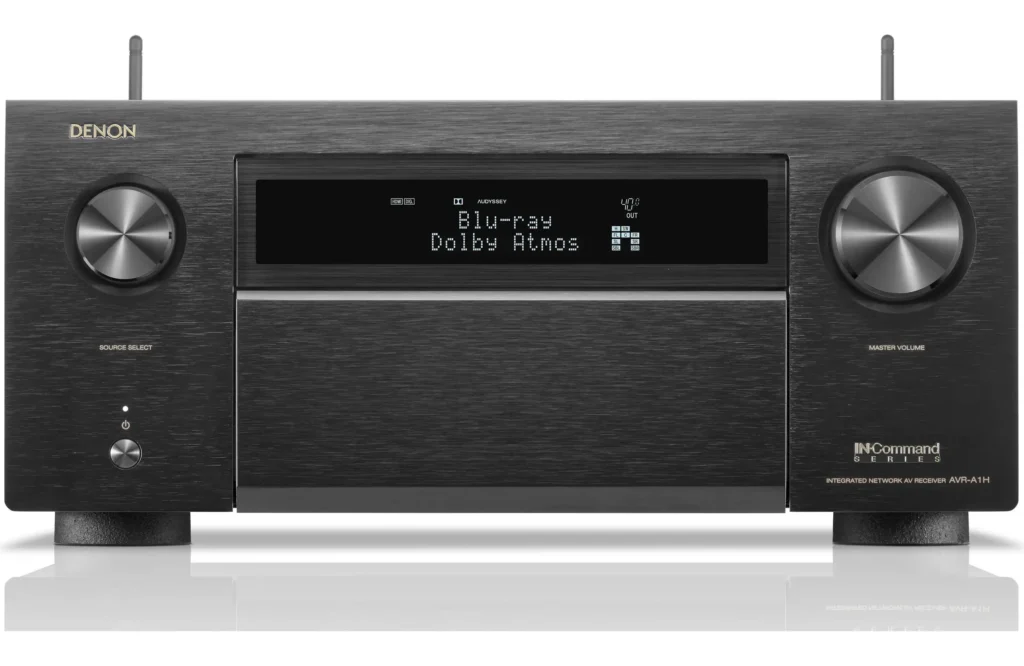
The Denon AVC-A1H is a home cinema amplifier for a genuinely large system. Fifteen internal power channels place it far beyond the needs of a typical living-room surround setup, while its weight and cost make it a serious installation decision. Its attraction is the ability to coordinate an ambitious speaker layout through one main component, backed by unusually strong independent assessments of cinematic performance.
Denon AVC-A1H — What fifteen channels are for
Denon documents support for layouts up to nine bed-layer speakers, four subwoofers and six height speakers. The fifteen internal amplifiers power the bed and height speakers; the subwoofer connections are line-level feeds for suitable powered subwoofers or separate amplification. Counting the decimal notation as nineteen powered speaker channels would be incorrect.
That capacity is relevant to a room with enough space for meaningful separation around and above the seats. Six height speakers are not automatically a better result if they are crowded together or placed in unsuitable positions. Start with a scaled layout and the required seating coverage before choosing the amplifier.
The European specification gives 150 watts per channel into eight ohms across the audio band under stated two-channel conditions. This is not a measurement of all fifteen channels delivering that output continuously. The speakers’ efficiency, distance and bass-management arrangement determine the practical requirement.
A single main chassis can make a complex system easier to manage than a processor and several separate amplifiers. It also concentrates much of the installation in one place. Consider access, ventilation and future servicing alongside the convenience of having the available channels built in.
Sound quality and dialogue
What Hi-Fi?’s original A1H review is exceptionally positive about its dynamic control, scale and natural dialogue presentation, while identifying bulk and price as the main drawbacks. That is strong independent evidence in favour of a premium cinema application, rather than a claim that Audio Review has repeated the listening test.
For a buyer, a flagship audition should examine control as well as loudness. Quiet speech followed by a major action sequence can reveal whether the system remains coherent without encouraging constant volume changes. Impressive impact is more useful when the centre and surround channels stay integrated with it.
The centre speaker and room remain fundamental. A poorly positioned centre or strongly reflective seating area can compromise dialogue even with an expensive amplifier. Correct the physical arrangement before assuming a higher trim level or another processing mode will solve every intelligibility problem.
Music should be evaluated in the form it will actually be played. Ordinary stereo, multichannel recordings and upmixed albums are distinct experiences. The A1H’s channel count provides options, but it does not mean every two-channel recording should be distributed across the entire room. Compare modes deliberately and keep the original presentation available as a reference.
Calibration and bass integration
Audyssey MultEQ XT32 is included, with optional Dirac upgrades available. Dirac’s official ART announcement explicitly names the European AVC-A1H. The existence of an upgrade path should not be confused with inclusion of every licence and accessory in the amplifier’s price. Confirm the current firmware, supported package and measurement requirements.
A large system increases the value of careful setup because there are more channels and more opportunities for a level or placement error. Label cables, verify each speaker with a test signal and inspect the configuration before running calibration. An automated measurement cannot correct a speaker connected to the wrong terminal.
Four subwoofer feeds provide useful flexibility, but the benefit depends on positioning and integration. More subwoofers can improve coverage across several seats, while badly chosen placements can reinforce the same problems. Measure the result rather than judging success from the number of outputs in use.
Advanced correction can refine the relationship between speakers and room, but it should complement sensible placement and acoustic treatment. It cannot make every seat identical or remove every reflection. The A1H is capable enough that professional installation or measurement assistance may be a more productive part of the budget than another cosmetic accessory.
Connections and everyday operation
Seven HDMI inputs and three outputs make the A1H a flexible hub for multiple modern sources. Denon documents 4K/120 Hz and 8K/60 Hz support, eARC and relevant gaming functions through a compatible system. The actual result still depends on the source format, display capabilities, cable and settings.
For a television and projector arrangement, confirm output behaviour and the formats supported by each display. Multiple sockets do not imply that every resolution and refresh combination is independent. Plan the connections before installation, especially when cables will be concealed or difficult to replace.
Television-app sound returned over eARC has different limitations from a disc player connected directly to the amplifier. The TV’s pass-through and app support remain part of compatibility. Atmos decoding in the A1H does not establish that every streaming programme arrives in the same audio format.
HEOS and AirPlay 2 provide convenient music playback, while analogue and digital inputs support a broader system. A moving-magnet phono input is useful for an appropriate turntable. Choose the European AVC version for the intended mains and warranty arrangements, and do not assume that regional AVR naming guarantees an identical tuner package.
Installation, cost and the alternatives
The A1H weighs approximately 32 kg according to Denon’s European information. Its shelf must support that load, with sufficient depth for the chassis and connected leads. Plan safe access and practical assistance for positioning rather than treating it as a routine lightweight source component.
Ventilation is equally important. A large multichannel amplifier needs an installation that can dissipate heat, so a sealed furniture compartment is a poor match. Check the manufacturer’s clearance guidance and allow access to the rear panel. A tidy front view is not enough to establish a suitable location.
Its financial case is strongest against a complete alternative system, not against the price of a small receiver alone. A separate processor and enough amplification for fifteen speakers can add cost, complexity and cabling. Conversely, a buyer who already owns good power amplifiers may find separates more flexible.
The step-down options deserve serious consideration if the room only needs eleven or thirteen speakers. Spending less on the main component can release funds for better speakers, subwoofer placement or room treatment. Those may produce a greater practical improvement than unused channel capacity.
For a large dedicated cinema with a clear layout and a balanced total budget, the A1H is a compelling all-in-one centrepiece. For a modest lounge, it is difficult to justify simply as a guarantee of the best sound. The flagship earns its place when the system can use what it provides.
Alternatives to consider
Anthem MRX 740 8K: A smaller-channel alternative to compare when calibration and existing external amplification matter more than fifteen internal power stages.
Marantz CINEMA 50: A much less ambitious system starting point if the room cannot meaningfully accommodate the A1H’s maximum speaker layout.
Denon AVC-X3800H: Useful for checking whether the actual speaker and source requirements can be met with a far smaller hardware commitment.
Denon AVC-A1H key specifications
- Powered speaker channels
- 15
- Supported layout
- Up to 9.4.6 with suitable speakers and powered subwoofers
- Subwoofer outputs
- 4 independent line-level outputs
- Rated output
- 150 W/ch, 8 ohms, 20 Hz–20 kHz, 0.05% THD, two channels
- HDMI
- 7 inputs / 3 outputs; eARC
- Video
- 4K/120 Hz and 8K/60 Hz with compatible equipment
- Calibration
- Audyssey MultEQ XT32; optional licensed Dirac facilities
- Weight
- Approximately 32 kg
- Region
- EU AVC version
Verdict
The AVC-A1H is a persuasive flagship for a large dedicated cinema, with fifteen internal channels and outstanding published sound assessments. Its price, weight and installation requirements are substantial. Choose it for a planned system that benefits from its capacity, with calibration and room work funded alongside the amplifier rather than sacrificed to buy it.
Primary documentation and independent reviews
Denon AVC-A1H official European information sheet · Denon official A1H product information · Dirac official ART compatibility announcement · What Hi-Fi? original A1H review
Editorial record
Sources and updates
Product specifications and factual claims were checked against Official Denon AVC-A1H product page ↗. Scores and buying advice follow our category-specific editorial methodology.
- Published
- November 7, 2026
- Last updated
- November 8, 2026