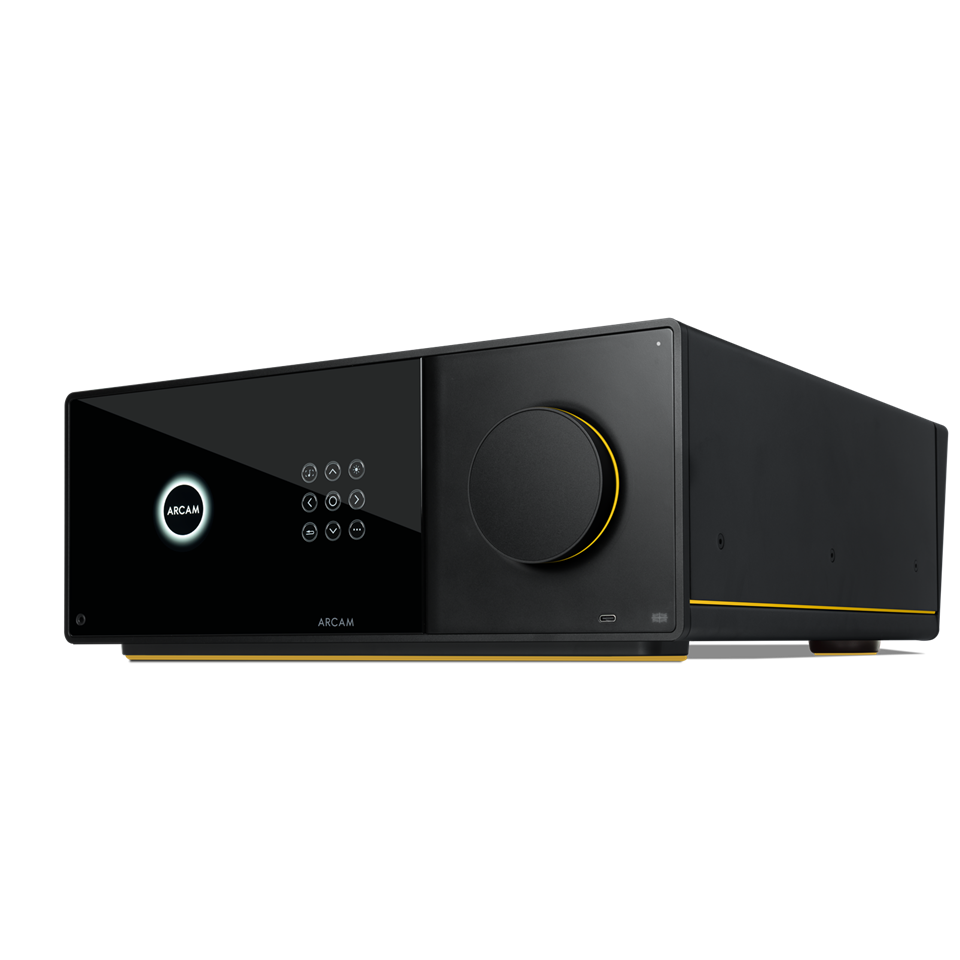
The ARCAM AVA15 is the entry point to the 2026 Radia AV amplifier family, but entry point should not be mistaken for a basic television accessory. It combines nine internal amplifier channels, surround processing, streaming and Dirac correction in one chassis. Its appeal is a carefully planned speaker system with a more modern interface than the preceding AVR generation. Final specifications matter here, because some early launch descriptions differ materially from the current documentation.
Nine amplifiers, twelve processed channels
The difference between amplification and processing is central to planning. Nine built-in power channels can serve a layout such as five speakers at ear level and four height speakers, with an active subwoofer handling its own amplification. The larger processed-channel figure does not mean the chassis contains twelve power amplifiers.
Write the intended layout down before buying. Count passive speakers separately from active subwoofers and identify any channels requiring an external amplifier. Also check the supported assignments rather than assuming every spare socket can take any role simultaneously. This makes the AVA15’s capability concrete and prevents discovering after installation that an ambitious speaker diagram requires more hardware, shelf space and cabling than originally budgeted.
Power ratings: use the final sheet
ARCAM’s current v1.2 sheet specifies 85 watts per channel into eight ohms across 20 Hz–20 kHz with two channels driven at 0.5% THD. Its nine-channel figure is 65 watts per channel into eight ohms at 1 kHz under the stated distortion condition. Those are manufacturer specifications, not Audio Review measurements.
They should not be collapsed into an unqualified nine-times-one-hundred-watts claim from preliminary material. Different numbers of driven channels and different test bandwidths describe different demands. For a buying decision, consider speaker sensitivity, listening distance and bass management alongside the rating. A lower number is not automatically inadequate, but it should be compared with equally specified competitor data rather than the largest watt figure in an advertisement.
Sound assessment and available evidence
Model-specific independent listening coverage is still narrower than for established alternatives. GROBI’s original first look is useful for understanding the new platform and setup approach, but it is not a substitute for a controlled amplifier bench test. Our assessment therefore avoids attributing a particular tonal character to the AVA15 simply because it uses Class D amplification.
The most useful audition is with speakers similar to those you intend to drive. Include a quiet vocal passage, a dense music recording and a demanding film section at a realistic level. Listen for intelligibility and composure rather than a deliberately spectacular demonstration. The result belongs to the amplifier, speakers, placement and room together; documentation alone cannot isolate how each will behave in your installation.
Dirac correction and optional upgrades
Dirac Live Room Correction is part of the core proposition. The Radia platform also lists support for Bass Control and Active Room Treatment, but support should not be interpreted as every advanced licence being included in the box. Confirm the licence package and current software requirements before making a purchasing decision around a particular correction workflow.
Start with sensible speaker and subwoofer placement. Measure the intended listening area carefully, keeping the microphone away from surfaces that would distort the measurement. A tidy target curve on a screen is not the only goal: compare ordinary speech, bass integration and transitions between channels afterwards. Correcting an avoidable placement error electronically is a weaker starting point than fixing the physical arrangement first.
HDMI, consoles and two displays
Seven HDMI inputs and two outputs provide useful source flexibility. The documented platform supports up to 8K/60 and 4K/120, with VRR and ALLM, but the source, display and cable path still determine which combination actually works. Test the console’s desired picture mode and audio format together rather than checking only that a menu appears on screen.
For television apps, eARC offers a return route from a suitably equipped TV. Check the received format and lip synchronisation using the intended service. A streaming interface displaying an Atmos logo does not establish that the selected track reaches the amplifier unchanged. If using both a TV and projector, confirm the output arrangement and source switching in the actual installation instead of assuming every display combination behaves identically.
Streaming and the new control interface
The large colour display, Bluetooth remote and Radia AV Control app are practical changes for a component that may serve music as often as films. The display can make source status easier to inspect, and a wireless remote reduces dependence on a direct infrared sightline. Check the controls from the main seat rather than only while standing beside the rack.
Network music support also reduces the automatic need for a separate streamer. Choose a service route that suits the household and check it through a complete session: start playback, pause, change volume and return to TV audio. A long compatibility list matters less than reliable use of the two or three functions that will be used every day.
Formats and the limits of the entry model
The final specification lists Dolby Atmos and DTS:X, while explicitly excluding AURO-3D and IMAX Enhanced. Those omissions matter to buyers whose libraries or preferred upmixing modes depend on them. Do not copy the format list from the more expensive AVA25 or from an early range-wide announcement onto the AVA15.
For most owners, the useful question is which formats their actual sources deliver. Review a few favourite discs, streaming services and games before paying for capabilities that may never be used. Conversely, if a required format is missing, no amount of attractive interface design makes that requirement disappear. This is one area where the newer entry model should be checked carefully against older ARCAM equipment rather than assumed to be superior in every respect.
ARCAM AVA15 vs AVR11
The Arcam AVR11 has seven internal Class AB amplifiers, while the AVA15 moves to nine Class D channels. For a planned four-height-speaker installation, the extra internal amplification can reduce the need for a separate power amplifier. The amplifier class itself is not evidence that one must sound warmer, cleaner or more musical.
The AVR11’s documented format support also differs, so this is not a simple replacement with every old function retained. Existing owners should list what is missing from their current installation: extra amplification, easier control, a particular platform feature or something else. If the present system already meets those needs, a new model name alone is a weak reason to replace it.
Installation, alternatives and value
At around ten kilograms, the AVA15 is manageable by AV-amplifier standards, but it still needs ventilation and cable clearance. Leave room behind the nominal chassis depth for connectors and avoid placing other warm components directly over its vents. Plan servicing access before the equipment becomes surrounded by furniture.
The Denon AVC-X4800H is a useful alternative to compare as a complete ownership package. Include calibration licences, external amplification, dealer setup and the controls you prefer. The ARCAM is most attractive when its nine-channel arrangement and modern platform fit a defined system. It is less compelling when bought speculatively without knowing the speaker layout or total upgrade cost.
ARCAM AVA15 key specifications
- Model year
- 2026 Radia AV series
- Internal amplification
- 9 channels, Class D
- Maximum processed channel count
- 12
- Stereo power, manufacturer
- 85 W/ch, 8 ohms, 20 Hz–20 kHz, 2 driven, 0.5% THD
- Nine-channel power, manufacturer
- 65 W/ch, 8 ohms, 1 kHz, 9 driven, 0.5% THD
- HDMI
- 7 inputs / 2 outputs; HDMI 2.1a
- Video
- Up to 8K/60 or 4K/120; VRR and ALLM
- Main immersive formats
- Dolby Atmos and DTS:X
- AURO-3D / IMAX Enhanced
- Not supported in current v1.2 specification
- Pre-outs
- 12 RCA; no XLR
- Weight
- Approximately 10 kg
Verdict
The AVA15 brings useful internal amplification and modern operation to ARCAM’s new AV platform. It deserves a shortlist position for a planned 5.1.4 system, but the final power figures, entry-model format exclusions and optional Dirac costs require careful reading. Audition it with suitable speakers and compare the whole installation with established alternatives. Its strongest case is a specific system plan, rather than an expectation that a new generation automatically improves every aspect of ownership.
Primary documentation and independent reviews
ARCAM current AVA15 product page · ARCAM final AVA15 v1.2 specification sheet · Dirac official Radia platform announcement · GROBI original Radia range demonstration and first look · ARCAM official AVR11 comparison specifications
Editorial record
Sources and updates
Product specifications and factual claims were checked against Official ARCAM AVA15 product page ↗. Scores and buying advice follow our category-specific editorial methodology.
- Published
- November 8, 2026
- Last updated
- November 8, 2026
Highly ranked reviews in this category
Selected by category rank and editorial score within av receivers. Check each product's design and intended use before adding it to your shortlist.