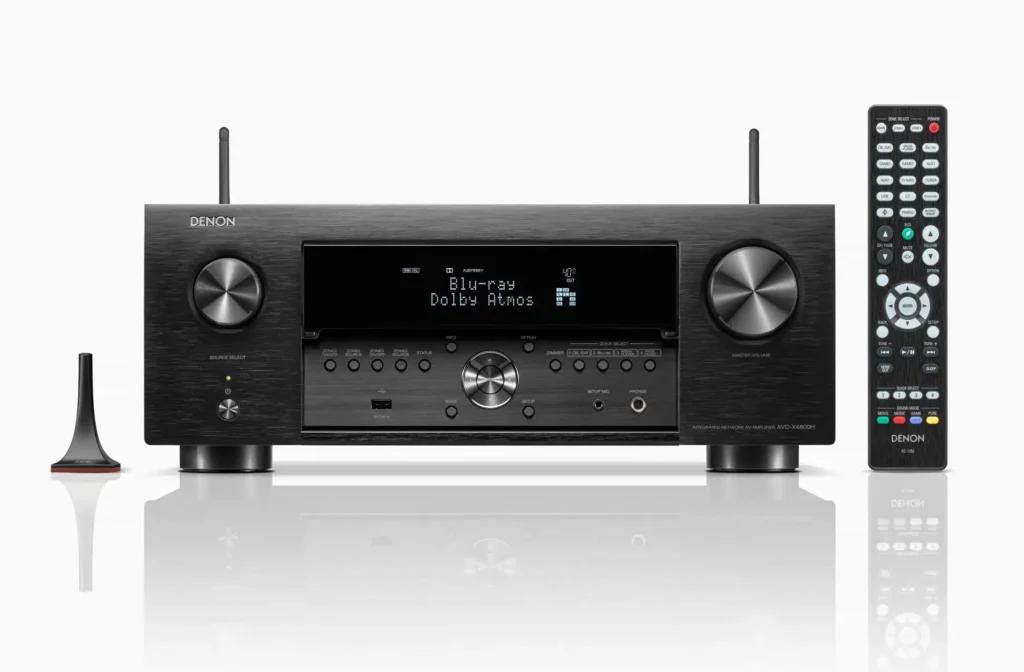
The Denon AVC-X4800H occupies a useful middle ground between affordable surround receivers and very large flagship amplifiers. It provides nine powered speaker channels, flexible processing and modern HDMI facilities, with several ways to develop the system later. Its value depends on whether those facilities match a realistic room plan rather than an ambition to collect the longest possible feature list.
Denon AVC-X4800H — Channels, processing and speaker planning
The European AVC-X4800H has nine power-amplifier channels and supports 11.4-channel preamplifier processing. That distinction matters: the extra processing does not create two additional powered channels inside the chassis. Expanding to an eleven-speaker arrangement requires an appropriate external power amplifier and the correct assignment settings.
With the internal amplification, a five-speaker bed and four height speakers is one logical Atmos layout. Seven bed speakers and two heights is another. The better choice depends on room shape and seating, not an assumption that rear surrounds always matter more than a second pair of heights.
Four independent subwoofer outputs allow more ambitious bass arrangements, but they are line-level outputs for suitable powered subwoofers or external amplification. They are not four extra speaker-power channels. The number of subwoofers should follow placement and coverage needs rather than the number of available sockets.
Denon rates the amplifier at 125 watts per channel into eight ohms under the stated two-channel test conditions. This must not be presented as a measured simultaneous nine-channel output. Speaker sensitivity, listening distance and the use of subwoofers determine the real demand on the amplifier.
Sound and calibration
AVForums’ original review praises the X4800H’s coherent multichannel presentation, effects placement and clear dialogue. It is less enthusiastic about the warmth and smoothness of two-channel music, and reports a room-dependent calibration result. That supports a strong cinema recommendation while keeping stereo preference and setup in the discussion.
For the owner, good dialogue starts with a suitable centre speaker and placement. A centre trapped deep in a cabinet or aimed away from listeners can undermine an otherwise capable amplifier. Address those conditions before repeatedly increasing the centre-channel level to compensate.
Audyssey MultEQ XT32 is included. Treat its measurement process as a careful setup stage: position the microphone correctly, reduce background noise and use a sensible listening-area pattern. After calibration, review distances, crossovers and levels rather than assuming an automated result needs no inspection.
An amplifier upgrade is less effective if subwoofer placement leaves a severe cancellation at the main seat. Multiple subwoofers can improve coverage, but they need integration rather than simply identical gain settings. The X4800H supplies useful tools and outputs; the room still determines how effectively they are used.
Dirac upgrades and total cost
Dirac’s current product page explicitly lists the AVR-X4800H and AVC-X4800H together, with Room Correction, Bass Control and ART available. These are optional licensed facilities rather than a promise that the full package is included in the amplifier’s purchase price. Confirm firmware and the licence combination before planning a system around them.
The dependencies matter. Dirac lists Room Correction as a prerequisite for the advanced options, with Bass Control required for ART when one or more subwoofers are involved. A buyer comparing receiver prices should include the intended software and suitable measurement equipment in the same budget.
There is no need to assume an immediate purchase of every upgrade. Begin with correct speaker placement and the included calibration system. If a specific integration problem remains, evaluate whether another tool addresses it. Software should be chosen to solve a documented requirement rather than as a compulsory badge of a serious system.
Room correction also has physical limits. It cannot create a good speaker position where none exists, remove all late reflections or guarantee equal results at every seat. A thoughtful layout and realistic target curve remain important even when sophisticated processing is available.
HDMI and everyday sources
Denon lists seven HDMI inputs and three outputs, with 4K/120 Hz and 8K/60 Hz support, eARC and gaming facilities including VRR and ALLM. That makes the X4800H flexible for several modern sources without immediately requiring an external HDMI switch. Exact signal combinations still depend on the source, display, cable and input settings.
Connecting a disc player directly to the amplifier is a different audio path from using a television app and returning sound over eARC. The latter depends on the television’s output capabilities. Dolby Atmos support in the amplifier does not establish that every TV app or external device delivers the same format.
For a console or PC, test the required resolution, refresh rate and HDR mode together. Confirm that the display reports the expected signal and that sound remains reliable after standby. A successful picture at sixty hertz is not proof that the complete chain also works at a higher refresh rate.
HEOS and AirPlay 2 add convenient music routes, while the moving-magnet phono input allows a compatible turntable connection. The European AVC designation should not be confused with the tuner-equipped AVR naming used in some other regions. Buy the appropriate mains and warranty version rather than importing solely for a model-name match.
Installation and value
The X4800H is a substantial component that needs ventilation and room for cables. Check the furniture depth with connected plugs, not only the chassis dimensions. A tightly closed cabinet can create thermal problems that have nothing to do with the quality of the surround processing.
Its strongest buyer has a clear nine-speaker plan, wants flexible subwoofer integration and may add external amplification later. Someone stopping at a simple five-speaker layout may obtain better value from a less expensive model and spend the difference on speakers or acoustic improvements.
Compare current European offers against the AVC-X3800H and competing nine-channel models. Additional power and construction features can be worthwhile, but they should be weighed against shared capabilities. A discounted higher-tier amplifier is attractive only if the complete system budget remains balanced.
The X4800H is also a sensible long-term hub when its connections prevent future switching compromises. That is a more concrete benefit than assuming it will remain current forever. Choose for the sources and speaker layout that are actually planned, leaving a reasonable upgrade route without paying for a hypothetical cinema that will never be installed.
Alternatives to consider
Denon AVC-X3800H: Compare the shared channel architecture and calibration route before paying more for the X4800H’s additional construction and connection facilities.
Marantz CINEMA 50: A close nine-channel alternative to audition for interface, presentation and current pricing.
Onkyo TX-RZ50: A useful comparison when the included calibration package and complete software budget influence the decision.
Denon AVC-X4800H key specifications
- Powered speaker channels
- 9
- Processing
- Up to 11.4 channels
- Subwoofer outputs
- 4 independent line-level outputs
- Rated output
- 125 W/ch, 8 ohms, 20 Hz–20 kHz, 0.05% THD, two channels
- HDMI
- 7 inputs / 3 outputs; eARC
- Video
- 4K/120 Hz and 8K/60 Hz; compatible chain required
- Calibration
- Audyssey MultEQ XT32; optional licensed Dirac facilities
- Region
- EU AVC version
Verdict
The AVC-X4800H is a highly capable nine-channel cinema hub with useful 11.4 processing, flexible subwoofer outputs and strong HDMI provision. It rewards a considered room and speaker plan. Include optional Dirac licences in the budget, keep two-channel power ratings in context and compare the step-down model before paying for facilities the system will not use.
Primary documentation and independent reviews
Denon AVC-X4800H official specifications · Denon official EU audio specification · Dirac current X4800H licence compatibility · AVForums original X4800H review
Editorial record
Sources and updates
Product specifications and factual claims were checked against Official Denon AVC-X4800H product page ↗. Scores and buying advice follow our category-specific editorial methodology.
- Published
- November 7, 2026
- Last updated
- November 8, 2026