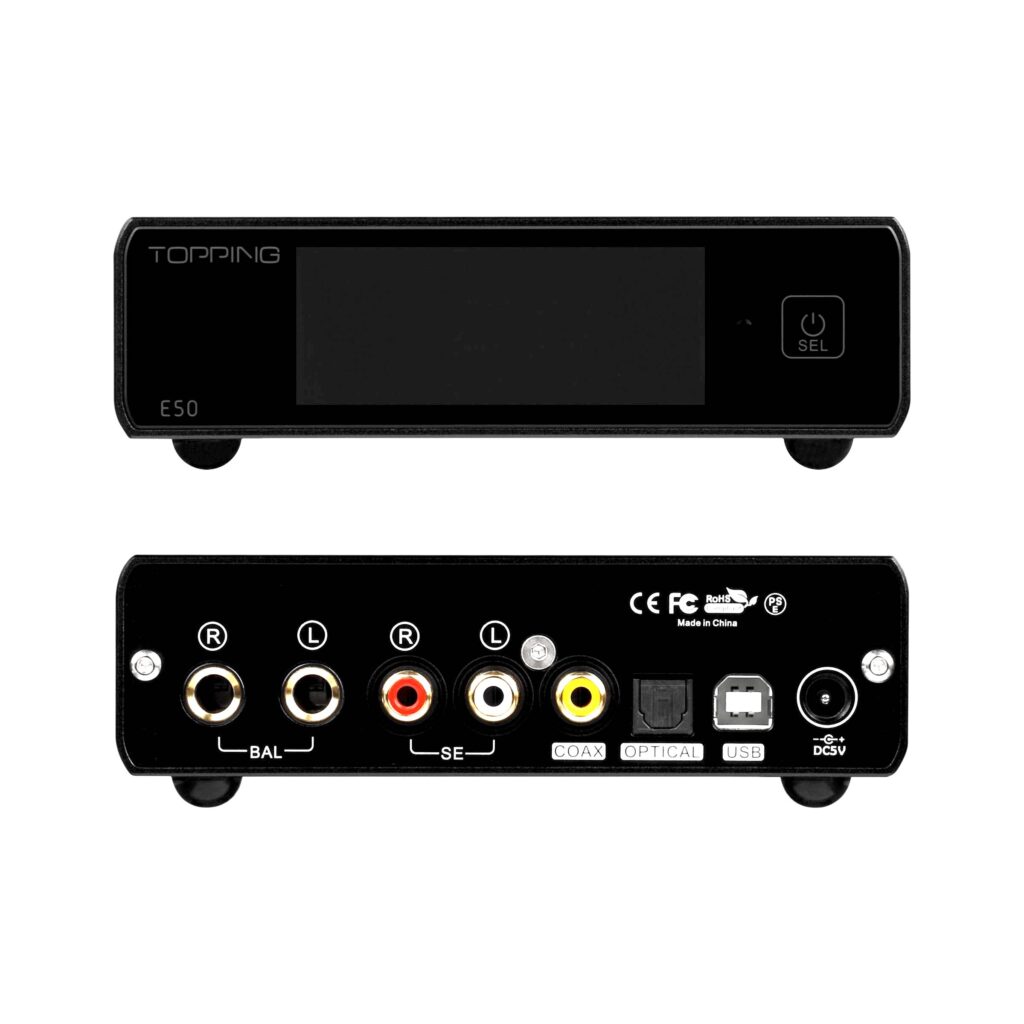
Topping E50 is an established separate DAC whose most useful distinction is its combination of balanced line outputs, RCA output and remote-controlled level. It does not contain a headphone amplifier. This review concerns the original ES9068AS-based E50, not E50 II. A similar name and case size do not justify transferring the newer model’s features to an older unit offered at a discount or on the used market.
Research-based review. This assessment draws on manufacturer documentation and the original published evaluations linked below. Audio Review has not performed a hands-on test of this model.
Two TRS sockets mean two line channels
The official manual identifies separate left and right balanced TRS outputs alongside a stereo RCA pair. Those larger jack sockets are line connections to compatible equipment, not a front-panel stereo headphone output. The outputs can be selected individually by type or enabled together.
Map the destination before choosing cables. A pair of active monitors with balanced inputs can be a natural match, while an integrated amplifier may simply use RCA. Confirm the receiving socket and required wiring rather than buying a lead by plug appearance. Balanced line connection can help a suitable system arrangement, but it is not a universal upgrade for every short cable run. Headphones need a separate amplifier, and passive speakers need their own power stage. Keeping those roles distinct makes the E50’s real value clearer: it is a compact digital source and controller for downstream equipment, not an all-in-one replacement for it.
Choose the volume-control mode deliberately
Topping provides fixed DAC operation and variable PRE mode. The remote controls volume only in the variable arrangement; fixed mode retains maximum output. The manufacturer’s specified maximum balanced line level is higher than the RCA level, so comparisons need sensible level matching.
For active monitors, establish a conservative gain arrangement and begin at low level. For an integrated amplifier, fixed output can leave everyday volume control to the amplifier. Avoid switching modes casually during playback. If both output types feed different destinations, check how each behaves before leaving them enabled. A clear control scheme is more valuable than simply having several ways to change level. Write down the chosen setup so another user knows which remote or knob matters. The E50’s remote is useful when it simplifies an established routine, not when it adds uncertainty about whether the next source change will be unexpectedly loud.
Digital compatibility depends on the input
USB supports the highest documented PCM and native DSD rates, subject to the host and playback configuration. Optical and coaxial have different limits. The unit is a stereo DAC rather than a surround decoder, and it has no HDMI audio-return connection.
For a television optical connection, select a compatible two-channel PCM output and check whether the desired volume-control routine works. For a computer, choose the correct playback device and begin with an ordinary supported format before configuring unusual rates or specialised playback modes. Do not buy on a maximum number alone if the music library and applications never use it. The original product also advertises MQA capability, but a legacy format badge does not establish the present content or service arrangement. Assess the sources actually owned and the files actually played. Stable ordinary playback is more important than collecting compatibility labels without a practical use.
Power and controls need a complete setup
The original E50 manual specifies a separate 5-volt DC supply connection, a display, touch control and remote. Data input and power should be treated as separate parts of the installation. The matching L50 amplifier uses a different electrical supply.
Keep each adapter and cable identified with the correct device. A physically similar barrel connector is not proof of compatibility. Leave room for the rear plugs and a clear line to the remote receiver. Check the local package contents, including the remote and suitable power arrangement, before deciding a discounted unit is complete. A used DAC without its remote may still pass audio, but it can lose much of the convenience that justified choosing it. The small case is easy to place, yet the whole system includes power, interconnects and the downstream amplifier. Count that complete arrangement when judging desk space and simplicity.
Published sound is context, not a guaranteed transformation
Headfonics’ original E50 evaluation describes an easygoing presentation with accessible detail, while noting limitations in layering and complicated passages. That is its listening account from a particular system. It should not become a promise that every owner will hear the same tonal shift against an already competent DAC.
Compare at similar loudness and focus on the practical questions: clean playback, absence of unwanted noise, reliable input switching and adequate output for the receiving equipment. If those were already satisfactory, the main benefit may be balanced connections or remote volume rather than a dramatic sonic change. That remains a valid reason to buy. A converter chip name and a low laboratory distortion claim describe parts of the design, not the whole listening result in a room. An upgrade should address an identifiable requirement rather than depend on expecting every familiar recording to become newly transformed.
Original-model value in a newer market
The existence of E50 II makes model identification especially important. Check the label and exact rear-panel arrangement instead of assuming a seller’s broad E50 title describes the newer product. Old launch pricing is not a current European value benchmark.
Compare the total local offer with alternatives that provide the required outputs and control style. Include cables, power and a headphone amplifier if needed. A combined DAC/amp can be simpler when headphones are the only destination; a separate DAC can be more flexible when several downstream components are already owned. For used equipment, test the inputs actually required, both output channels and remote functions before judging a saving worthwhile. The original E50 is most convincing when its particular connection package remains useful at a favourable price. It is less compelling if the buyer immediately needs analogue sources, wireless networking, HDMI or direct headphone drive.
Alternatives to consider
Schiit Modius E: Modius E is a relevant separate-DAC comparison for a system with balanced line connections. Check output and volume-control requirements against the actual equipment rather than choosing solely from the converter chip.
Topping E70 Velvet: E70 Velvet deserves consideration if a more capable separate source is justified by the system. Compare the complete connection and control benefit with the current price gap instead of assuming a higher range position guarantees a useful audible improvement.
Topping DX5 II: DX5 II is the more relevant class of product when direct headphone use is required. Compare a complete combined unit with the total cost and desk space of an E50 plus separate amplification.
Topping E50 key specifications
- Version
- Original E50
- DAC
- ESS ES9068AS
- Inputs
- USB, optical and coaxial digital
- Outputs
- Stereo RCA and two balanced 6.35 mm TRS line sockets
- Maximum line level
- 2 Vrms RCA; 4 Vrms balanced at 0 dBFS, maker specification
- Output selection
- RCA, TRS or both
- Modes
- Fixed DAC or variable PRE
- USB support
- PCM up to 32-bit/768 kHz and native DSD512 with suitable host
- Power
- Separate DC 5 V / 1 A
- Dimensions
- 155 x 129 x 41 mm
- Weight
- 445 g
- Headphone amplifier
- None
Verdict
The original Topping E50 remains a practical option for a digital system that benefits from balanced line outputs and remote control. Its role is clear once the line connections, output modes and separate power arrangement are understood.
Confirm the version and complete package, then compare current alternatives on the functions the system will use. It can be a tidy source for compatible monitors or amplification. It should not be bought as though it were E50 II, a network streamer or a complete headphone system merely because the product name appears in a DAC-and-amp category.
Documentation and original reviews
Topping official original E50 product page · Topping official E50 specifications and connection description · Topping official original E50 operating manual · Headfonics original E50 listening evaluation within the E50/L50 test
Editorial record
Sources and updates
Product specifications and factual claims were checked against Official Topping E50 product page ↗. Scores and buying advice follow our category-specific editorial methodology.
- Published
- November 17, 2026
- Last updated
- November 17, 2026