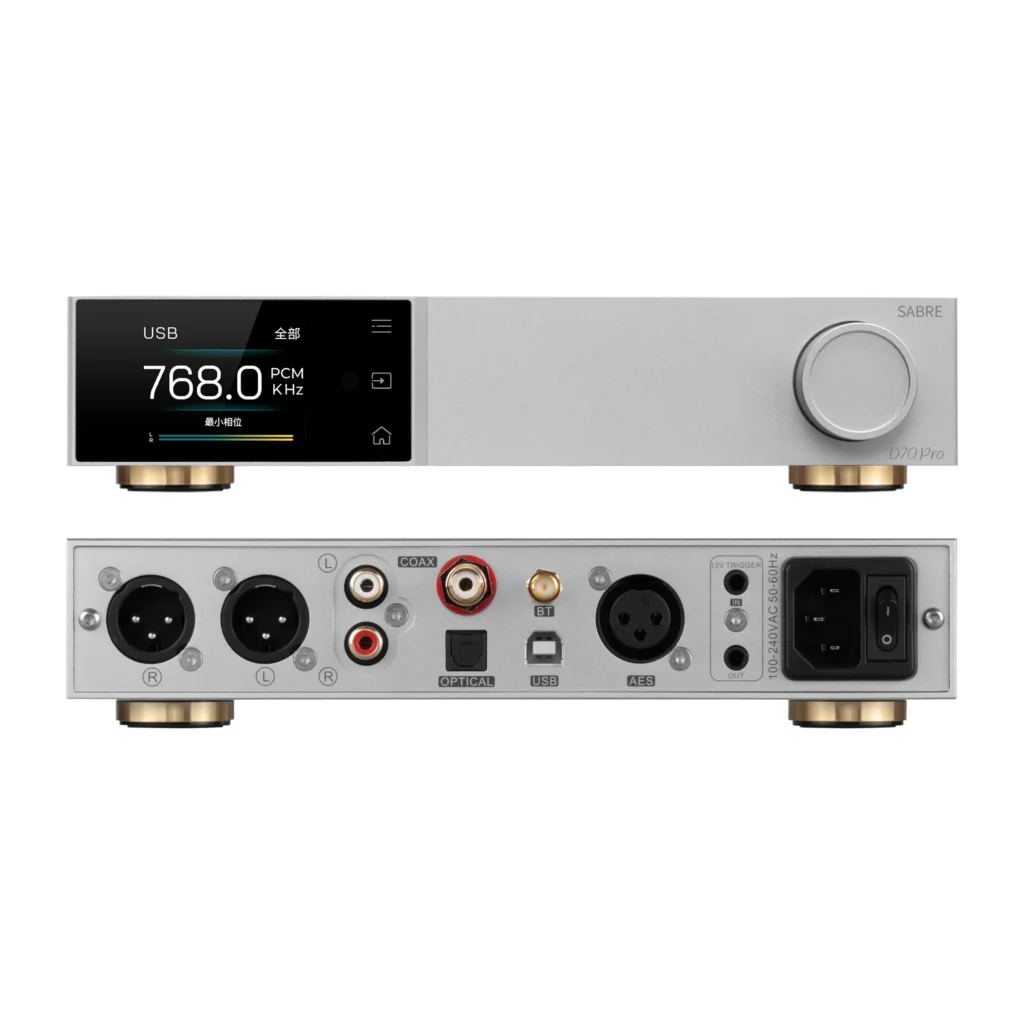
Topping D70 Pro Sabre is a desktop stereo DAC with a broad set of digital inputs, balanced line output and optional variable volume. Its attractive screen and technical specification can suggest a complete listening system, but it still needs an amplifier or active speakers. This research-based review looks at the strong original evidence for its musical performance and the practical choices behind a successful installation. It also separates this ESS-based version from the similarly named OCTO, rather than assuming the two are interchangeable.
Research-based review. This assessment draws on manufacturer documentation and the original published evaluations linked below. Audio Review has not performed a hands-on test of this model.
Clear original evidence, with a separate amplifier in the chain
Soundnews evaluated the D70 Pro SABRE alongside the A70 Pro and reported a clear, detailed and engaging presentation. That is encouraging evidence for this particular conversion-and-amplification combination. It is not an Audio Review listening test, and observations from the complete pairing should not automatically be assigned to the DAC alone.
Try it with the amplifier and transducers actually intended for the system. Match playback level before judging changes in bass authority, vocal clarity or apparent detail. A higher line level can make one DAC seem more immediate even when the comparison is mainly a difference in loudness. Listen to quiet material as well as dense tracks, and check the usefulness of the volume range. A converter should earn its place through the resulting system and everyday operation. The available evidence supports a serious shortlist position without requiring a promise of dramatic improvements over every competent existing DAC.
A digital input hub rather than an all-source preamplifier
The official manual identifies USB, optical, coaxial, AES and Bluetooth sources. That is a useful spread for a computer, disc transport and other digital equipment, but it does not include an analogue line input or a phono stage.
Draw the intended signal path before buying. A turntable cannot simply occupy an unused digital socket, and a separate phono stage still produces analogue audio that this DAC does not accept. A television may work through a supported optical output, but there is no HDMI ARC convenience here. Confirm the television’s output format and volume-control arrangement rather than assuming remote behaviour from another connection standard. AES is another supported digital input, not evidence that every studio or multichannel format is accepted. The D70 Pro Sabre is most coherent when the required sources are already digital and another component handles any analogue system. Adding adapters to force an unsuitable role can cost more and work less neatly than selecting the right control centre initially.
Fixed and variable output need different system arrangements
Topping documents both DAC and PRE operation, with RCA and balanced XLR line outputs. Fixed DAC mode delivers the selected fixed output rather than functioning as the listening volume control. PRE mode provides variable output for a suitable downstream system.
Confirm which component controls volume before playing music. An active speaker or power amplifier without an appropriate independent volume control must not receive an unexpectedly high fixed signal. Begin at a low setting and check behaviour after changing modes, sources or power state. Do not assume that a front-panel number means the same operating level in every output configuration. With an integrated amplifier, a conventional line input and sensible gain arrangement may be simpler than juggling two volume controls. Balanced wiring can be useful where both components support it correctly, particularly when routing cables around a busy desk. It does not guarantee a superior result in every short domestic connection. Choose the route that fits the actual equipment and remains predictable for everyone using it.
The display is useful feedback, not a measurement laboratory
The colour interface offers ordinary playback information and display choices including meter-style views. It makes the unit more approachable than a converter with only a few LEDs, especially when several sources are connected.
Check readability from the listening position and the convenience of the remote before treating the screen as a deciding feature. Decorative spectral and level displays do not replace calibrated analysis of noise, distortion or loudspeaker response. They also cannot confirm that a source has become audibly better merely because the animation looks more active. Keep the interface in a mode that helps identify the selected input and intended output behaviour. The best screen is one that reduces mistakes without demanding attention during every track. If the DAC is hidden in a cabinet or controlled entirely from the source, the visible features may be worth less than reliable switching and suitable connections. Allow space for cables and ventilation rather than arranging a stack solely to align the two front panels.
Bluetooth adds convenience without creating a network streamer
Wireless reception is useful for a visitor’s phone or quick listening, and the official store lists several Bluetooth codec options. Actual codec use depends on what the sending device also supports. It is not a guarantee that any phone selects the most ambitious format.
Check the active connection and practical stability in the intended room. Bluetooth reception does not turn this unit into a Wi-Fi music server, multiroom endpoint or autonomous streaming player. A phone or other source remains part of that route. Use USB or another appropriate wired input when predictable operation or a particular supported file format is the priority. There is no need to force high sample-rate playback into an ordinary listening routine merely because it appears in marketing. Source settings, application behaviour and a consistent volume arrangement matter more than a format badge alone. For a shared household system, decide whether Bluetooth convenience and the other inputs cover actual habits or whether a network player would be a better purchase.
SABRE identity and installed cost are the buying checks
The SABRE version uses the ESS conversion platform identified by Topping. The OCTO is a distinct model with a different internal conversion arrangement. Neither should be described by borrowing the other’s chip specification or firmware instructions.
Check the rear label, order description and relevant support documents, especially for a used unit. Include a suitable amplifier, interconnects and any missing remote in the total price. The 12V trigger connections can simplify compatible system switching, but they do not carry audio or power a loudspeaker. Follow the manuals at both ends of that connection. Ask about current regional warranty arrangements rather than assuming a historical review price still reflects local value. If an existing combined DAC and headphone amplifier already meets the need, this separate component should offer a clear reason to add another box. Its strongest case is a deliberate digital system where connection flexibility, output control and positive original listening evidence all have a practical role.
Alternatives to consider
Topping E70 Velvet: Compare the connections, output-control routine and total installed price. A less elaborate display can be entirely adequate when the DAC is controlled elsewhere.
Topping D90 III Sabre: Consider the more ambitious alternative only after identifying a useful functional or demonstrated listening benefit. Chip family and model number alone do not settle value.
Topping D70 Pro Sabre key specifications
- Role
- Stereo desktop DAC and digital preamplifier
- Conversion
- ESS ES9039SPRO
- Inputs
- USB, optical, coaxial, AES and Bluetooth
- Analogue outputs
- Stereo RCA and balanced XLR line outputs
- Output modes
- Fixed DAC or variable PRE
- Headphone amplifier
- Not included
- Control
- Front controls, remote and colour display
- Integration
- 12V trigger input and output
- Power
- Internal mains supply; follow regional requirements
- Not provided
- Analogue input, HDMI ARC or native network streaming
- Dimensions (W × H × D)
- 222 × 48 × 176 mm including protruding parts
- Weight
- 1.05 kg
Verdict
D70 Pro Sabre is a persuasive research-based choice for a digital system with separate amplification. Its input variety and output modes are useful, while original evaluation supports capable musical performance. Confirm the exact version, downstream volume control and finished system cost. It is a well-equipped converter, with the clearest value when its actual connections solve an existing requirement.
Documentation and original reviews
Topping official D70 Pro SABRE product · Topping official D70 Pro SABRE operating manual · Topping official store specification overview · Soundnews original D70 Pro SABRE and A70 Pro evaluation
Editorial record
Sources and updates
Product specifications and factual claims were checked against Official Topping D70 Pro Sabre product page ↗. Scores and buying advice follow our category-specific editorial methodology.
- Published
- November 17, 2026
- Last updated
- November 17, 2026