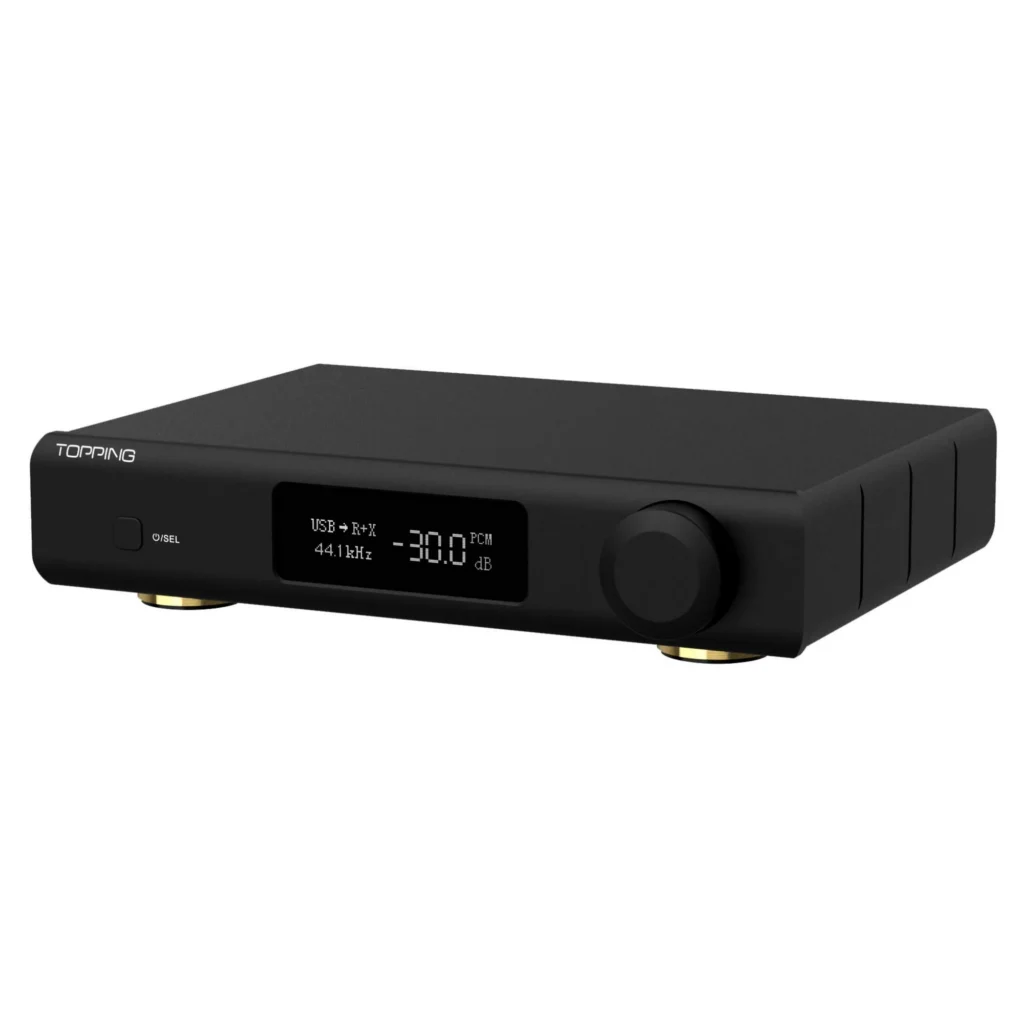
The Topping D90 III Sabre is a dedicated desktop DAC with variable or fixed line outputs and a broad digital connection set. It can serve an existing headphone amplifier, integrated amplifier or active-speaker system, but it does not contain a headphone amplifier of its own. Its strongest case is a system that needs its input and control flexibility rather than simply the largest sample-rate number.
Topping D90 III Sabre — Design and the role it fills
The compact case and clear front display suit either a desktop stack or a conventional hi-fi shelf. The main controls are relatively sparse, with the remote providing convenient access from a listening seat. Think about how the unit will be used before deciding its form is ideal. A DAC that remains on one input and feeds an integrated amplifier has different control needs from one acting as the main volume controller for active speakers.
There is no headphone socket. A photograph beside a matching Topping amplifier can make the pair look like a single solution, but the DAC requires that second amplification stage for wired headphones. It also has no analogue input for a turntable or another analogue source. Someone seeking one box for digital playback, headphone listening and analogue switching should compare a different product type rather than adding the missing functions after purchase.
Plan cable clearance behind the unit and leave the remote accessible. A small box can still occupy significant depth when several digital and analogue leads are connected. Keep the installation understandable by labelling sources and choosing one primary volume-control point. That simple planning has more practical value than a visually impressive stack whose controls overlap confusingly.
Digital inputs and source compatibility
USB, optical, coaxial, AES and IIS inputs cover a broad range of digital sources, with Bluetooth providing another route. The USB and IIS paths support the highest advertised PCM and DSD rates, while other inputs have different limits. The manual’s input-specific table is the useful reference. A large format headline does not mean that the same format can be supplied through every socket.
The IIS connection uses an HDMI-style connector, but it is not a normal television HDMI input and does not provide ARC or eARC. Its wiring and settings must match the digital transport. A television is more straightforward through a suitable optical PCM output, with its audio settings checked. This is a stereo DAC rather than a Dolby or DTS decoder, so sending a surround bitstream can produce an incompatible signal instead of ordinary television sound.
For a computer, confirm the DAC is selected by the player and operating system. The display reports the incoming sample rate; it does not prove that the original file reached the DAC unchanged. Shared operating-system audio can resample several sources to one selected rate. Exclusive playback may be useful for a dedicated music session, but everyday convenience can reasonably favour shared audio when calls and other applications must remain audible.
Fixed output and preamplifier operation
The D90 III Sabre offers a PRE mode with adjustable volume and a DAC mode with fixed maximum output. That difference matters when connecting power amplifiers or active speakers. Confirm the mode and begin with a controlled level before playback. A fixed DAC output is appropriate when a downstream component handles volume, while direct speaker or power-amplifier use normally requires the intended variable-level arrangement.
RCA and XLR line outputs can be selected or used together according to the setup. This can serve a headphone amplifier and speaker system, but the owner should understand which devices are receiving signal. Turning down or muting the wrong component is an easy source of confusion in a mixed desktop setup. Test the normal switching routine and confirm what happens after standby before treating the installation as finished.
The manual documents nominal four-volt and five-volt output modes, with measured specifications listing slightly higher full-scale values. The higher setting is not automatically the better choice. Match the receiving amplifier’s input capability and the desired gain structure. Extra voltage can make one comparison louder or reduce useful volume-control range without improving the underlying conversion. Choose the appropriate level for the system rather than the largest available number.
Bluetooth, remote control and configuration
Bluetooth reception supports a range of codecs, including LDAC and aptX-family options listed in the manual. The transmitting phone or computer must support the chosen codec too. A Bluetooth version number alone does not establish which codec is negotiated. Use a wired input for a predictable reference path, and treat wireless reception as a convenient option whose behaviour should be checked with the actual source.
The remote can operate through infrared or paired Bluetooth. That is a control function separate from music reception. The distinction is useful if Bluetooth audio is disabled while the remote remains in use. Input selection, output routing and volume should be tested as ordinary daily actions rather than discovered during the first serious listening session. Keep a note of settings that affect the signal path so that later comparisons remain repeatable.
The setup includes filters, channel balance and selectable sound modes. Start with a clearly understood reference configuration and change one option at a time if there is a reason. A mode described as valve sound is processing, not evidence that the DAC contains a valve amplifier. Such facilities can be interesting, but they should not distract from correct connection, appropriate output level and reliable source operation.
Research evidence and sound expectations
Headfonics’ original D90 III Sabre review described a transparent, resolving presentation and valued its connections and preamplifier capability. It also noted that accessing detailed settings during playback relied on the remote. Those are the reviewer’s observations in a complete headphone system, not Audio Review listening or laboratory results. They support the DAC as a capable source candidate without establishing an audible advantage in every system.
A well-performing DAC should provide a clean signal to the next stage. Once existing conversion is already quiet and accurate, differences in headphones, speakers, room response and level can be more consequential than moving to a more expensive converter. The D90 III Sabre therefore needs a practical justification as well as promising specifications. Its input provision and output control can be that justification even when the existing DAC is not obviously defective.
Compare at matched level and with the same amplifier, transducers and processing. A higher output setting can make a casual demonstration seem more detailed simply through loudness. Avoid assigning a permanent tonal character to a chip brand from one comparison. The two ESS conversion chips are part of an implementation whose complete behaviour matters more than the logo, and any personal preference deserves a repeatable audition rather than a technology assumption.
Value and the right buyer
This DAC is most attractive when several digital sources, balanced line connections and remote-controlled volume all have a job. It can also simplify an active-speaker system that already has suitable amplification in each speaker. Its value is harder to justify if a computer is the only source and a lower-cost DAC already provides a clean, appropriately controlled signal. More unused inputs do not improve the recording.
Compare current European pricing, retailer support and the cost of any separate headphone amplifier required. An all-in-one DAC and amplifier may be more economical for a new headphone system, while the D90’s separation can be useful when good amplification is already owned. Buy it to complete an identified system need, with source compatibility and volume behaviour checked, rather than expecting premium conversion alone to transform every aspect of listening.
Alternatives to consider
RME ADI-2 DAC FS: Compare if extensive adjustment and integrated headphone facilities are more useful than this DAC’s particular input set.
FiiO K7: A different all-in-one approach when a separate headphone amplifier would otherwise add cost and desk space.
Topping D90 III Sabre key specifications
- Conversion
- Dual ESS ES9039SPRO
- Inputs
- USB, optical, coaxial, AES, IIS and Bluetooth
- Outputs
- Stereo RCA and XLR line outputs
- Volume modes
- Fixed DAC / variable PRE
- USB format support
- Up to PCM 32-bit/768 kHz and native DSD512; source support required
- Headphone amplifier
- Not included
- Mains
- 100–240 V AC, 50/60 Hz
Verdict
The Topping D90 III Sabre is a capable and flexible digital source for a system that needs its connections, line-output choices and remote volume control. It requires separate headphone amplification and careful output-mode setup. Its strongest value comes from solving those practical system needs rather than chasing format or chip specifications alone.
Primary documentation and independent reviews
Topping official D90 III Sabre product information · Topping official D90 III Sabre manual · Topping model-specific support guidance · Headfonics original D90 III Sabre review
Editorial record
Sources and updates
Product specifications and factual claims were checked against Official Topping D90 III Sabre product page ↗. Scores and buying advice follow our category-specific editorial methodology.
- Published
- November 8, 2026
- Last updated
- November 8, 2026