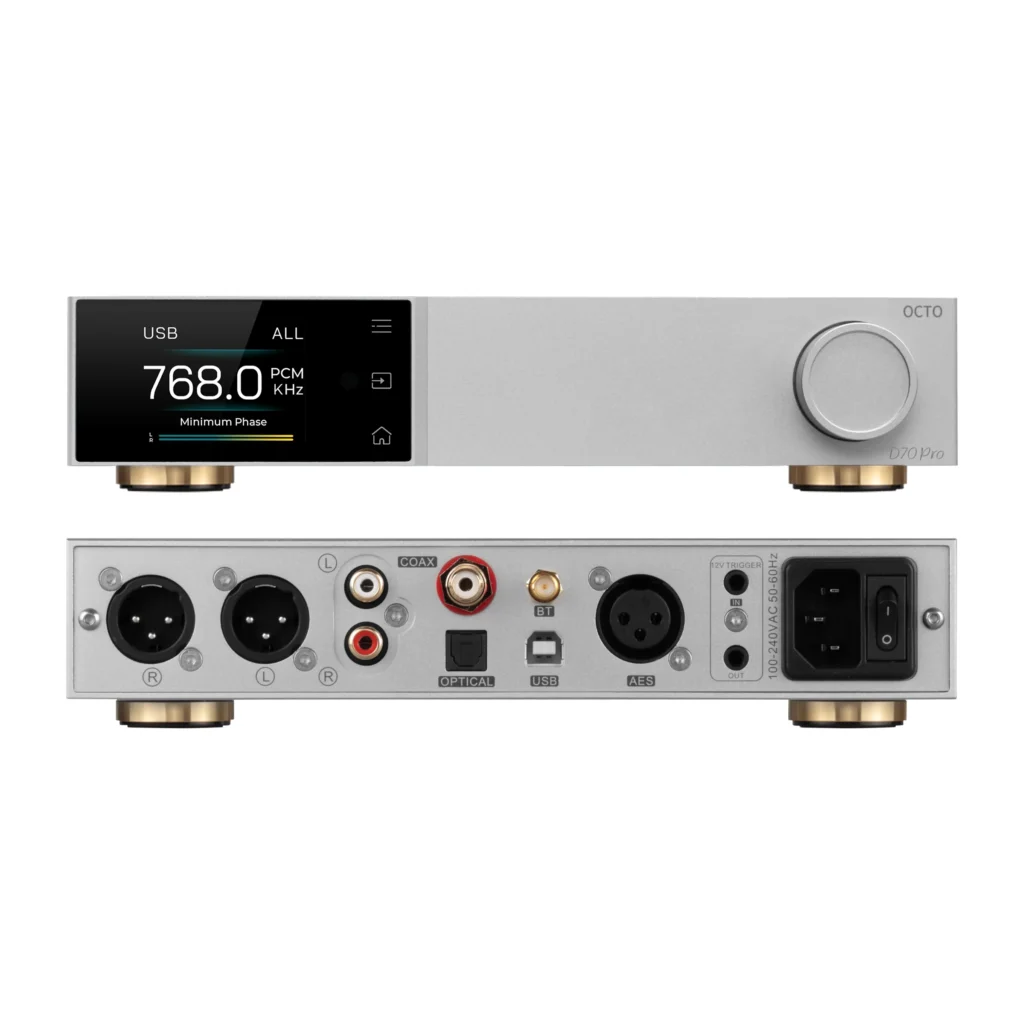
Topping D70 Pro Octo puts eight Cirrus Logic conversion chips into a stereo desktop DAC with digital source selection, balanced output and a colour interface. The chip count is distinctive, but it does not make this an eight-channel interface or a complete headphone system. This research-based review considers the positive original listening account alongside the everyday implications of variable output, multiple sources and external amplification. The OCTO identity matters because the similarly named SABRE version should not supply its internal specification or support files.
Research-based review. This assessment draws on manufacturer documentation and the original published evaluations linked below. Audio Review has not performed a hands-on test of this model.
Eight conversion chips still serve a stereo listening system
Topping’s product panels identify eight CS43198 chips. That arrangement is part of the manufacturer’s implementation of a two-channel DAC. The available analogue outputs are stereo line connections, not eight independently addressable channels for surround sound or recording.
Choose the unit for its system role rather than treating the number eight as an automatic performance ranking. Converter architecture, analogue circuitry and complete implementation all contribute to the final result. A large chip count cannot by itself establish what is audible in a particular room or headphone chain. If the requirement is multichannel home cinema, a recording interface or separate outputs for active crossover processing, this product is the wrong category of device. For conventional stereo, the important questions are source compatibility, noise-free operation, useful output control and the resulting listening experience. The OCTO is interesting because it combines those practical facilities with a specific conversion design, not because its name replaces a careful comparison.
A refined presentation in the original listening account
iiWi’s original evaluation characterises the OCTO as revealing yet relaxed, with full bass and a substantial midrange. The comparison with the SABRE version describes a somewhat different balance rather than a universal winner. These are the original reviewer’s impressions, not Audio Review listening findings.
Use that account as a reason to audition, especially if an existing system tends towards a lean or insistent balance. It should not become a promise that a DAC will correct unsuitable headphones, bright speakers or poor placement. Match levels closely when comparing converters and use familiar material with natural voices and clear bass lines. Listen for fatigue across a realistic session rather than deciding from a short, louder demonstration. Small tonal descriptions are also affected by the wider chain and individual expectations. The available original evidence makes the OCTO a credible option for a balanced digital system, while leaving room for preference and for competent less expensive alternatives to remain entirely satisfying.
Digital flexibility needs a source plan
USB, optical, coaxial, AES and Bluetooth provide several ways to reach the conversion stage. They do not create analogue inputs, a phono stage or an HDMI television connection. The unit also does not operate as a native network player simply because it accepts a wireless Bluetooth source.
List the sources that will actually be connected and check their output formats. A computer can use USB, while a compatible transport or television may suit another digital input. Television optical playback still needs a supported audio format and a workable volume arrangement. A turntable requires an appropriate analogue route elsewhere in the system. Avoid assuming that a cable adapter adds an input function that the DAC never had. With Bluetooth, the transmitting device determines which shared codec is available, and room conditions affect reliability. For a shared system, straightforward source switching can be more valuable than a rarely used format maximum. The OCTO’s flexibility is real when it replaces awkward digital source selection, not when it becomes the centre of an unnecessarily complicated adapter chain.
Volume control belongs to a clearly chosen component
The OCTO offers fixed DAC and variable preamplifier roles, with RCA and balanced XLR line connections. Those roles have different implications for an integrated amplifier, a power amplifier or active loudspeakers.
Establish the volume-control path before connecting a downstream device that can produce substantial output from a fixed line signal. Start at a low level and confirm behaviour after changing operating modes or restarting the system. An integrated amplifier may be most convenient with the DAC serving a conventional line input and the amplifier controlling listening level. A variable DAC output can suit active speakers, but convenience and safety depend on the entire arrangement. Balanced connectors do not remove the need to check compatible levels and wiring. Do not compare two output routes at different loudness and call the louder one more detailed. Predictable operation is more useful than the highest selectable voltage. The right setting is the one that gives a comfortable adjustment range and remains clear to anyone else using the system.
The screen should make operation easier
The front display is part of the appeal, showing playback information and supporting a more visual control experience than a basic status LED. The compact chassis can also fit neatly beside a separate headphone amplifier.
Try reading it from the intended position rather than assuming it will remain clear across a room. A desktop and a hi-fi rack impose different requirements on the remote and front controls. Meter-style graphics are useful feedback or decoration, not proof of calibrated audio measurements. Leave adequate cable clearance and sensible ventilation when stacking components. Check whether one remote command changes the intended box if several products share a similar control language. A visually matched stack is attractive, but a combined DAC and amplifier may remain more convenient when only headphones are used. The extra component earns its space when source switching, line-level output or separate amplification is genuinely helpful. A tidy installation should reduce friction during ordinary listening rather than require menu adjustments before every album.
Version checking and support determine long-term convenience
The D70 Pro OCTO and D70 Pro SABRE are distinct products despite their shared visual style. Topping provides OCTO-specific support material. Firmware and setup instructions should correspond to the exact model and hardware guidance.
Check the product label when buying used and confirm that the remote, mains lead and other expected accessories are included. Follow official update procedures only when relevant to the actual unit; do not cross-install files from a similarly named DAC. Historical review prices are not current European offers, so compare the complete local package and warranty route. Include the separate headphone amplifier if one is required. The best reason to choose the OCTO is a combination of useful digital inputs, suitable output control and a listening preference supported by an audition. Paying for its internal architecture makes less sense if an existing converter already offers the same practical result. Its value should be judged as a complete stereo component rather than as a contest between chip brands.
Alternatives to consider
Topping E70 Velvet: Compare the exact connections and control routine rather than buying by converter-chip reputation. Include current local pricing and the required external amplifier.
Topping D90 III Discrete: A different conversion design is worth considering when it brings a useful system benefit. Compare level-matched playback and functional needs before paying for a more ambitious architecture.
Topping D70 Pro Octo key specifications
- Role
- Stereo DAC and digital preamplifier
- Conversion architecture
- Eight Cirrus Logic CS43198 chips
- Channel format
- Stereo analogue output, not an eight-channel interface
- Inputs
- USB, optical, coaxial, AES and Bluetooth
- Analogue output
- RCA and balanced XLR line outputs
- Output operation
- Fixed DAC or variable preamplifier role
- Headphone output
- Not included
- Control
- Colour display, front controls and remote
- Size
- Approximately 222 × 176 × 48 mm
- Not provided
- Analogue input, HDMI ARC or native network playback
- Mains input
- 100–240 V AC, 50/60 Hz
Verdict
D70 Pro Octo is a strong research-based stereo DAC candidate with useful connections and positive original evidence for a refined, substantial presentation. The eight-chip design is not a multichannel feature. Confirm exact model identity, external amplification and volume behaviour. It is most convincing when the whole system benefits from its digital flexibility and line-output facilities.
Documentation and original reviews
Topping official D70 Pro OCTO product and specification panels · Topping official OCTO manual download page · iiWi original D70 Pro OCTO evaluation
Editorial record
Sources and updates
Product specifications and factual claims were checked against Official Topping D70 Pro Octo product page ↗. Scores and buying advice follow our category-specific editorial methodology.
- Published
- November 17, 2026
- Last updated
- November 17, 2026