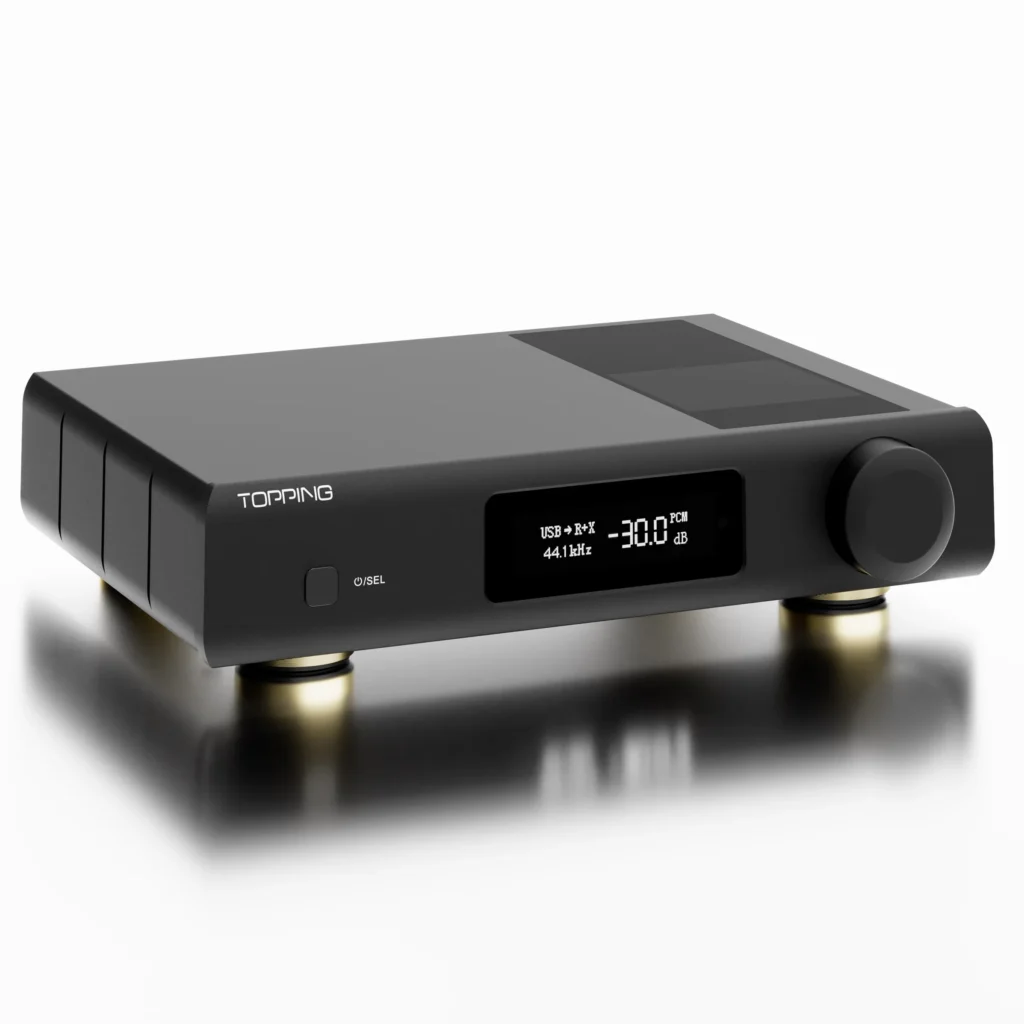
The Topping D90 III Discrete combines a proprietary discrete conversion design with a more immediately practical feature: stored parametric equalisation. It is a standalone DAC and digital preamplifier for an existing amplifier or active-speaker system. Its value depends on the inputs, EQ and control facilities fitting the system, because it does not add headphone amplification or a network music player.
Topping D90 III Discrete — Design and the standalone role
The compact case and front display are suitable for a desktop stack or a shelf-based hi-fi system. It looks similar to other Topping converters, so the full model name matters when ordering. The D90 III Discrete and D90 III Sabre use different conversion arrangements and do not have identical adjustment facilities. A photograph of a matching case is not enough to establish which product a discounted listing supplies.
There is no headphone socket and no analogue source input. A headphone system therefore needs a separate amplifier, while a turntable needs suitable phono electronics and another route into the system. The D90 is a digital source and level controller, not a universal analogue preamplifier. Write down every source before deciding it can replace an existing control component.
The remote is useful when the DAC controls active speakers from a listening seat. On a desk, the front controls may be sufficient for ordinary adjustments. Try the input and output switching routine and keep the chosen volume strategy simple. A clear arrangement with one main controller is easier to operate than a chain in which several devices alter volume without an obvious reference.
Discrete conversion without assumptions
Topping uses its proprietary discrete one-bit conversion platform in this model rather than the dual ESS chip arrangement of the Sabre version. That is an interesting engineering distinction, but discrete construction alone does not establish a superior audible result. Implementation, output level, noise and the connected system all matter. An architecture label should help identify the product, not replace a properly controlled comparison.
The manufacturer’s published specifications indicate a very capable conversion stage, but they remain manufacturer data rather than measurements performed by Audio Review. A buyer should also consider which functions change everyday use. Stored EQ and input flexibility can provide a clearer practical reason to choose this model than an expectation that a different converter architecture must transform familiar recordings.
The final listening chain still includes the downstream amplifier and transducers. A good DAC cannot correct a headphone fit problem or a loudspeaker placement problem merely by converting the same data more expensively. Decide what the existing system lacks, then choose the converter that supplies that missing function with appropriate signal levels and reliable operation.
Parametric EQ and its boundaries
The D90 III Discrete offers ten-band parametric EQ through Topping Tune, with custom configurations stored in the unit for later use. The manual documents five custom configurations alongside built-in choices. That is useful when the same correction should remain available without running a computer equaliser during every session. Check the current software and operating-system support before making this the centre of a workflow.
The format limits are important. The manual’s table lists EQ operation up to 192 kHz PCM on the supported wired digital paths and up to 96 kHz on Bluetooth, while IIS is not an EQ-supported route. Native DSD playback should not be assumed to pass through the same PCM EQ facility. A maximum decoding figure and a maximum processed format are different specifications, so choose the source route around the intended processing.
Use EQ with a clear goal, such as a measured loudspeaker issue or a known headphone preference. A parametric equaliser is not an automatic microphone-based room-correction system by itself. Sensible settings require appropriate measurements or a considered starting profile. Allow headroom when boosting frequencies and compare profiles at similar perceived level. A louder boosted setting can otherwise appear better for reasons unrelated to the correction’s accuracy.
Save an untouched reference profile and label custom settings clearly. Different headphones or speakers can require different corrections, and applying a profile to the wrong output can produce an unhelpful balance. The stored facility is most valuable when it makes a repeatable improvement easy to recall, rather than turning every session into unstructured adjustment.
Inputs, outputs and volume setup
The digital inputs include USB, optical, coaxial, AES, IIS and Bluetooth, with RCA and XLR line outputs. The IIS connector resembles HDMI but carries a different digital-audio interface. It is not a television ARC or eARC input, and a transport needs compatible wiring and settings. For television use, a suitable optical PCM route is simpler, with the television set to send a compatible stereo signal.
The DAC mode fixes the output at maximum level, while PRE mode allows volume adjustment. Confirm the mode before connecting directly to a power amplifier or active speakers. A fixed converter output is appropriate when a downstream amplifier controls volume; direct level control requires the intended variable arrangement. Test muting and standby recovery with the completed system so that ordinary use is predictable.
The nominal four-volt and five-volt output settings provide gain-structure choices. The higher setting should be matched to the receiving device’s input headroom rather than selected automatically. An apparent improvement in a casual comparison may simply be higher level. The same care applies when switching RCA and XLR paths: compare the actual levels and receiving circuitry, not just the connector type.
Bluetooth and format use
Bluetooth reception supports several codecs, including LDAC and aptX-family options, with the actual choice dependent on the transmitting device. It is a convenient source route rather than a built-in network streamer. The DAC does not browse a music-service library or replace a separate network endpoint merely because a phone can send it audio. Decide whether that phone-dependent workflow fits the household.
USB supports higher PCM and DSD rates than ordinary optical and coaxial routes, but the largest format is not necessarily the most useful. Most listening depends on recordings and applications that do not need extreme rates. Check reliable input selection and the intended EQ behaviour with normal material first. A display reporting a high incoming rate does not establish that the operating system has avoided resampling the original file.
The remote can recall useful user settings and makes a speaker-based installation more convenient. Keep track of what is stored in a profile and confirm which output becomes active. A setup that alternates between a headphone amplifier and active speakers should have an easy routine that does not accidentally leave both playing. Practical clarity matters more than filling every socket.
Published sound assessment and value
Headfonia’s original D90 III Discrete review praised transparency, detail and a natural presentation, and valued the EQ facility. Those are observations from that reviewer’s system, not Audio Review listening results. They make the DAC a credible audition candidate but do not prove an audible advantage over every less expensive, competently engineered converter. Match levels and processing before comparing.
The strongest buyer already has suitable amplification and wants the D90’s particular combination of stored correction, connections and output control. For a new headphone desk, an integrated DAC and amplifier may be simpler and cheaper. For a loudspeaker system needing automatic multi-seat room correction, a different processing product may be more appropriate than manual EQ alone. The role should be chosen before the technology.
Compare current European prices with the complete signal chain included. Software support, local service and a clear method for saving configurations are useful ownership considerations. The D90 III Discrete is most convincing when its functions solve identified needs and can be operated reliably, rather than when the purchase rests solely on the attraction of a new conversion architecture.
Alternatives to consider
RME ADI-2 DAC FS: Compare its integrated headphone facilities and adjustment workflow against the D90’s standalone source role.
FiiO K7: A simpler integrated headphone solution when separate amplification and stored DAC EQ are unnecessary.
Topping D90 III Discrete key specifications
- Conversion
- Proprietary discrete one-bit platform
- Inputs
- USB, optical, coaxial, AES, IIS, Bluetooth
- Outputs
- Stereo RCA and XLR line outputs
- Volume
- Fixed DAC or variable PRE modes
- EQ
- 10-band parametric; 5 stored custom configurations
- EQ PCM limits
- Up to 192 kHz on supported wired paths; up to 96 kHz Bluetooth; not IIS
- USB decoding
- Up to PCM 32-bit/768 kHz and native DSD512; processing limits differ
- Headphone amplifier
- Not included
Verdict
The Topping D90 III Discrete is an appealing digital source when stored parametric EQ, broad inputs and flexible line control have a clear role. Its EQ format limits and lack of headphone amplification must be included in the plan. Choose it for those practical capabilities, with architecture claims kept in proportion.
Primary documentation and independent reviews
Topping official D90 III Discrete information · Topping official D90 III Discrete manual · Headfonia original D90 III Discrete review · Headfonia EQ and listening evaluation
Editorial record
Sources and updates
Product specifications and factual claims were checked against Official Topping D90 III Discrete product page ↗. Scores and buying advice follow our category-specific editorial methodology.
- Published
- November 8, 2026
- Last updated
- November 8, 2026