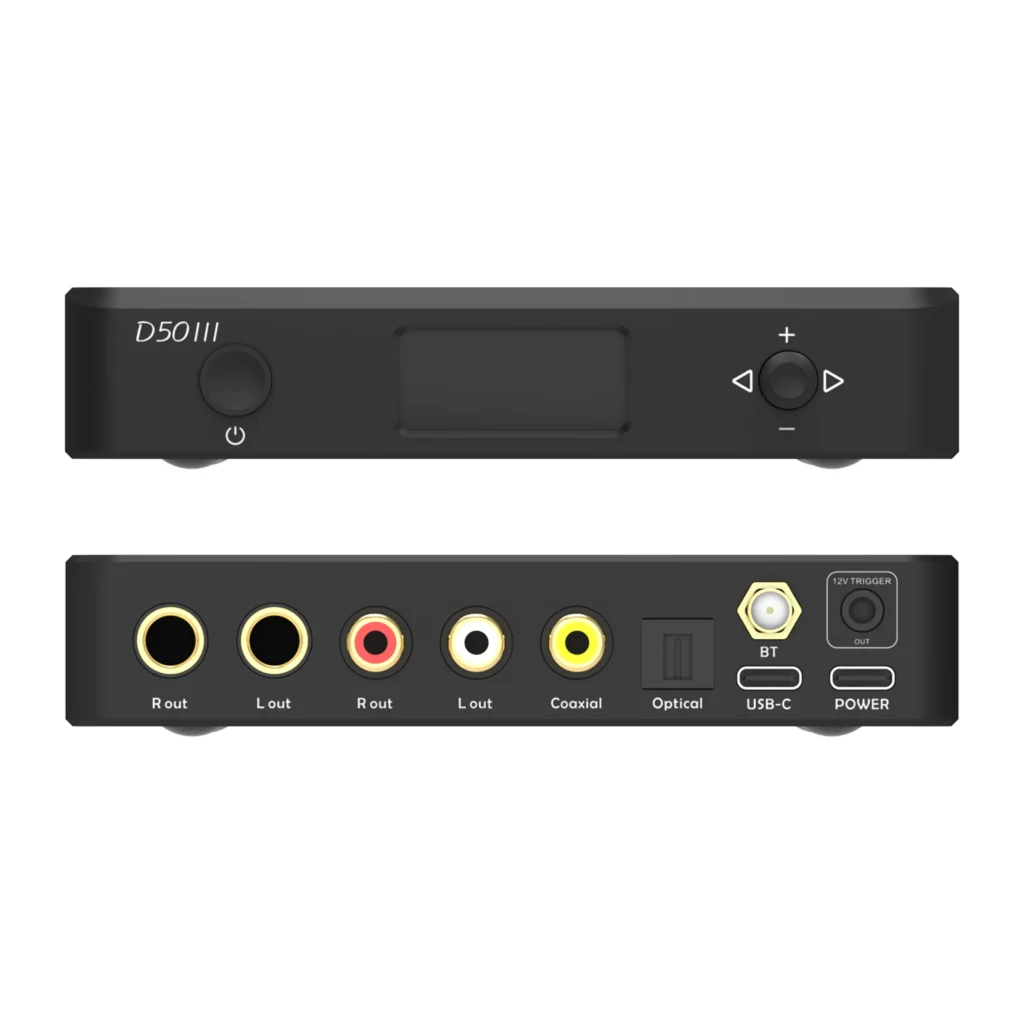
Topping D50 III is a compact DAC with line outputs, remote-controlled preamplifier operation and USB-only parametric EQ. It is not a headphone amplifier, even though its balanced line connections use large TRS sockets. This research-based review considers the positive original evidence for clean conversion and the practical usefulness of its inputs and configuration options. The central buying decision is whether it fits the existing amplifier or active speakers, with particular care over fixed output mode, USB power and the source limitations of its equaliser.
Research-based review. This assessment draws on manufacturer documentation and the original published evaluations linked below. Audio Review has not performed a hands-on test of this model.
Clean conversion is supported by the original evaluation
Headfonia’s D50 III assessment describes a clean, balanced and transparent presentation with good handling of complex music through its tested amplifier and active speakers. It also identifies the compact balanced connection format as a practical compromise. These are observations from the reviewer’s equipment, not Audio Review listening or laboratory results.
Compare the DAC in the actual system at matched levels. A slightly louder source can seem more detailed or dynamic even when the difference is primarily level. Use familiar voices, low-level ambience and a busy arrangement, then assess quiet playback as well as stronger passages. The amplifier, headphones or speakers remain major influences on the result. A capable DAC should make source use dependable rather than force a purchase around a particular converter chip or maximum sampling number. The positive original evidence supports a shortlist position, while system control and EQ may provide the more obvious everyday benefit. Do not assume that every change in a downstream component becomes proof of a dramatic DAC character.
USB-only EQ is useful when the source route is right
The official manual states that parametric EQ is supported only on USB input. TOPPING Tune can store configurations for later use, but optical, coaxial and Bluetooth playback should not be described as receiving the same processing. EQ also has its own documented supported format range.
That is a decisive distinction for television owners who intend to connect optical output. If their main aim is equalising that route, the D50 III does not provide the expected function. For a computer-based system, the facility can be valuable when carefully chosen adjustments improve a known headphone or speaker balance. Start with a specific goal, preserve appropriate headroom when boosting frequencies and compare at similar loudness. Save an unprocessed reference so changes can be reversed easily. Use the supported current software and configuration workflow rather than expecting every operating system to run the same utility. Equalisation is most useful when it addresses an identified response preference, not when a complex curve is applied simply because ten bands are available.
Line outputs and volume modes must match the next device
The D50 III provides RCA and balanced TRS line outputs, with variable PRE and fixed DAC modes. In fixed mode, the manual specifies maximum-level output without ordinary volume adjustment. The large TRS sockets are individual balanced line channels, not stereo headphone sockets.
Decide where volume is controlled before connecting active speakers or a power amplifier. Begin with appropriate low-level settings and verify the route rather than assuming the remote remains in control in every mode. A separate headphone amplifier is required for headphones. Choose suitable line interconnects and do not improvise an adapter from a line output to a headphone cable. Balanced connectivity can be useful in a compatible installation, but is not an automatic sound-quality upgrade over a short, well-behaved RCA connection. Compare at consistent level and use the route supported by the downstream equipment. The D50 III is flexible as a source controller when its roles are understood. It is not a universal all-in-one simply because its back panel is densely populated.
Digital inputs and Bluetooth serve different convenience needs
USB, optical, coaxial and Bluetooth provide several source options. The manual lists input-specific format limits, so the highest USB capability should not be transferred to other connections. Bluetooth remains a reception route from a compatible source device rather than a native network service player.
Test the actual computer, phone and transport. Check device selection, reconnection and recovery after standby or sleep. Codec negotiation depends on both ends, so a supported high-resolution wireless codec does not mean every phone uses it. For television or a digital transport, send an appropriate supported stereo signal and assess synchronisation where video is involved. Maximum-format test files are less useful than confirming reliable playback of the collection already owned. A household may gain more from predictable remote source selection than from a sampling rate never used. Map those repeated tasks before buying so the DAC’s versatility supports the real installation instead of adding several rarely used alternatives.
Power and small controls deserve a practical desk check
The DAC uses USB-C power and provides a separate power connection when the source supply is insufficient. Its small enclosure, display, control interface and trigger output can suit a compact desk or source shelf. Those facilities still need suitable cable clearance and a clear operating routine.
Use the documented supply requirements and test the intended mobile or computer source. Do not assume that a more elaborate power supply automatically improves audible performance; first identify a power or noise issue in the actual installation. Check the display from the normal seat and demonstrate source selection and volume adjustment with the remote. Consider how the DAC and downstream amplifier recover after shutdown and whether trigger operation is supported by both devices. A compact stack can be tidy, but stiff cables may move lightweight components or obscure controls. Include suitable interconnects in the complete budget. Good desktop usability comes from the finished arrangement, not just small front-panel dimensions in isolation.
The complete chain decides whether it is the right DAC
D50 III can provide conversion, source switching and variable line control while leaving headphone amplification separate. That division is useful when an existing amplifier is already satisfactory or active speakers need a compact digital controller.
Compare the total price with the required headphone amplifier, interconnects and appropriate power arrangement included. A combined DAC and amplifier may be simpler for someone starting from nothing, while a separate converter preserves flexibility in an established chain. Check current firmware, accessories, remote and support on a used or demonstration unit. Make sure the reason for buying is concrete: USB EQ, a needed digital input, suitable line outputs or an improved control routine. If the existing DAC already performs those jobs reliably, a larger format ceiling alone may not justify replacement. The strongest value case combines competent conversion evidence with practical facilities that are actually used. Its USB-only EQ limit is central to that decision, not a minor detail to discover after purchase.
Alternatives to consider
Topping E70 Velvet: Compare line connections, physical controls and the actual need for USB EQ. A different converter implementation alone does not establish the better complete system.
S.M.S.L C200: Consider a combined conversion and headphone route if direct headphone listening is required. Include the price and space of a separate amplifier when comparing the D50 III.
Topping D50 III key specifications
- Role
- Desktop DAC / digital preamplifier; no headphone power stage
- Inputs
- USB, optical, coaxial and Bluetooth
- Line outputs
- Stereo RCA and balanced 6.35 mm TRS pairs
- USB formats
- Supported PCM up to 32-bit/768 kHz; native DSD512 per manual
- Optical / coaxial
- Supported PCM up to 24-bit/192 kHz; documented DoP limits apply
- EQ
- TOPPING Tune parametric EQ; USB input only, with its own supported format range
- Volume modes
- Variable PRE; fixed maximum-level DAC mode
- Power
- USB-C 5 V; separate power connection available when needed
- System control
- 12 V trigger output
- Size / weight
- Approximately 125 × 26 × 131 mm including protrusions; 465 g
- Not included
- Native network streaming, HDMI, analogue input or direct headphone output
Verdict
D50 III is a strong research-based compact DAC choice for a suitably planned desktop or active-speaker system. Its USB EQ and line-control facilities have clear value when the source route fits. It needs separate headphone amplification, and fixed mode and TRS connections require accurate setup. Compare the complete chain rather than its specification ceiling alone.
Documentation and original reviews
Topping official D50 III V1.4 operating manual · Topping official D50 III product · Headfonia original D50 III DAC evaluation
Editorial record
Sources and updates
Product specifications and factual claims were checked against Official Topping D50 III product page ↗. Scores and buying advice follow our category-specific editorial methodology.
- Published
- November 17, 2026
- Last updated
- November 17, 2026