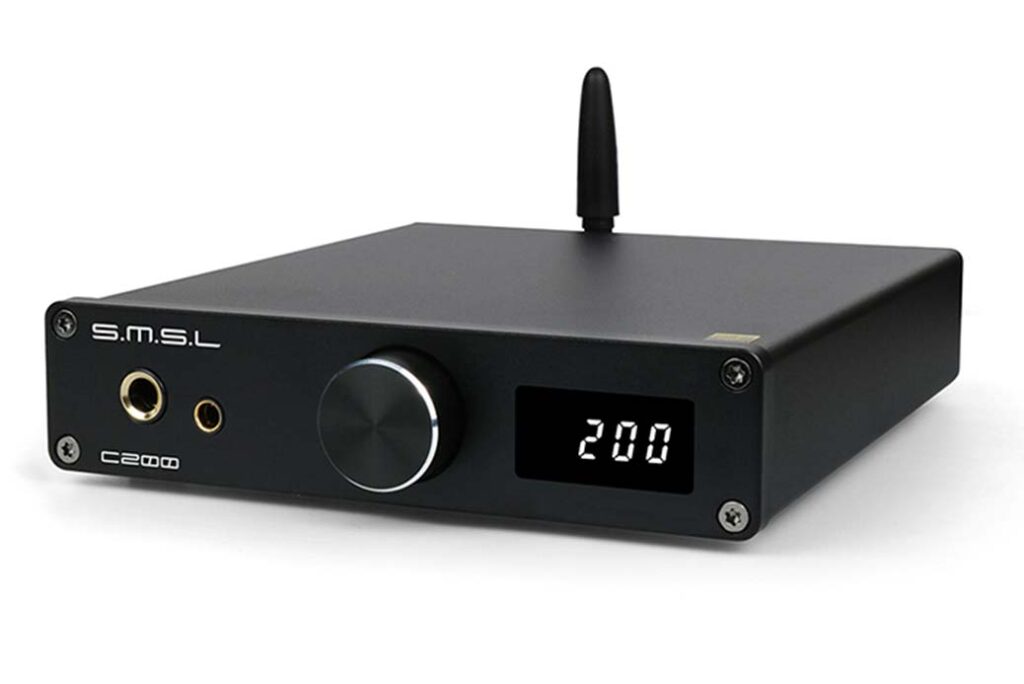
The original S.M.S.L C200 is a compact DAC and headphone amplifier with more useful desktop connections than its plain appearance suggests. It can serve a computer, a second digital source and a pair of active speakers while keeping headphones within easy reach. This review concerns the original C200, not the later C200 Pro.
S.M.S.L C200 — A small desktop component with a clear purpose
The best argument for the C200 is the amount of everyday utility it fits into a small box. A desk does not always have room for a separate converter, headphone amplifier and monitor controller. A combined component can simplify that arrangement, particularly when the sources are digital and the speakers already contain their own amplification. Its restrained design should also be easier to place beside a laptop than a full-width hi-fi component.
A small front display and a multifunction control mean learning the menu is worthwhile. The included remote helps when the unit is tucked beside a monitor or used for speakers from a chair. That is useful flexibility, although a display designed for close operation is not the same as a large living-room interface. Plan where cables will sit before buying: headphone plugs need clearance at the front, while rear connections and their cable bends add to the total depth needed on a desk.
Inputs and what can connect
The official input list is USB, optical, coaxial and Bluetooth. At the back are RCA and TRS line outputs, with 6.35 mm and 4.4 mm headphone sockets at the front. These connections cover many straightforward desktop systems. There is no analogue input, HDMI ARC connection or speaker power stage. A passive loudspeaker therefore still needs an amplifier, and a turntable cannot be routed through the C200 as an analogue source.
Use USB for a compatible computer and keep optical or coaxial available for another suitable digital source. A television connection should be checked for stereo PCM output compatibility; this is not a surround decoder. With a game console, verify the available route rather than assuming every USB audio device will work directly. Some setups may need a separate compatible digital output path. An attractive list of sockets is useful only when those sockets match the equipment you intend to connect.
Headphone outputs: connector format is not a power upgrade
The manual specifies 1.3 W per channel into 32 ohms and provides low and high gain settings. That is a useful starting point for assessing desktop headphone needs, but it is a manufacturer rating rather than an Audio Review measurement. It is not a promise of unlimited drive with all planar headphones. A high-impedance model can need voltage, while a low-sensitivity model can make different demands; impedance alone is insufficient to settle compatibility.
The presence of a 4.4 mm socket should not be read as an automatic extra-power mode. The documentation gives one headphone-power specification, so select the socket that suits the cable rather than assuming a new balanced cable is essential. Avoid using connector shape as a substitute for understanding the output. Start at low gain, establish a comfortable range on the volume control and only increase gain if the headphone and recording actually require it.
For sensitive earphones, maximum wattage is seldom the main concern. Quiet operation and usable adjustment near normal listening levels matter more. A full-size headphone and a very sensitive earphone should therefore be checked separately, even when both fit the available sockets. This is a more useful approach than treating every device with a headphone jack as equally suitable for every pair of headphones.
Sound evidence and realistic expectations
Prime Audio’s original C200 review found it clean and engaging with several headphones and earphones, with favourable comments on background noise and its overall desktop performance. That supports a positive recommendation for the intended role. It does not establish a universal sonic signature for every system, and the review’s subjective observations should remain attached to that reviewer’s equipment and listening conditions.
A sensible expectation is a capable way to get audio out of a computer and into headphones or speakers, without requiring a large stack. If the existing computer output has an inconvenient level control, lacks the right connections or struggles with a particular headphone, those are practical reasons to consider the C200. If the present setup is already quiet and sufficiently powerful, the change may be more about convenience than a dramatic transformation in sound.
When comparing, keep the listening level consistent and use music you know. Dense arrangements help assess whether a system remains comfortable and intelligible; quiet passages help expose unwanted noise. Neither test requires an exotic high-resolution file. Headphone fit, loudspeaker position and the recording itself remain large influences on the result. The C200 should be judged as one functional part of that chain, rather than asked to correct every weakness elsewhere in it.
Line outputs and active-monitor use
Official specifications give a maximum of 4 V for the TRS line output and 2 V for RCA, and the connection diagram identifies the rear TRS sockets as balanced line outputs. Each rear TRS socket carries one channel, so these are not a second pair of headphone sockets. Use the correct left and right interconnects for the receiving speakers. A cable that physically fits is not always wired for the job you want it to perform.
For active monitors, begin with their input sensitivity or gain reduced and the C200 at a low volume. Confirm both channels before increasing playback level. Decide where everyday volume adjustment will happen and keep the arrangement consistent. Feeding a conventional integrated amplifier is also possible through a suitable line input; its own volume control then remains part of the setup. These outputs do not provide crossover management or room correction, so adding a subwoofer requires an appropriate plan elsewhere in the system.
USB files, Bluetooth and ownership
The stated USB format ceiling is PCM 32-bit/768 kHz and native DSD512. Those numbers describe supported data formats with compatible software and drivers. They do not mean a normal CD-quality recording becomes better merely because the computer converts it to a higher rate. Stable playback at an appropriate setting is a better starting point than chasing the largest indicator on the display. Check the operating system’s selected audio device before investigating more complicated causes of silence.
Bluetooth is useful for a quick phone connection, and the official codec list includes LDAC, aptX variants, SBC and AAC. The connected source and its settings determine what is actually negotiated. Wireless convenience should not be confused with an independent streaming system: the phone or other sending device still supplies the programme and interface. A separate network player may be preferable if the goal is music without relying on a phone connection.
For buying value, compare the original C200 against current alternatives and the later Pro model with care. A familiar name does not mean identical hardware or performance. European pricing, included VAT, local returns and support can change which version is the better purchase. The original remains interesting when offered at a sensible price for its role, particularly for a listener who wants to keep the setup compact rather than continually add separate boxes.
Alternatives to consider
Topping DX3 Pro+: A relevant compact all-in-one alternative. Compare the headphone connector and line-output arrangement against your actual cables and speakers.
FiiO K7: Consider this when a desktop headphone amplifier is the central priority. Check source connections and the available space before choosing between them.
S.M.S.L C200 key specifications
- Model
- Original C200; not C200 Pro
- Inputs
- USB, optical, coaxial, Bluetooth
- Headphone sockets
- 6.35 mm and 4.4 mm
- Line outputs
- RCA and balanced TRS
- Maximum line levels
- 2 V RCA; 4 V TRS
- Rated headphone power
- Manufacturer: 1.3 W/channel at 32 ohms
- USB decoding
- PCM up to 32-bit/768 kHz; DSD512
Verdict
A well-judged compact digital desktop hub with headphone outputs, useful line connections and positive original review evidence. Its strengths are convenience and breadth at a sensible price; it should not be mistaken for a speaker amplifier, analogue preamp or a higher-power device simply because it has a 4.4 mm socket.
Primary documentation and independent reviews
S.M.S.L official C200 specifications · S.M.S.L C200 manual · Prime Audio original C200 review
Editorial record
Sources and updates
Product specifications and factual claims were checked against Official S.M.S.L C200 product page ↗. Scores and buying advice follow our category-specific editorial methodology.
- Published
- November 8, 2026
- Last updated
- November 8, 2026