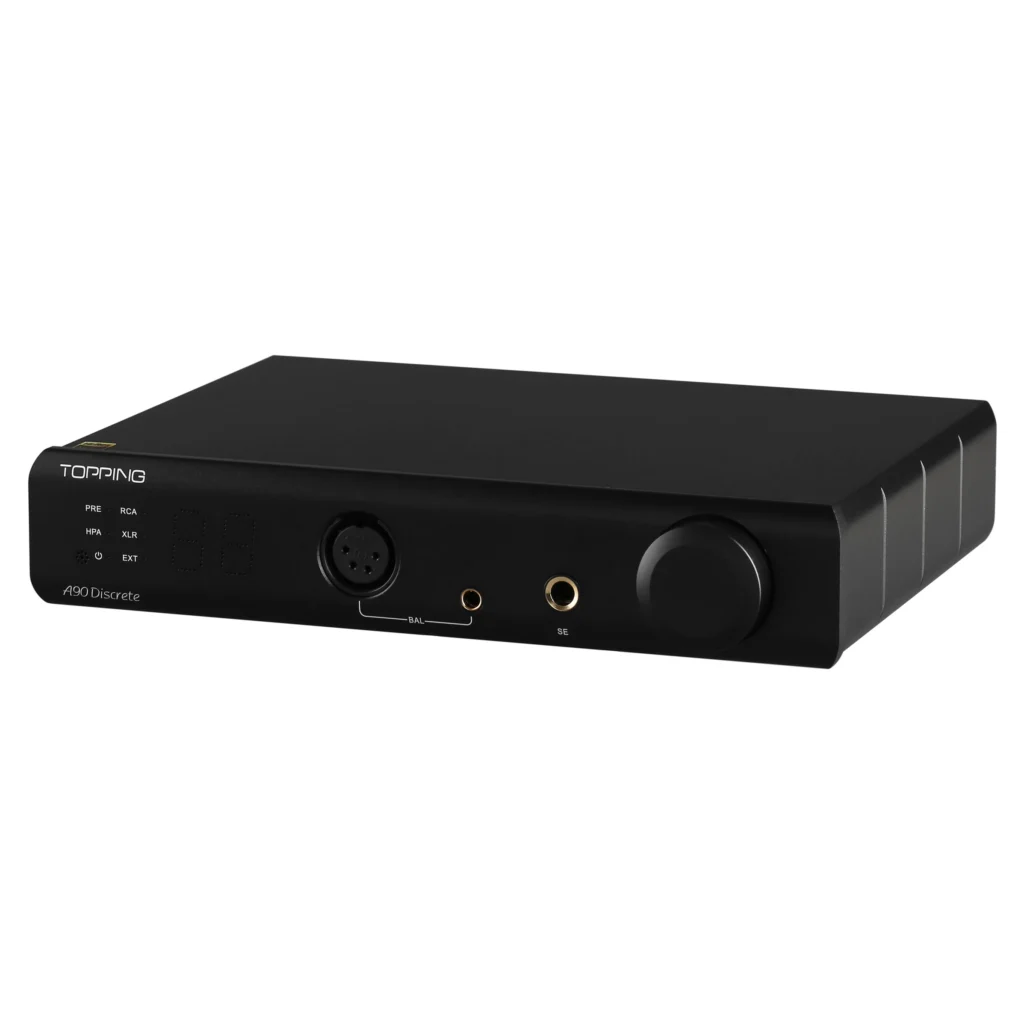
The Topping A90 Discrete is an analogue headphone amplifier that can also control a speaker-based system as a preamplifier. Its attraction is substantial headphone headroom, remote-controlled volume and a useful choice of connections. It needs a separate analogue source such as a DAC: the rear USB connection is for firmware work, not a built-in computer-audio input.
Topping A90 Discrete — Design and the analogue role
The A90 Discrete uses a compact case with a visible volume display and several headphone connections on the front. The display and remote make it more convenient as a preamplifier than a headphone-only box with an unmarked analogue knob. It can sit close to the listener on a desk or serve an active-speaker system from farther away. Cable layout and access to the volume control should follow the intended role.
RCA and XLR analogue inputs connect a suitable DAC or other line-level source. A phone or computer does not become a compatible digital source merely by being attached to the firmware USB socket. Similarly, a turntable requires a suitable phono stage before feeding these inputs. The A90 amplifies and controls an analogue signal; it does not supply digital conversion or cartridge equalisation.
This separation is useful when a good DAC is already owned or the owner wants to choose conversion and amplification independently. It is less economical if the entire headphone system is being built from scratch on a strict budget. Include the source, interconnects and desk space in the comparison with an integrated DAC and amplifier. A matching stack can be attractive, but the two boxes have separate jobs and separate costs.
Headphone outputs and sensible connections
The front provides a 6.35 mm single-ended socket and balanced 4.4 mm and four-pin XLR sockets. These cover many existing headphone cables, but cable wiring matters as much as plug size. A balanced headphone output should be used with an appropriately wired cable. A simple adapter that joins the separate output returns is not a sensible way to make a single-ended headphone behave as a balanced load.
Balanced outputs can provide more available power, but they are not automatically preferable for every headphone. A sensitive dynamic model may already have ample level from the single-ended socket, while a less sensitive planar can benefit from greater headroom. Choose the connection that suits the actual cable and required level. Buying a new cable solely to use another socket may offer little practical benefit if the existing arrangement is already quiet and sufficiently powerful.
Use a repeatable connection routine and begin at low volume after changing headphones. Different sensitivity and impedance can make the same displayed setting produce very different loudness. The gain selection and safe-volume facility are useful tools for keeping operation predictable. They should be understood before swapping between a sensitive in-ear monitor and a less efficient full-size headphone.
Power ratings and gain matching
Topping’s manual lists up to 6.7 watts per channel into thirty-two ohms from the balanced outputs at less than 0.1 percent THD+N, with different figures for the single-ended sockets and other loads. The conditions matter. A low-impedance power headline cannot be assumed to describe the voltage available into a high-impedance headphone or the noise heard through a very sensitive earphone.
Headphone suitability depends on sensitivity and the required listening level as well as impedance. A nominal impedance alone does not establish whether an amplifier is necessary or how much power will be used. The A90 Discrete offers substantial capacity for many desktop headphones, but the lowest useful gain is generally the sensible starting point. That gives a more manageable volume range and reduces the chance of an unexpectedly large level change.
Extra power should be treated as reserve for the relevant load rather than a target to use. A headphone that already reaches the desired level cleanly will not automatically improve because the amplifier can supply far more. The practical audition should include the owner’s actual headphones and normal volume, checking low-level channel balance, audible noise and the amount of adjustment available around a comfortable setting.
Volume control and preamplifier operation
The relay-based volume arrangement, numeric display and remote are useful when the A90 serves both headphones and speakers. The headphone and preamplifier output modes should be configured deliberately. Confirm whether speakers remain active when headphones are selected and whether the chosen memory behaviour recalls the level expected. A mixed desktop system benefits from a simple routine that can be understood without revisiting the manual every evening.
The RCA and XLR line outputs feed active speakers or a separate power amplifier. They do not directly power passive loudspeakers. Check the downstream amplifier’s gain and input sensitivity, because a powerful preamplifier output is not a reason to use excessive level. An active-speaker installation should start with sensible gain settings so that the A90’s normal listening range is comfortable and repeatable.
The optional EXT90 increases source-input provision, which can make the A90 more useful as a compact analogue control centre. Include that accessory’s cost and space if several analogue sources are required. A system with only one DAC may never need it. The same principle applies to trigger functions: they are valuable when they simplify power sequencing, but unnecessary complexity should not be added merely because another control socket exists.
What the original reviews establish
Soundnews’ original A90 Discrete review praised its transparency, available drive and usefulness with a broad headphone selection. It also reported troublesome behaviour around its sample’s 6.35 mm connection. Those are observations from that review’s unit and period, not evidence that every current unit has the same issue. They justify checking ordinary connection and muting behaviour on the actual unit being purchased.
Positive Feedback evaluated the A90 Discrete specifically as a preamplifier and found it a highly capable, unobtrusive part of that system. The author explicitly did not test it as a headphone amplifier, so that conclusion should remain attached to preamplifier use. Audio Review has not performed its own listening or bench tests on this model. The two sources provide complementary evidence rather than one universal measurement of every role.
A useful comparison keeps the source, headphones and volume consistent. An amplifier that plays slightly louder can appear more forceful or detailed in a quick demonstration. Avoid deciding the result from topology alone: discrete circuitry is an implementation choice, and the full design and matching still determine performance. Choose the A90 because it operates well with the intended load and control arrangement, not because one circuit category is assumed always superior.
Daily setup and troubleshooting
An analogue desktop chain can expose grounding or source-noise problems. If hum occurs, inspect the entire connection path and use only the manufacturer’s documented controls and procedures. Randomly replacing cables or adding components can obscure the cause. Establish whether the noise follows the source, input or output before changing the system. A quiet baseline is more useful than a stack assembled around an unresolved problem.
Keep signal and power connections accessible and avoid stiff heavy cables pulling a small component backwards. A remote-controlled preamplifier should also have a clear mute and standby routine. Check normal input switching, level memory and output selection with the finished system. These ordinary operations are worth more to long-term satisfaction than repeating a maximum-output demonstration that the owner will never use.
Value and buying advice
The A90 Discrete makes a strong case for someone who already owns a suitable DAC and wants a capable headphone amplifier with preamplifier duties. It is particularly useful where several headphones have different requirements and the owner values remote control and visible level settings. A listener using only an easy-to-drive headphone from one computer may find a simpler integrated solution more economical.
Compare current European price, local service and any accessories required. Test the exact unit’s headphone connection behaviour and the volume range with the intended headphones. Published enthusiasm supports a shortlist, but it does not replace checking that the system is convenient and quiet at home. The A90’s value lies in capable amplification and practical control used regularly, with its analogue-only role understood from the start.
Alternatives to consider
iFi ZEN CAN 3: Compare if a simpler analogue headphone amplifier and its adjustment options better fit the system.
FiiO K7: An integrated DAC-and-amplifier route when a separate digital source would otherwise be required.
Topping A90 Discrete key specifications
- Role
- Analogue headphone amplifier / preamplifier
- Inputs
- Stereo RCA and XLR; optional EXT90 expansion
- Headphone outputs
- 6.35 mm single-ended; 4.4 mm and 4-pin XLR balanced
- Line outputs
- Stereo RCA and XLR
- Published balanced power
- 6.7 W/ch into 32 ohms, THD+N <0.1%; other loads and outputs differ
- Gain
- Low / high
- USB
- Firmware interface; not audio input
Verdict
The Topping A90 Discrete is a strong analogue amplifier and preamplifier option for an existing desktop source system. Its output choices, headroom and remote control are practical strengths. Match gain to the headphones, check ordinary connection behaviour and include a separate DAC when computer playback is needed.
Primary documentation and independent reviews
Topping official A90 Discrete information · Topping official A90 Discrete manual · Soundnews original A90 Discrete headphone-amplifier review · Positive Feedback original preamplifier evaluation
Editorial record
Sources and updates
Product specifications and factual claims were checked against Official Topping A90 Discrete product page ↗. Scores and buying advice follow our category-specific editorial methodology.
- Published
- November 8, 2026
- Last updated
- November 8, 2026