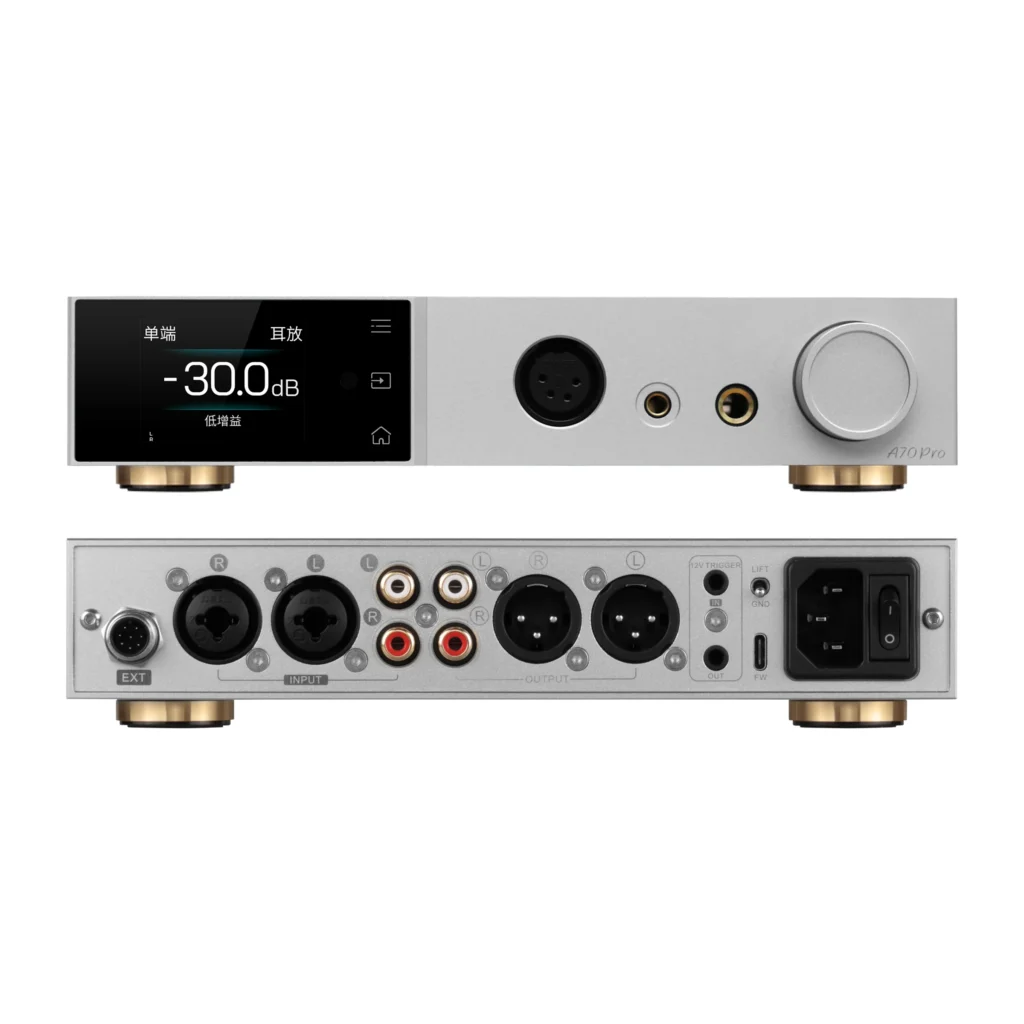
Topping A70 Pro is an analogue headphone amplifier with balanced and single-ended connections, relay volume control and useful preamplifier output options. Its screen can make it look like a combined DAC and amplifier, but it does not convert USB or other digital audio. This research-based review examines the positive original performance evidence and the operating details that matter with headphones and active speakers. Gain, cable wiring and output modes deserve at least as much attention as the substantial available power.
Research-based review. This assessment draws on manufacturer documentation and the original published evaluations linked below. Audio Review has not performed a hands-on test of this model.
Strong performance evidence from an original system evaluation
Soundnews’ original D70 Pro and A70 Pro evaluation describes the amplifier as clean, dynamic and capable with demanding headphones. The source also reports substantial available drive. Those observations are useful evidence, but they are not Audio Review listening results or a guarantee for every headphone pairing.
Audition with the intended source and transducers at matched listening level. More available gain can sound initially more energetic simply because the playback is louder. Assess quiet passages, background noise and the range of comfortable volume adjustment as well as demanding musical peaks. A headphone that reaches suitable level from a modest amplifier does not automatically improve because a larger one is connected. Conversely, a difficult load may expose limitations that are invisible in a casual demonstration. The A70 Pro deserves consideration as a serious amplifier, with the final recommendation tied to the actual headphone and practical control range. It is not necessary to justify it through claims that every listener needs a large power reserve.
An analogue source is required
The rear connections accept stereo RCA and balanced analogue input through XLR/TRS combination sockets. The unit also supports an optional compatible input extender. There is no internal DAC, Bluetooth receiver or native network playback function.
Connect a DAC, suitable player or other correct line-level source. A USB port associated with firmware maintenance is not a computer-audio input. A bare turntable output is also not an ordinary line-level source; it needs the appropriate phono stage elsewhere. Check the output level of the connected source and start conservatively. A source with unusually high output can make gain and volume adjustment less convenient even when the connection is electrically supported. Balanced and single-ended routes should be selected for the actual equipment rather than for appearance. If a phone or laptop is the only source, a combined DAC and headphone amplifier may be simpler and less expensive. The A70 Pro makes sense when separate analogue amplification is an intentional part of the system.
Low and high gain serve different headphones
The official manual documents two gain levels. Its relay volume arrangement and stored settings are useful tools, but they do not remove the need to establish an appropriate operating range for each headphone.
Begin with low gain and check quiet listening, left-right consistency and background noise. Sensitive earphones and less sensitive full-size headphones can demand very different control behaviour. Impedance alone does not define the required drive, so consider sensitivity and actual musical level rather than choosing a setting by a single number. Turn volume down before changing headphones or connection type. A saved setting may belong to a previous output configuration, not the new headphone. The knob position is not a percentage of maximum electrical power. The ideal arrangement provides enough headroom without compressing normal listening into a tiny range. An amplifier that is impressive at its limit should still be judged by how comfortably it handles ordinary sessions at the level a listener actually uses.
Balanced headphone outputs require correct wiring
The front offers 6.35 mm single-ended output and balanced connections through 4.4 mm and four-pin XLR sockets. These are headphone outputs. They must not be confused with balanced line inputs or with an interchangeable socket that accepts any adapter.
Use a correctly wired cable intended for the headphone and amplifier. Do not join independent negative channels through a common-ground adapter. A proper single-ended connection can remain entirely satisfactory for an easy-to-drive headphone, so there is no need to buy another cable solely to use the balanced label. When comparing suitable outputs, match loudness and assess the actual result rather than interpreting increased level as better detail. Check that a cable is long enough for normal movement and that a heavy connector does not strain the socket. The useful feature is choice across supported headphone arrangements. It does not make an incompatible wiring scheme safe, and it does not establish that every balanced connection is superior in every listening situation.
Preamp modes need a deliberate speaker routine
Topping documents separate HPA and PRE roles as well as a combined HPA+PRE mode. Rear RCA and XLR outputs can therefore serve suitable downstream equipment. In the combined mode, headphone listening should not be assumed to silence every connected speaker path.
Configure the intended output role before starting a private listening session. Check the active speakers or power amplifier at a low level and confirm what remains audible when headphones are connected. Stored volume settings can make transitions convenient, but they should be verified rather than trusted blindly after a change of equipment. The 12V trigger connections can coordinate compatible power switching; they do not transport audio or replace volume control. Follow the manuals at both ends. This flexibility makes the A70 Pro useful for a desktop that alternates between headphones and speakers. The benefit depends on predictable switching and sensible gain. A simpler amplifier may be preferable if several output modes would create confusion for other people using the desk.
Installation and package value matter alongside power
The A70 Pro combines an internal mains supply, a colour interface and a substantial control feature set. It needs space for analogue cables and a location that permits sensible ventilation. A visually matched DAC stack is optional rather than a requirement.
Include the source, interconnects, correct headphone cable and any missing remote in the total cost. If hum appears, investigate the supported signal-ground options and the complete connection chain; never defeat protective mains earth. A ground-related switch should not be described as a universal cure for all noise. Check the exact model label and relevant support instructions before firmware maintenance. For a used example, test both gain levels, required inputs, volume operation and intended output modes. A high maximum rating is only one part of ownership. The stronger reason to buy is a system that benefits from clean amplification, flexible analogue routing and dependable everyday control. Those qualities can justify a separate amplifier without promising improvements that have not been demonstrated with the buyer’s own headphones.
Alternatives to consider
Topping A90 Discrete: Compare the analogue switching and volume routine with the actual headphones and source. A familiar control layout may matter more than cosmetic matching.
Topping L70: Assess how much amplifier and preamplifier flexibility the system really needs. Include source cost and correct headphone cables before comparing package prices.
Topping A70 Pro key specifications
- Role
- Analogue headphone amplifier and preamplifier; no DAC
- Inputs
- Stereo RCA and balanced XLR/TRS combination inputs
- Optional expansion
- Compatible EXT90 input extension
- Headphone connections
- 6.35 mm single-ended; 4.4 mm and four-pin XLR balanced
- Preamp outputs
- RCA and balanced XLR
- Gain
- Low and high
- Output roles
- HPA, PRE and combined HPA+PRE modes
- Volume
- Relay control with independent stored output settings
- Integration
- 12V trigger input and output
- Size / weight
- Approximately 222 × 176 × 48 mm; 1.27 kg
- Not provided
- Digital audio conversion, network streaming or Bluetooth
Verdict
A70 Pro is a capable research-based analogue amplifier choice with useful volume and preamplifier control. Confirm the source, gain range and correctly wired headphone route, then verify speaker behaviour in the chosen output mode. It offers substantial flexibility, with the best value in a system that actually uses its separate amplification and routing facilities.
Documentation and original reviews
Topping official A70 Pro product · Topping official A70 Pro operating manual · Topping official A70 Pro control and relay overview · Soundnews original A70 Pro and D70 Pro evaluation
Editorial record
Sources and updates
Product specifications and factual claims were checked against Official Topping A70 Pro product page ↗. Scores and buying advice follow our category-specific editorial methodology.
- Published
- November 17, 2026
- Last updated
- November 17, 2026