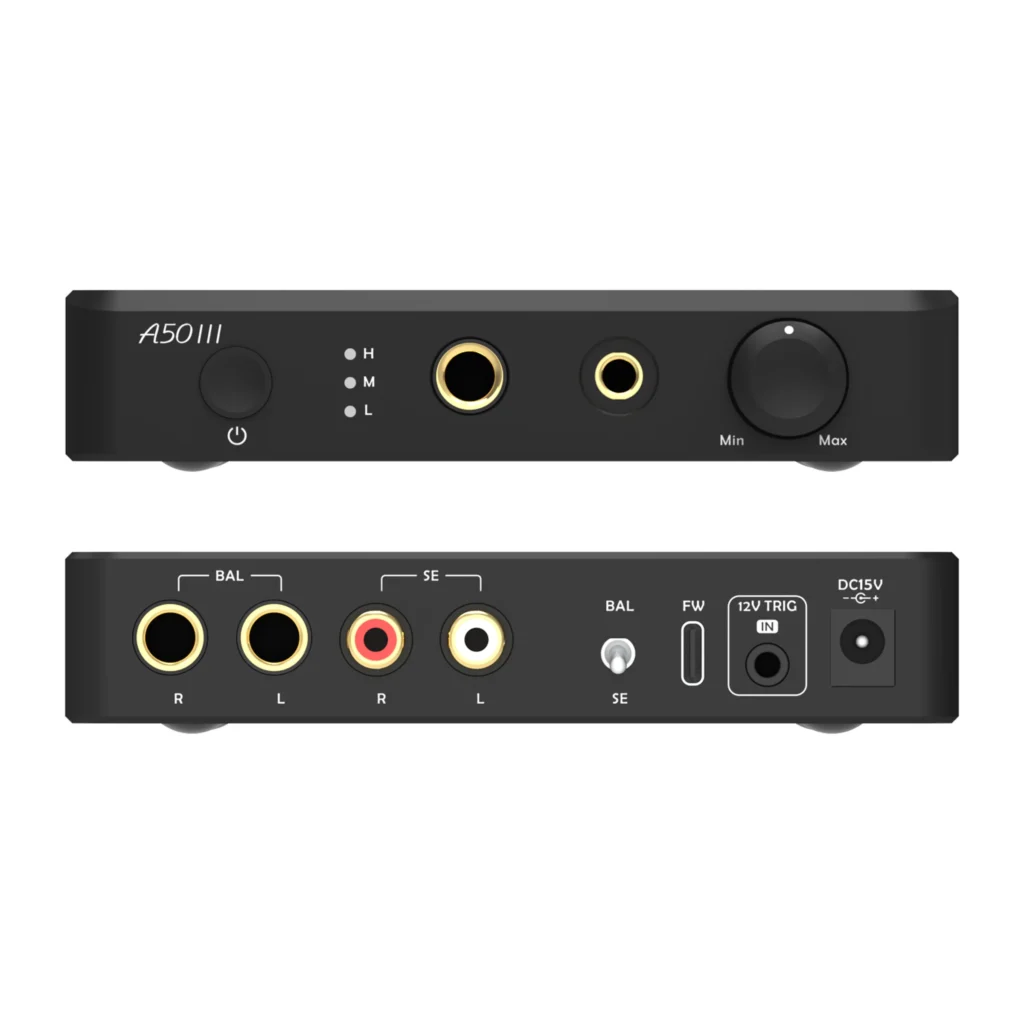
Topping A50 III is a small analogue headphone amplifier designed to work after a separate DAC or other suitable line source. It offers single-ended and balanced headphone connections with three gain levels, but no digital conversion, Bluetooth or network playback. Its USB-C port is for firmware. This research-based review considers positive original evidence for clean drive and practical gain flexibility while separating the amplifier’s role from the matching D50 III. The useful decision is whether it improves the actual headphone chain, including source level, wiring and everyday volume control.
Research-based review. This assessment draws on manufacturer documentation and the original published evaluations linked below. Audio Review has not performed a hands-on test of this model.
Clean headphone drive is the original-review strength
Headfonia’s A50 III evaluation describes a neutral, transparent presentation with useful performance across its tested earphones and full-size headphones. It also reports favourable low-gain behaviour with sensitive designs. Those observations come from the reviewer’s examples and system, not an Audio Review test or a guarantee for every headphone.
Try the actual pair and source before deciding. Compare at matched levels, including quiet passages where hiss, channel balance and useful volume adjustment are easier to assess. A powerful amplifier is not automatically better for sensitive earphones if the gain or control range is inconvenient. With a more demanding headphone, follow bass control and clarity as the level changes rather than listening only for maximum loudness. The original evidence supports a strong compact option. It does not mean that every headphone needs a separate amplifier or that replacing an already competent output will produce a dramatic change. A concrete improvement in usable level, noise or control is the better reason to add another component.
This is an analogue amplifier, not a combined DAC
The A50 III accepts RCA and balanced TRS line input. Its USB-C connection is a firmware interface, while the headphone jacks are outputs. It cannot accept a computer’s digital music directly and does not include Bluetooth reception.
Plan the upstream source before purchase. A separate DAC with a suitable line output can fulfil that role, but the matching D50 III is not compulsory. A phone or computer may need an external converter rather than a simple USB cable. Check source output level and the amplifier’s input selection. A balanced connection uses one channel per TRS line plug and should not be confused with a stereo headphone socket. Use correctly wired interconnects rather than an adapter chosen only because it fits. The separate-source arrangement can be flexible in an established system, but adds boxes and cost for a first-time buyer. Compare it with a combined unit using the actual complete connection path.
Gain flexibility is more useful than chasing maximum power
The amplifier provides low, medium and high gain. The manufacturer also supplies output figures tied to load and distortion conditions, including separate single-ended and balanced ratings. Those figures describe capability under specified conditions, not a requirement to use the highest gain or balanced connection.
Begin with the lowest gain that provides adequate level and headroom for the intended headphone. Assess the range of comfortable adjustment rather than aiming for a particular knob position. Headphone sensitivity matters alongside impedance, and a low-impedance planar can present different demands from a sensitive earphone. A volume setting is not a direct percentage of available power. Keep source level consistent when comparing outputs and do not interpret a louder route as inherently higher quality. A stronger output can be useful when a real headphone needs it. It provides less practical value if the existing source already drives the pair cleanly and comfortably. The A50 III’s three gain levels are valuable because they help fit different loads to a sensible control range.
Balanced headphone wiring needs an appropriate cable
The front panel provides 6.35 mm single-ended and 4.4 mm balanced headphone outputs. A balanced output is not simply an alternative socket for any ordinary common-ground cable. The headphone wiring must suit the connection.
Use the cable arrangement supported by the headphone and amplifier instructions. Do not join separate negative output channels through an improvised balanced-to-single-ended adapter. Changing plug size alone does not turn a shared-return cable into independent balanced wiring. A single-ended connection can remain entirely suitable and should not be dismissed because a larger balanced power figure is advertised. Compare at matched level if both correctly wired routes are available. Include any genuinely required cable in the system price, but avoid buying one merely to satisfy a specification preference. The goal is safe, predictable and useful operation with the actual headphones. A well-matched single-ended chain can be a better practical choice than a more complicated balanced arrangement that adds expense without solving a real limitation.
Power and trigger operation define the desktop installation
The official manual specifies an external fifteen-volt supply and a trigger input. The trigger is a control connection rather than a music source, while the firmware port has its own service role. The compact enclosure still needs sensible placement and connection access.
Use the correct supply and confirm that accessories are included in a used offer. Do not connect a supply solely because its barrel plug fits. If linking power behaviour to another component, verify compatible trigger operation and the resulting startup routine. Reduce volume before changing connections or listening modes. Check how the small amplifier sits with stiff interconnects and a heavier headphone cable attached. A neat stack can save desk space, but cables should not pull components towards an edge or obstruct controls. The A50 III does not provide a line pre-out for active speakers, so plan any speaker-switching requirement elsewhere. A complete desk check can reveal a more useful limitation than a few tenths of a watt in an output table.
Value depends on what the existing chain is missing
A compact standalone amplifier is particularly attractive when a satisfactory DAC already exists and the headphone output needs improvement. It is a less complete purchase for someone who still needs conversion, source switching and active-speaker control.
Compare current complete prices with interconnects and any necessary DAC included. Check support, correct power supply, input switching and both headphone outputs on a used or demonstration example. The original combined-stack review is positive, but the buyer should separate the contribution and functions of each component. Avoid purchasing a matching stack simply because the finishes align. Identify the actual problem first: inadequate level, poor gain range, audible noise or a needed connection. If none exists, a different headphone or better fit may have a larger effect on listening than another electronics box. The A50 III’s strongest value case is clean analogue drive with practical flexibility at a compact size. That remains a substantial recommendation without claiming universal headphone compatibility or built-in functions it does not have.
Alternatives to consider
Topping L70: Compare analogue input, output and control requirements with the actual headphone collection. A larger amplifier should provide a useful function rather than simply a larger number.
FiiO K9 AKM: Consider a combined DAC and headphone platform if digital conversion is also needed. Include the separate DAC and interconnect cost when comparing the compact A50 III.
Topping A50 III key specifications
- Role
- Analogue desktop headphone amplifier; no DAC
- Inputs
- Stereo RCA and balanced TRS pairs; input selector
- Headphone outputs
- 6.35 mm single-ended and 4.4 mm balanced
- Gain
- Three levels: low, medium and high
- Manufacturer 32-ohm output
- 1.4 W/channel single-ended; 2.7 W/channel balanced at stated THD+N below 0.1%
- Power
- External DC 15 V / 1 A supply per manual
- Control connections
- 12 V trigger input; USB-C firmware port
- Size / weight
- Approximately 125 × 26 × 140 mm including protrusions; 495 g
- Not provided
- Digital audio inputs, Bluetooth, native streaming, line pre-out or passive-speaker power
- Cable care
- Balanced headphone wiring must be compatible; do not combine negative outputs
Verdict
A50 III is a strong research-based compact analogue headphone amplifier for a suitably matched existing source. Its gain options and output flexibility are useful strengths. Confirm headphone wiring, source level and the correct supply, and remember that digital conversion remains separate. Compare the complete chain and choose it to solve a real listening or control need.
Documentation and original reviews
Topping official A50 III operating manual and output table · Headfonia original A50 III amplifier evaluation · Headfonia original D50 III / A50 III combined-system comparison
Editorial record
Sources and updates
Product specifications and factual claims were checked against Official Topping A50 III product page ↗. Scores and buying advice follow our category-specific editorial methodology.
- Published
- November 17, 2026
- Last updated
- November 17, 2026