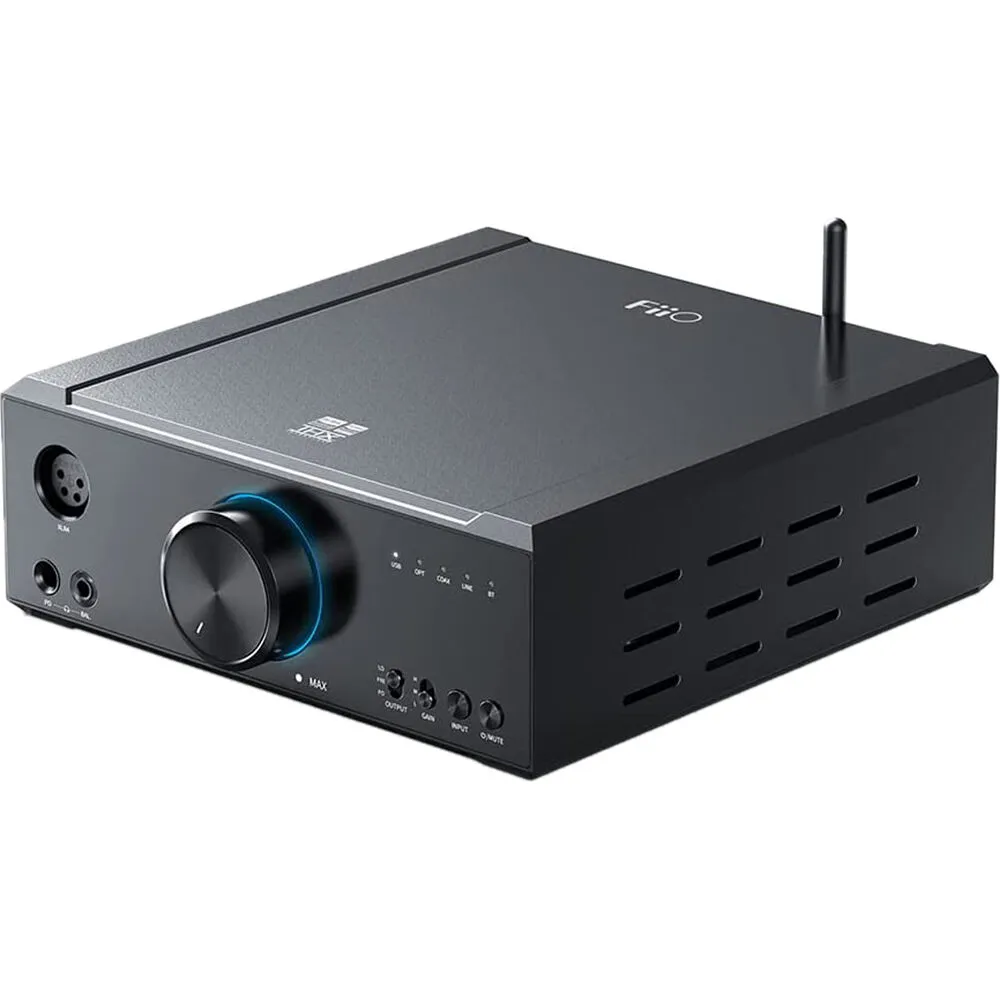
The FiiO K9 AKM is a desktop DAC and headphone amplifier for a system that needs more than a USB connection. It combines digital sources, analogue input flexibility and several headphone connections in a substantial single box. Its identity matters: this is the later K9 AKM with AK4191EQ and AK4499EX conversion, not the original K9 Pro AKM or the K9 Pro ESS.
FiiO K9 AKM — Design and the desktop experience
The large volume control and physical switches make the K9 AKM a component to operate directly rather than a miniature player to navigate through a screen. That is appealing when headphones are the focus and the amplifier sits beside the keyboard. Its enclosure can be placed horizontally or in the supplied vertical stand, giving some flexibility around monitors and other desk equipment. Check cable clearance in either orientation before deciding where it will live.
A substantial desktop box brings benefits and compromises. Plugs are less likely to drag it around than a lightweight dongle, but it occupies a permanent part of the desk and needs mains power. Keep the ventilation clear instead of filling every free surface around it. For a European installation, check the voltage selection and supplied power arrangement before first use. Establishing a safe, stable position and a readable view of the controls is more useful than simply finding the smallest possible footprint.
Connections and useful analogue flexibility
The K9 AKM accommodates USB, optical, coaxial and Bluetooth digital sources, alongside analogue input options. Its front headphone connections include 6.35 mm, 4.4 mm and four-pin XLR, while RCA and XLR line outputs serve compatible downstream equipment. Unlike a digital-only DAC and amplifier, it can also be used with an external analogue source. That makes it easier to keep a favourite separate DAC in the system or add a suitable line-level output from another component.
A turntable still requires phono equalisation and gain before reaching a line input. A raw cartridge signal is not interchangeable with a normal line-level source. Similarly, the rear line outputs cannot power passive speakers: use active speakers or a separate amplifier. Thinking through those two distinctions before buying prevents a versatile headphone component from being mistaken for a complete stereo integrated amplifier. The best use of its flexibility is a clearly planned source and listening arrangement, not simply connecting every available socket.
Headphone drive and sensible matching
FiiO quotes balanced output up to 2 W into 32 ohms and 780 mW into 300 ohms at its stated one-percent distortion boundary. These figures are manufacturer ratings rather than our measurements. They describe useful desktop capability, but the headphone’s sensitivity and voltage or current requirements still decide whether a pairing is appropriate. A nominal impedance number by itself cannot establish how loud a headphone will play or how much headroom a recording needs.
The three gain settings are valuable because not every headphone needs the same voltage range. Begin with the lowest setting and increase it only when normal listening needs more usable level. Sensitive earphones often benefit from finer adjustment rather than more gain. The balanced sockets offer a suitable route for headphones already wired that way, while the single-ended output remains useful for conventional cables. There is no reason to replace a perfectly suitable cable before checking how the existing one performs.
Headfonics’ original evaluation found the volume adjustment particularly usable and reported good results with several headphones, while finding a demanding 600-ohm pairing less convincing. That is a useful reminder that a flexible amplifier is not a universal one. Someone with an unusually difficult headphone should examine that exact pairing rather than infer compatibility from the size of the enclosure or the THX branding.
Sound quality and what the review evidence means
The Headfonics listening assessment described the K9 AKM as smoother and richer in character than the K9 Pro ESS used for comparison. That gives a helpful subjective perspective on the model’s positioning, but it should not become a rule that all AKM converters sound warm or all ESS converters sound bright. Circuit implementation, gain, level matching and the headphones used remain relevant. Our recommendation recognises the complete device and its practical role rather than assigning a personality to a chip name.
For a listener considering a change from an already competent DAC and amplifier, identify the expected benefit first. Extra inputs, a better volume routine or analogue source flexibility are tangible improvements. A more expensive converter may make a much smaller difference than changing an uncomfortable or poorly suited headphone. Compare familiar music at matched volume, keeping other settings fixed, and give longer listening comfort more weight than a momentary impression of extra sparkle.
The K9 AKM is especially attractive when its integrated design removes a troublesome connection between separate components. A single level control for several sources can make a listening desk easier to use every day. That convenience is a real part of value even if a comparison does not reveal a dramatic change in the recording’s tonal balance.
Bluetooth, app control and EQ boundaries
The official product page specifies Bluetooth receiving and FiiO Control app support. Crucially, it says its EQ and PEQ functions apply to Bluetooth decoding. App access from another input does not mean that a USB source automatically receives the same equalisation. If system-wide correction is a central requirement, verify the signal path and use suitable source-side processing where needed. This limitation deserves more attention than the number of preset names in the app.
Bluetooth is convenient for casual phone playback, but it is a receiving function here. It does not make the amplifier a transmitter for wireless headphones or wireless loudspeakers. The phone’s codec support and selected settings determine the actual connection. USB is often the more predictable choice at a computer desk, and documented UAC modes can help with device compatibility. Check the required mode for the source rather than assuming every game console behaves like a Windows or Mac computer.
Buying advice and long-term usefulness
The K9 AKM’s strengths suit an owner who expects the rest of the system to change. Analogue input means it can retain a role when an external DAC is added, while line outputs allow headphones and speakers to share the sources. That is a stronger ownership argument than the maximum USB format alone. The stated PCM 768 kHz and DSD512 support is a compatibility ceiling, not a reason to upsample every recording.
Before ordering, compare current EU pricing and local service against newer all-in-one models. Include the required cables and confirm the exact model name on the listing. A discounted K9 Pro, K9, K9 AKM and K9 Pro ESS should not be treated as interchangeable stock. If only one USB source and one easy-to-drive headphone are involved, a simpler amplifier may provide everything needed for less money and less space. The K9 AKM earns the extra investment when its broader role is actually used.
Alternatives to consider
FiiO K7: A simpler desktop path when the headphone system does not need the K9 AKM’s wider source and output flexibility.
FiiO K17: Compare this for a more elaborate desktop system. Make a list of the inputs and processing functions you need before paying for a larger feature set.
FiiO K9 AKM key specifications
- Conversion
- AK4191EQ and AK4499EX
- Amplifier
- THX AAA 788+
- Headphone outputs
- 6.35 mm, 4.4 mm and four-pin XLR
- Line outputs
- RCA and XLR
- Balanced rated power
- Up to 2 W at 32 ohms; 780 mW at 300 ohms, manufacturer one-percent boundary
- USB formats
- PCM up to 768 kHz/32-bit; DSD512
- EQ limitation
- Official page: Bluetooth decoding only
Verdict
A versatile and convincing desktop DAC and headphone amplifier, particularly for a desk mixing analogue and digital sources. Its useful gain control and flexible outputs are stronger reasons to buy than chip branding, while Bluetooth-only EQ and demanding headphone matching deserve attention.
Primary documentation and independent reviews
FiiO official K9 AKM product information · Headfonics original K9 AKM review · Headfonics headphone matching and connectivity
Editorial record
Sources and updates
Product specifications and factual claims were checked against Official FiiO K9 AKM product page ↗. Scores and buying advice follow our category-specific editorial methodology.
- Published
- November 8, 2026
- Last updated
- November 8, 2026