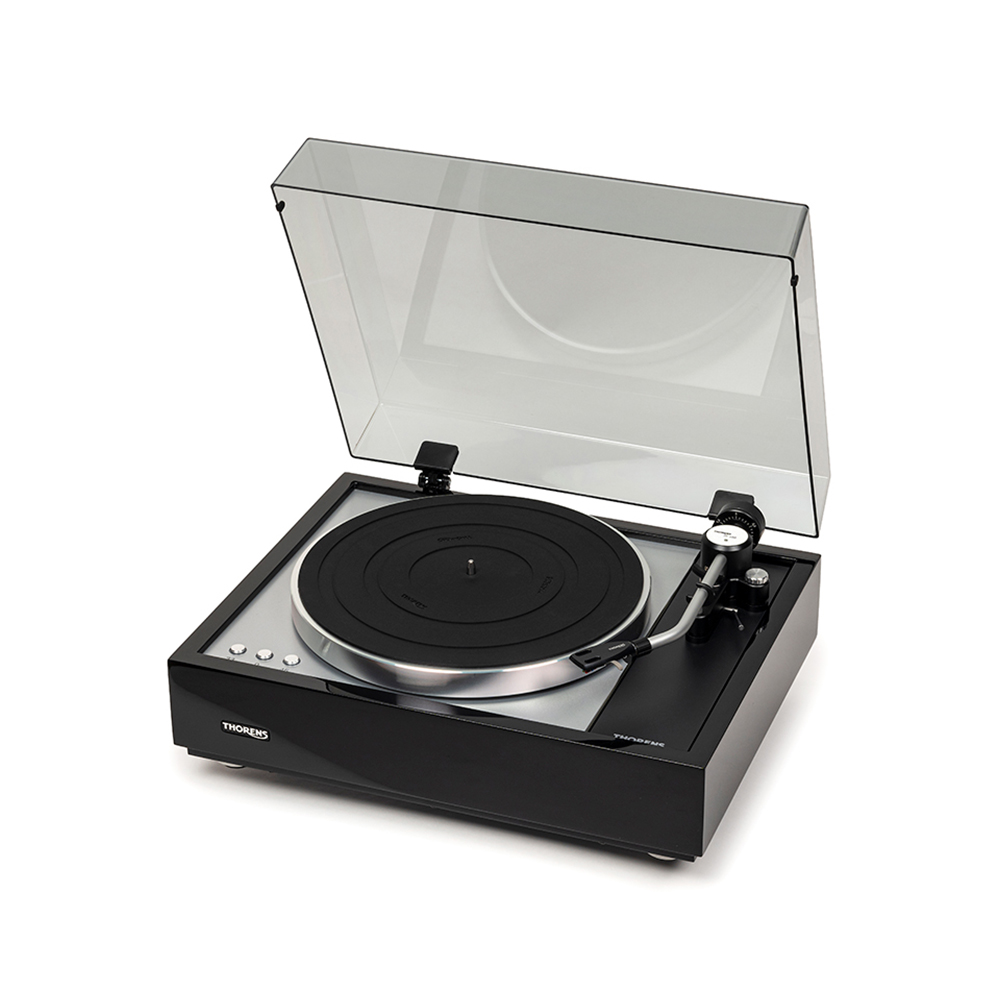
Thorens TD 1600 combines familiar suspended-turntable thinking with electronic speed control and a choice of arm configurations across its production history. This review focuses on the current TP 160 proposition. A listing for a TD 1600 with the older TP 92 is not the same package, even when the plinth looks almost identical. That distinction should be settled before comparing prices or applying a published sound assessment.
Research-based review. This assessment draws on manufacturer documentation and the original published evaluations linked below. Audio Review has not performed a hands-on test of this model.
Identify the arm before comparing offers
Thorens documents a TP 160 version with a J-shaped arm, knife-edge bearing and detachable SME-type headshell. Earlier documentation and stock use TP 92. The current brochure also describes retrofitting through Thorens, which is a service question rather than a reason to assume every used example has been upgraded.
Ask for a clear photograph of the actual arm and a written model description. Confirm which cartridge is fitted, whether alignment is included and whether the seller is offering a new complete package or a previously owned deck. These checks prevent a cheap-looking quotation from becoming an expensive surprise after purchase. They also make comparisons fair: the same turntable name can conceal a different arm, cartridge and condition. A review should guide that inspection rather than encouraging the buyer to ignore it because the cabinet and badge appear familiar.
Suspension supports the system, not careless placement
The official design places the subchassis on three damped conical springs, with a restraint intended to control lateral movement. The motor drives an aluminium subplatter by belt, and the deck uses a separate TPN 1600 supply. It remains a mechanical record-playing system rather than a device that eliminates every external disturbance.
Choose a level, stable support and keep access clear around the controls. If footfall or furniture movement causes the stylus to mistrack, solve the support problem instead of immediately changing cartridge settings. Have the suspension checked by someone familiar with this model when buying used or after transport. The purpose of the suspended construction is to manage mechanical interactions, but its actual success depends on correct installation. Store the original transport materials and ask the dealer how the subchassis and platter should be secured before a move.
What the TP 160 evaluation supports
HiFi-Advice’s original comparison finds the TP 160-equipped TD 1600 more refined, transparent and fluid than its older reference arrangement. It also reports clear differences between the TAS 1600 and TAS 1500 cartridges. Those findings support an audition of the complete current combination, not a claim that every cartridge will produce an identical tonal result.
For a useful demonstration, take records whose vocal balance and bass timing are familiar. Ask to hear a demanding inner groove as well as an easy opening track, and listen through louder ensemble passages. Keep notes about the cartridge and phono stage rather than memorising adjectives alone. A smooth presentation can be attractive, but it should preserve articulation and interest on the music the owner actually plays. The practical aim is a stable, enjoyable combination, not a promise that a newer arm automatically improves every possible system in the same way.
Balanced outputs still need a phono stage
Both RCA and XLR connections are part of the documented TD 1600 platform. Thorens describes the balanced route in conjunction with a moving-coil cartridge. These sockets carry the cartridge signal; they should not be mistaken for an amplified line output ready for any ordinary AUX input.
Confirm the cartridge type, phono-stage gain and loading before deciding which cable to buy. A compatible RCA phono connection is a perfectly relevant alternative when that is how the existing system is designed. XLR sockets alone do not establish an audible improvement, and a simple connector adapter does not recreate a complete balanced phono system. Plan the ground connection and cable route with the equipment instructions. If there is hum, investigate the actual installation before replacing major components. A coherent signal path matters more than selecting the visually more professional connector.
The manual TD 1600 ownership routine
The TD 1600 provides electronic speed selection but remains the manual member of this pair. The electric lift and contactless end-of-side stop belong to TD 1601. HiFi-Advice also notes the need for care with the manual cueing action and the suspended platform.
Try the arm lift in person and decide whether the routine is comfortable. Allow enough free space to move records without nudging the deck, and do not treat a detachable headshell as a guarantee of correct alignment after any cartridge swap. Different cartridges can require different tracking force, balance and geometry checks. A second ready-mounted headshell may make changes easier, but it still needs proper setup for the arm. If the owner often listens while occupied elsewhere, automatic lifting can be worth the higher model’s cost; it is a practical feature rather than an admission that manual operation is inferior.
Assess the complete price and service package
A TD 1600 quotation should identify the arm, cartridge, supply, cover, setup and warranty arrangements. Old launch prices and a bare deck are weak comparisons against a current configured European offer. On a used example, condition and service history can outweigh a modest price saving.
Inspect the arm bearings, headshell connection and cueing function with the seller rather than attempting intrusive checks. Ask how the deck was transported and whether the packing and documentation remain available. Reserve a realistic allowance for cartridge wear and professional setup over time. Buyers who enjoy configuring a vinyl system may find that flexibility appealing; those seeking a sealed plug-and-play appliance may prefer a simpler package. Good value here means obtaining the exact system that fits the records, room and intended level of involvement, with reliable support when adjustment or maintenance is eventually needed.
Alternatives to consider
Thorens TD 1500: TD 1500 is worth comparing when the preference is for a modern Thorens suspended design. Assess the complete cartridge and arm package, dealer setup and current price instead of choosing by the historic model number alone.
Technics SL-1200GR2: SL-1200GR2 provides a different direct-drive routine with familiar hands-on controls. An audition can establish whether the Thorens system earns its place; handling and ease of adjustment can matter as much as a shared premium positioning.
Rega Planar 6: Planar 6 offers a contrasting light, rigid approach to record playback. Compare complete systems with compatible cartridges and phono stages, allowing the listening preference and installation needs to decide rather than treating suspension as inherently superior.
Thorens TD 1600 key specifications
- Operation
- Manual
- Drive
- Belt
- Suspension
- Subchassis on three conical springs
- Speeds
- 33 1/3 and 45 rpm
- Speed selection
- Electronic
- Configuration discussed
- TP 160; older TP 92 versions also exist
- TP 160 headshell
- Detachable SME-type connection
- Outputs
- RCA and balanced XLR phono-level
- Supply
- External TPN 1600
- Automatic end lift
- No
- Dimensions
- 454 x 180 x 369 mm
- Weight
- 11 kg
- Tonearm effective mass
- 14 g for the TP 160
- Cartridge
- Not supplied in the standard Thorens TP 160 package.
Verdict
Thorens TD 1600 is a persuasive option for listeners who want a suspended platform and are willing to choose the cartridge and phono system carefully. The TP 160 evaluation provides meaningful support for the current configuration, while also demonstrating why arm and cartridge details cannot be ignored.
Buy the documented package, arrange proper setup and try the manual cueing routine before committing. Choose it for the sound and ownership approach that suit the actual system. If end-of-side lifting is a priority, compare the TD 1601 directly rather than assuming the two model numbers provide identical convenience.
Documentation and original reviews
Thorens official TD 1600 TP 160 product page · Thorens official TD 1600 and TD 1601 TP 160 brochure · HiFi-Advice original TD 1600 TP 160 test and configuration details · HiFi-Advice original listening comparisons and cartridge differences
Editorial record
Sources and updates
Product specifications and factual claims were checked against Official Thorens TD 1600 product page ↗. Scores and buying advice follow our category-specific editorial methodology.
- Published
- November 17, 2026
- Last updated
- November 17, 2026