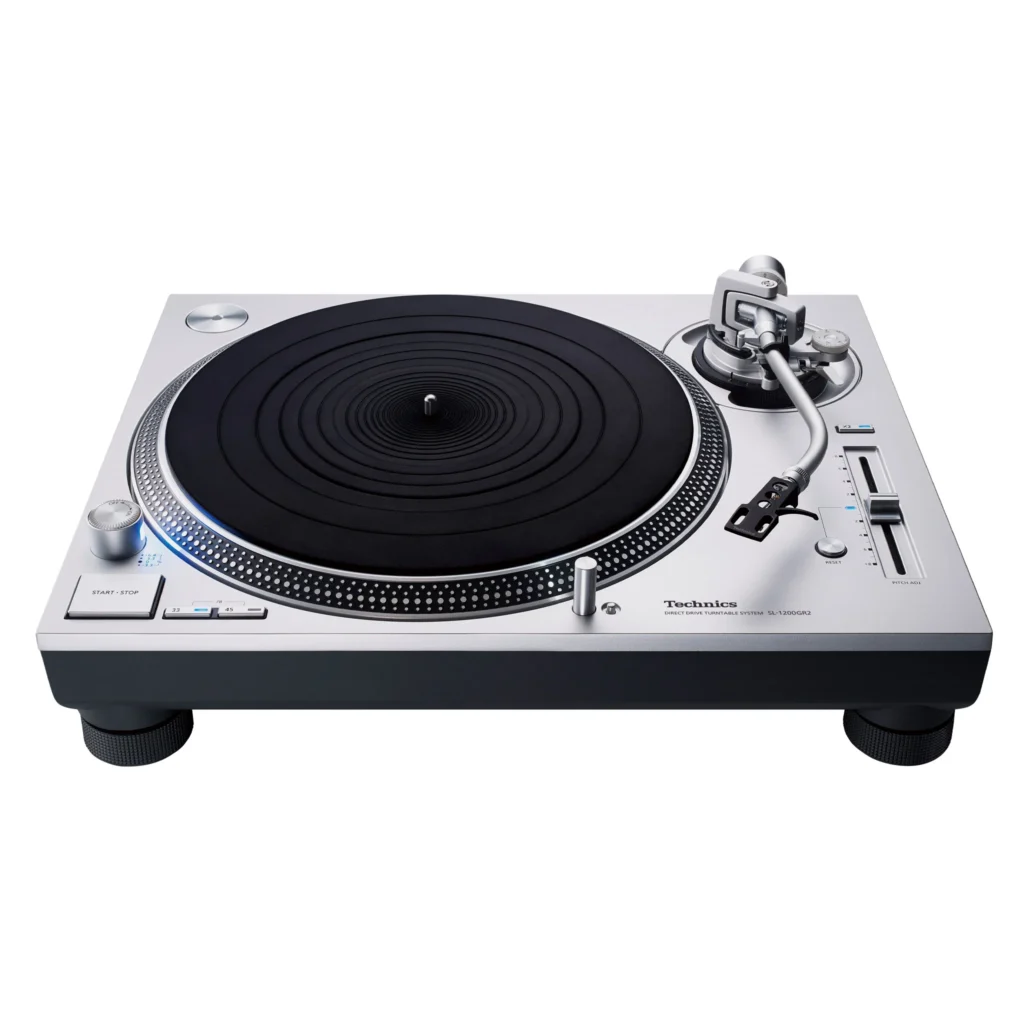
The Technics SL-1200GR2 combines familiar direct-drive controls with updated motor-drive electronics and a substantial mechanical platform. Its appeal is as much about dependable handling and adjustment as it is about sound. A detachable headshell, accessible arm-height adjustment and three speeds give it flexibility, but the cartridge and phono stage remain additional parts of the system.
Technics SL-1200GR2 — Construction and everyday usability
The SL-1200GR2 retains the recognisable layout of the SL-1200 family: a large start-stop button, speed controls, pitch slider and S-shaped arm. Those details do not make it merely a nostalgic DJ product. They give a home listener direct, understandable control of the record player. The conventional cover and substantial body are also practical for someone who prefers familiar handling to the more exposed skeletal form of some specialist hi-fi decks.
Technics specifies a weight of approximately 11.5 kilograms. That calls for suitable furniture and careful lifting, but it does not remove the need for isolation from footsteps or speaker vibration. Allow space behind the deck for connections and above it for the lid. Before installation, consider whether the chosen shelf lets the owner reach the cueing lever comfortably and change records without leaning over another component. Good ergonomics become more valuable with years of use.
What Delta Sigma Drive means
The GR2 introduces Technics’ Delta Sigma Drive motor-control system and a revised power-supply approach. The digital techniques concern the motor-drive signal; they do not mean the cartridge’s audio is automatically converted to digital. That distinction is useful for buyers puzzled by digital terminology on an analogue turntable. The cartridge still supplies a phono-level analogue signal to the connected phono stage.
Direct drive eliminates a belt between motor and platter, while electronic control maintains the selected rotation. Technics uses a coreless motor and a damped aluminium platter. These features describe the mechanical and control approach, but the manufacturer’s intended benefit should not be confused with a listening result independently established by Audio Review. We have not measured this turntable’s motor vibration or speed accuracy.
Hi-Fi News’ original laboratory report provides more useful evidence than a technology label alone, reporting very accurate pitch and examining rumble through different measurement paths. Those are the publication’s measurements on its sample. A single wow-and-flutter headline is not the whole story of record replay: the pressing, cartridge setup, arm behaviour and supporting furniture remain part of what reaches the speakers.
Tonearm and cartridge flexibility
The static-balance arm has a detachable headshell and a specified height-adjustment range of zero to six millimetres. That makes cartridge installation and changes more accessible than on a deck whose arm offers little adjustment. It does not make every cartridge automatically compatible. Check cartridge mass, headshell mass, mounting geometry and the available balancing weights before ordering a particularly light or heavy model.
No cartridge is included in the standard package. A retailer may offer a fitted combination, so distinguish that from the bare turntable when comparing prices. A good dealer can supply a compatible cartridge, align it and demonstrate tracking-force and anti-skate checks. The owner should still understand the settings, especially if a second headshell will carry another cartridge. A detachable headshell simplifies swapping, but it does not guarantee identical force or alignment between cartridges.
Choose the phono stage at the same time. A moving-magnet cartridge and a low-output moving coil can require very different gain and loading. The receiver or amplifier’s ordinary line input is not a substitute for a phono stage. If a package includes an external stage, check what happens when the cartridge is later replaced. A flexible turntable is most useful when the electronics preserve that flexibility rather than limiting future choices unexpectedly.
Speeds, pitch and manual operation
The GR2 supports 33⅓, 45 and 78 rpm, plus pitch adjustment. The third speed is a useful capability for a broader collection, but a modern microgroove stylus should not automatically be used for every historical 78. Appropriate stylus size and, where relevant, equalisation need checking for those records. Speed support alone does not establish complete compatibility with every record format.
For ordinary albums, the direct controls and electronic brake make operation straightforward. The arm remains manual: the owner cues it and returns it at the end of a side. Buyers wanting automatic return should treat that as a separate requirement. A deck can be easy to operate while still requiring attention when playback finishes. That distinction matters for someone who listens while working in another room or often falls asleep during a record.
Pitch adjustment is useful for specific material or deliberate changes, but normal reference-speed listening should begin with the appropriate standard setting. If pitch seems unstable on one record, check another known pressing before changing the turntable. An off-centre record can create audible variation that the motor cannot correct, because the problem is in the groove’s position relative to the spindle.
Published listening assessment
What Hi-Fi’s original review described clean, composed and weighty sound, while finding competing decks more insightful and rhythmically precise. It particularly valued the build and ease of use. Those observations support a balanced recommendation: the SL-1200GR2 is attractive as a complete ownership proposition, but should not be assumed the automatic sound-quality winner at every package price. They are not Audio Review listening results.
The audition should use a cartridge representative of the one being purchased and a suitable phono stage. A bare-deck comparison is incomplete when different cartridges supply the signal. Ask which cartridge, loading and gain are active, and keep playback levels comparable. Use familiar records with exposed voices and sustained notes as well as energetic music. The right combination should remain convincing after the initial impression of solidity has worn off.
The turntable’s adjustment facilities are valuable for an engaged owner, but they do not oblige constant modification. Start with a well-matched cartridge and correct setup. Changing mats, cables and cartridges simultaneously makes it difficult to identify what helped. A stable baseline is a better foundation for later experiments than assuming the stock product must immediately be rebuilt.
Placement, upkeep and value
A rigid level support, clean records and careful stylus maintenance are basic requirements. Keep the deck away from direct speaker vibration and inspect setup after moving it. Preserve the packing for transport, particularly the protection for the arm and separate platter. Direct drive removes belt replacement from ordinary ownership, but it does not eliminate stylus wear or the need for careful mechanical handling.
The best buyer values build, easy adjustment and a manual direct-drive routine, with enough budget left for a suitable cartridge and phono stage. Compare complete European package prices and local setup support. A lower-cost turntable supplied with a good cartridge may represent a very different total from the GR2 alone. Conversely, an owner who changes cartridges or plays several record types can derive real value from facilities that a simpler deck lacks.
Its silver SL-1200GR2 identity should also be distinguished from the black SL-1210GR2 and from the older GR generation. A colour variation does not justify pretending there is an entirely separate performance platform, while a generation change can involve meaningful electronics. Confirm the exact model on the box and invoice. Buy the GR2 because the whole package fits the intended use, not merely because the familiar outline evokes a durable older turntable.
Alternatives to consider
Technics SL-1500C: Compare a more convenience-focused Technics package and the total cost with cartridge and phono facilities.
Rega Planar 3: A different belt-drive approach worth auditioning as a complete cartridge package.
Technics SL-1200GR2 key specifications
- Drive / operation
- Direct drive / manual
- Speeds
- 33⅓, 45 and 78 rpm
- Motor control
- Delta Sigma Drive
- Tonearm
- Static balance; 230 mm effective length; detachable headshell
- Arm-height adjustment
- 0–6 mm
- Cartridge / phono stage
- Not supplied as standard / external stage required
- EU mains
- 220–240 V, 50/60 Hz
- Weight
- Approximately 11.5 kg
Verdict
The Technics SL-1200GR2 is a robust, flexible and enjoyable manual turntable whose handling is a major strength. Its updated drive system has useful independent technical coverage, while published listening comparisons leave room for strong rivals. Budget for the cartridge and phono stage, and audition the exact combination.
Primary documentation and independent reviews
Technics UK official GR2 specifications · Technics official product and motor-control information · Hi-Fi News original laboratory report · What Hi-Fi original GR2 review
Editorial record
Sources and updates
Product specifications and factual claims were checked against Official Technics SL-1200GR2 product page ↗. Scores and buying advice follow our category-specific editorial methodology.
- Published
- November 8, 2026
- Last updated
- November 8, 2026