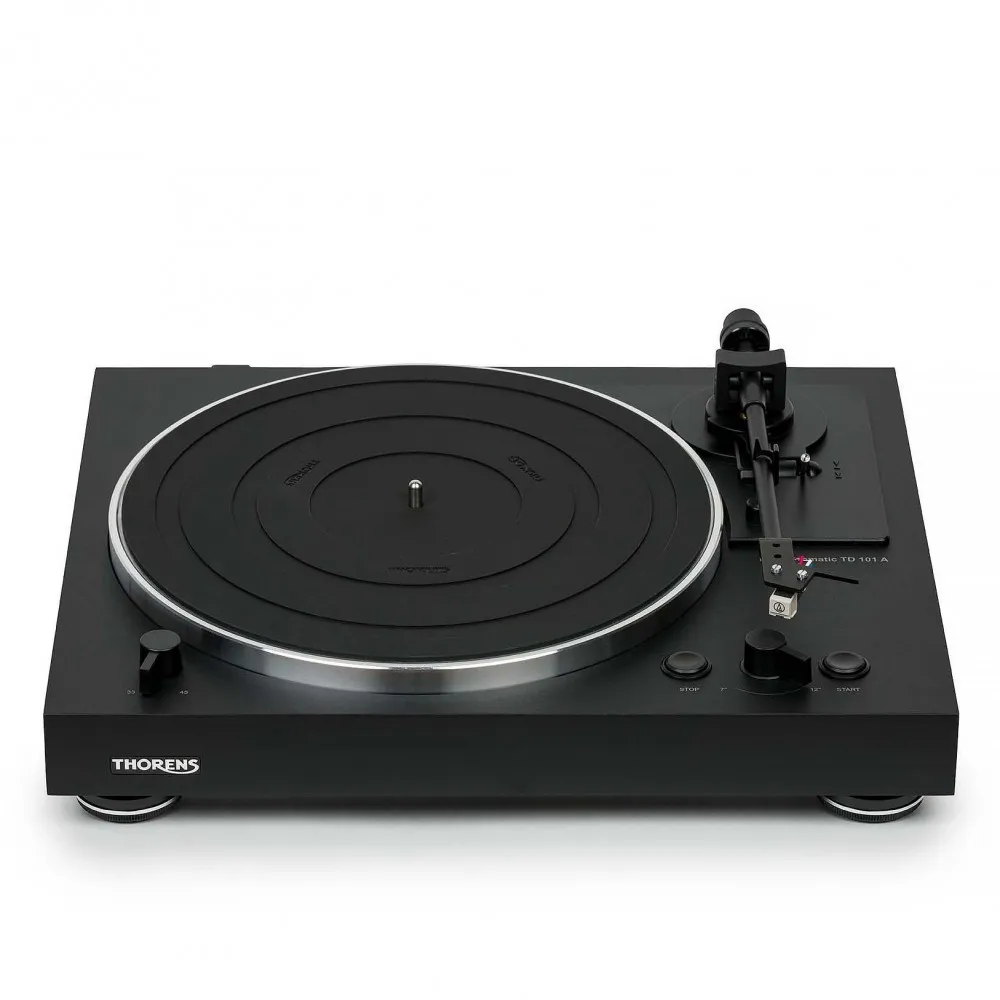
Thorens TD 101 A is a straightforward route into automatic vinyl playback. Its fitted Audio-Technica cartridge, independent size selection and switchable phono stage make a useful package for an owner who wants a clear daily routine. The original published test also identifies setup and sample-speed concerns that deserve attention rather than being hidden beneath the familiar brand name. This is best considered as an accessible complete record-playing arrangement, with sensible checks before purchase and realistic expectations about fine adjustment or later cartridge experimentation.
Research-based review. This assessment draws on manufacturer documentation and the original published evaluations linked below. Audio Review has not performed a hands-on test of this model.
An energetic presentation with entry-level limits
AUDIO’s original listening account describes direct, engaging playback with a prominent midrange and controlled bass. It also finds limited tonal nuance and detail, with more scope for dynamic improvement through the supporting phono arrangement. This is positive evidence for ordinary musical enjoyment, with clear limits on sophistication.
Choose a familiar vocal record and listen to complete phrases rather than only a dramatic opening. Check whether accompaniment stays easy to follow and whether the balance remains comfortable across a full side. Then try a dense or more forceful recording at the normal listening level. An accessible system can be enjoyable without exposing every small detail, but it still needs to communicate the music the owner cares about. Compare the complete supplied package at similar level against a relevant alternative. A dealer demonstration with different speakers or a different cartridge may be interesting without settling this purchase. The strongest case is a working basic arrangement that makes the owner want to play another record.
Automatic operation suits a conventional collection
The model combines automatic start and return with separate speed and record-size selection. That distinction is useful when size and speed do not follow the most common LP and single combinations. It also has a manual playing option.
Bring representative records into the buying decision. Check how the controls select the intended landing point, how stopping works, and whether everyone using the system understands the routine. The turntable should have enough clear space around it that no object obstructs the arm or cover. Do not interpret automatic playback as permission to leave a damaged or unfamiliar record unchecked. The benefit is reduced intervention during an ordinary listening session, particularly at the end of a side. A listener who enjoys choosing an exact starting track may still prefer manual cueing. Someone sharing a living-room system may value the automatic sequence much more. The right comparison is the routine that encourages use, not an assumption that either automatic or manual operation is inherently the more serious choice.
The phono switch needs the correct receiving input
The internal MM stage can feed a suitable line input, while the bypass route is intended for an appropriate external phono arrangement. Thorens’ guide warns against feeding the already amplified output into a phono input.
Set up this connection deliberately before raising playback level. Identify the switch position and the amplifier input, and consult the relevant documentation if either is unclear. The internal route can keep a first system simple and reduce the number of purchases. The bypass option gives an existing phono stage a role, but does not automatically justify adding a costly box. First establish that both channels work cleanly and that background noise is reasonable. If a change is being considered later, compare it with the same record and level rather than treating a louder result as proof of quality. This flexibility is useful when it matches a real system requirement. It is less valuable as an abstract upgrade promise on a deck whose other adjustment limits should also be considered.
Setup deserves a proper check before the first record
AUDIO highlights a disagreement between the supplied instructions and the tested counterweight’s practical adjustment. Its sample also runs noticeably faster than nominal. These observations do not prove every unit has the same issue, but they are specific reasons to request a proper setup and speed check.
Ask the dealer or Thorens support to establish the correct procedure for the actual supplied unit and cartridge. Avoid improvising around contradictory instructions or repeating a tracking-force number taken from a different cartridge. A competent setup check is particularly useful for a new owner who cannot yet recognise a problem by ear. Confirm the ordinary operating speeds and keep a record of any service advice. If the deck sounds unexpectedly high-pitched or behaves incorrectly, raise the issue during the return period rather than assuming it is part of vinyl’s character. This is a buying recommendation based on a documented concern, not an instruction to open the product or alter hidden service controls. A correctly working example should be the starting condition of the purchase.
A fitted package is different from an upgrade platform
The manufacturer’s cartridge designation is the AT3600 family, and the original evaluation identifies limited arm adjustment. A normal mounting arrangement alone does not establish that any desired cartridge is an appropriate substitution.
Before purchase, confirm the exact stylus replacement available for the fitted cartridge and its cost. For used equipment, ask about wear, handling and whether the fitted parts still match the supplied setup. A simple stylus replacement can be a more coherent maintenance plan than redesigning the package around an unrelated cartridge. If extensive experimentation is the main ambition, compare a deck designed with the required adjustments in mind. Buying an approachable automatic model and immediately spending heavily on changes can erase its value advantage. The sensible owner wants the basic package to work well for a sustained period. Any later change should solve a clear limitation and remain compatible with the arm, cartridge interface and intended phono arrangement.
The complete ownership cost decides the recommendation
TD 101 A is attractive when its automatic routine and integrated phono option reduce practical friction. Its modest hardware and the original test’s caveats make current condition and setup support especially important to value.
Compare the complete delivered price rather than a bare headline figure. Include any setup service, required replacement stylus and supporting equipment. Check the furniture space with the cover open as well as closed, and allow comfortable access for records. Place the turntable on a stable level surface, following the guide, instead of relying on a basic enclosure to resist every vibration. A slightly more expensive package with confirmed setup can be better value than a cheap example that creates uncertainty from the first day. Equally, an intact well-supported unit may be entirely sufficient for an owner who mainly wants enjoyable ordinary LP playback. Judge that actual outcome rather than paying for a historic brand reputation or expecting a simple automatic deck to become a completely different product through accessories.
Alternatives to consider
Dual CS 529: CS 529 is a useful automatic alternative when convenience is the main requirement. Compare the supplied cartridge, connection options and local support as a complete package rather than choosing only by brand.
Rega Planar 3: Planar 3 offers a manual contrast for listeners willing to handle more of the daily routine themselves. Compare the actual cartridge and phono arrangement at a similar total cost.
Thorens TD 101 A key specifications
- Drive
- Internal belt, electronically controlled DC motor
- Operation
- Fully automatic start, return and stop; manual option
- Speeds
- Electronic 33⅓ / 45 rpm
- Record sizes
- Separate 7-inch / 12-inch selector
- Cartridge
- Audio-Technica AT3600 family, manufacturer designation
- Tonearm
- Aluminium, fixed headshell
- Platter
- 12-inch die-cast aluminium
- Phono stage
- Switchable internal MM
- Outputs
- RCA phono or line according to switch
- Size / weight
- Approximately 420 × 141 × 360 mm / 5.4 kg
- Supplied items
- Dust cover, power adapter and RCA cable
Verdict
TD 101 A has a coherent brief: accessible automatic playback, useful input flexibility and an engaging basic musical balance. The original sample’s speed and counterweight observations make a dealer check worthwhile. Confirm condition, setup and stylus support before purchase. It is most persuasive as a reliable complete starting system, with a modest upgrade plan and a daily routine that suits the intended owner.
Documentation and original reviews
Thorens official TD 101 A product page · Thorens official TD 101 A specification sheet · Thorens official TD 101 A user guide · AUDIO original TD101A listening, setup and sample-speed evaluation
Editorial record
Sources and updates
Product specifications and factual claims were checked against Official Thorens TD 101 A product page ↗. Scores and buying advice follow our category-specific editorial methodology.
- Published
- November 17, 2026
- Last updated
- November 17, 2026