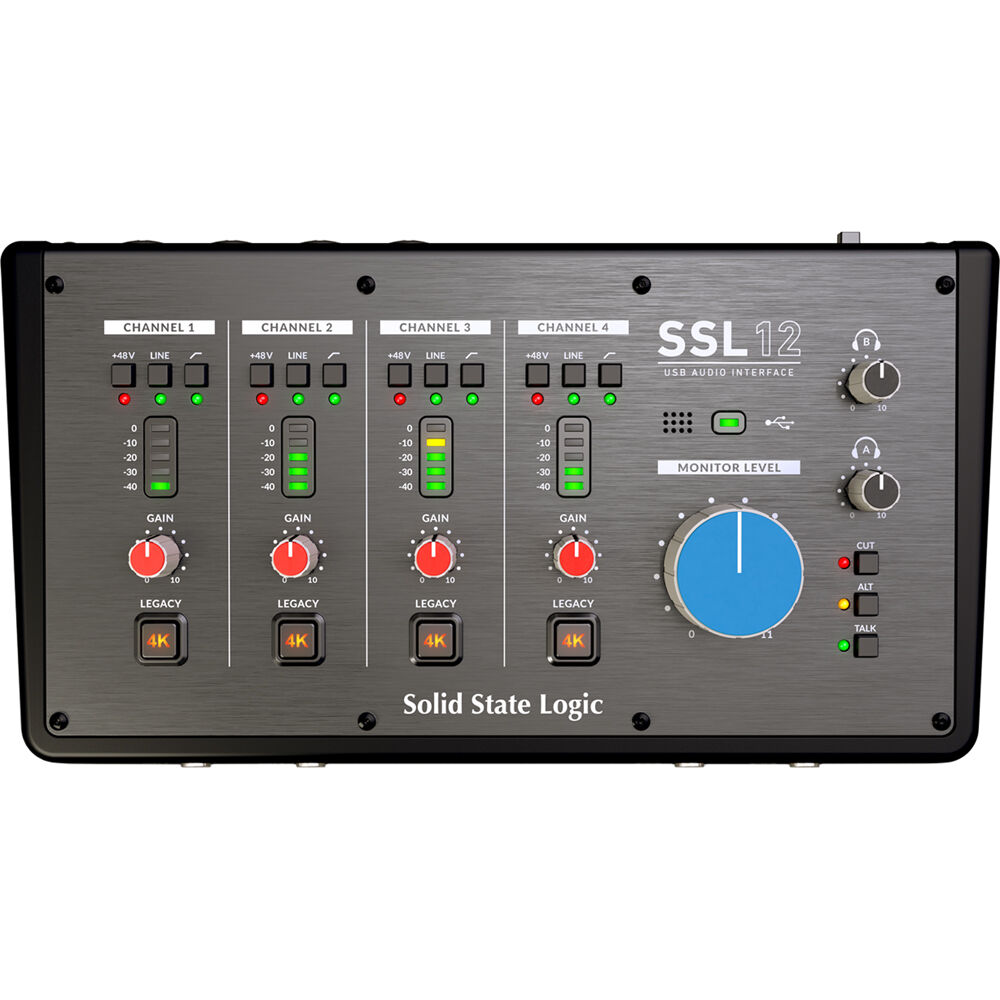
SSL 12 combines four microphone preamps with a more capable monitoring arrangement than a basic two-input interface. Independent headphone routing, talkback and ADAT input expansion make it relevant to a small studio that records more than one person. The twelve-input headline needs context: it includes digital channels from an external device, and the front instrument sockets do not add two extra analogue recording channels. Understanding that layout is the first step toward deciding whether the SSL 12 fits the studio.
Research-based review. This assessment draws on manufacturer documentation and the original independent evaluations linked below. Audio Review has not performed a hands-on test of this model.
Count simultaneous sources before comparing interfaces
The four analogue channels can cover a useful small session, such as two microphones plus a stereo line source. Plugging into a front instrument socket overrides the corresponding rear input rather than creating another simultaneous channel. Plan the actual session on paper before buying.
For example, a singer, a guitar and a stereo keyboard may already occupy the available analogue paths. A later wish to add several drum microphones changes the requirement substantially. A connection that is available in a different mode is not the same as another input that can record at the same time. This is why a realistic source list is more useful than comparing headline channel totals without checking how the physical sockets are assigned.
Sound and the 4K choice
MusicRadar’s original review is positive about the interface’s sound, routing flexibility and ease of control through SSL 360°. It describes the 4K option as a subtle but useful colour. That supports a strong recording shortlist, while leaving the decision to use colour dependent on the source and production.
Record a short comparison with and without the enhancement before committing an important take. A brighter or more assertive signal may suit one voice and be unnecessary for another. Keep enough input headroom and judge the recording in context, not only in solo. A respected console name does not mean every source benefits from the same treatment, and a simple switch should be regarded as an option rather than an obligation to process every channel.
Two headphone destinations with a real purpose
The two headphone outputs can carry independently configured mixes. That can solve a common small-studio problem: the performer wants a prominent voice or instrument, while the engineer wants a different balance. Separate level controls alone would not provide the same flexibility.
Build a simple monitoring preset before a session and check it with both listeners. Label the paths clearly so that a request for more vocal changes the intended feed rather than the recording gain. If a third person needs another independent cue, plan the output and headphone-distribution arrangement first. A capable interface does not remove the need for clear routing; it provides the tools to make that routing predictable when several people need different things.
ADAT expansion and sample-rate choices
The ADAT input provides additional channels from an appropriate external converter or preamp. The count falls at higher sample rates, as shown in the technical table. There is no ADAT output, so a system needing optical sending as well as receiving should compare a different interface.
Include the expander, cables and clock arrangement in the total cost. An empty optical input is a growth path, not eight supplied microphone preamps. For a larger recording, test the complete system before the session and confirm that the DAW shows the expected inputs. A higher sample rate should not be selected automatically if it removes channels that the performance requires. Choose the operating rate for the project and workflow rather than the largest supported number.
Talkback and monitor switching
Built-in talkback and configurable monitor controls can make a small recording setup feel more organised. The practical benefit is communication: the engineer can address a performer without changing the recording microphone arrangement. The same control surface can also support an alternative speaker pair when configured appropriately.
Rehearse the mute, talkback and speaker-switching actions before someone is waiting to record. Keep the monitoring level conservative when changing routing and verify what each button currently does. User-assigned functions are useful only when their role remains clear. A saved, labelled setup can be more valuable than an elaborate configuration that is difficult to reconstruct after a computer restart or software change.
USB power, software and latency
SSL specifies USB 3.0 power while using the USB 2.0 audio protocol. Check the computer port, cable and any hub rather than assuming connector shape alone guarantees adequate power. Windows and Mac setup requirements also differ, so confirm current operating-system support before replacing a working interface.
Use direct monitoring when the performer needs to avoid the computer’s buffer delay, or test a practical low-buffer software path when effects must be heard through the DAW. Do not combine both routes accidentally and then mistake the resulting doubled sound for poor conversion. The highest sample-rate modes also have documented mixer-versus-I/O behaviour, so consult the manual if end-to-end operation at those rates is a specific requirement.
Who benefits from paying for SSL 12?
The strongest buyer needs several features at once: four preamps, two independently managed headphone destinations, talkback and a possible ADAT expansion. Someone recording a single microphone may be better served by a simpler interface and a better microphone position or quieter room.
Compare the complete studio cost, including cables, headphones, an expander if required and suitable monitoring. Software bundles can be useful, but verify current entitlement and compatibility instead of treating a promotional list as permanent. If buying used, check registration and hardware condition. The SSL 12 provides value when its additional routing solves real daily work, rather than when a larger specification merely looks reassuring for a hypothetical future session.
Alternatives to consider
Audient iD14 MKII: iD14 MKII is a useful comparison for a smaller analogue-input requirement with digital expansion. Compare the microphone count and exact headphone routing instead of treating any two sockets as evidence of two independent performer mixes.
Focusrite Scarlett 4i4 4th Gen: Scarlett 4i4 offers another desktop workflow at a different feature level. Write down the simultaneous microphone and line sources, then compare the actual input and cue-mix requirements rather than the number in either product name.
SSL 12 key specifications
- Role
- USB bus-powered audio interface
- Analogue input channels
- Four mic/line preamps
- Instrument sockets
- Two, sharing analogue channels 1 and 2
- Analogue line outputs
- Four balanced
- Headphone outputs
- Two, independently routable
- Digital expansion
- ADAT input only
- ADAT input count
- Eight at 44.1/48 kHz; four at 88.2/96; two at 176.4/192
- MIDI
- DIN input and output
- Control software
- SSL 360°
- Power
- USB 3.0 power; audio uses USB 2.0 protocol
- Maximum sample rate
- 192 kHz, mode-dependent output behaviour
Verdict
SSL 12 is a persuasive small-studio interface with strong original-review support for sound and usability. Four analogue preamps, independent headphone mixes and ADAT input expansion form a coherent working package.
Buy it with the shared instrument channels and digital expansion limits understood, and verify adequate USB power. Compare a smaller interface for simpler sessions or a different digital connection set for more complex systems. The recommendation is strongest when the monitoring and routing functions make an actual recording routine easier.
Primary documentation and independent reviews
SSL official SSL 12 product information · SSL 12 official operating and routing guide · MusicRadar original SSL 12 evaluation
Editorial record
Sources and updates
Product specifications and factual claims were checked against Official SSL 12 product page ↗. Scores and buying advice follow our category-specific editorial methodology.
- Published
- November 17, 2026
- Last updated
- November 17, 2026