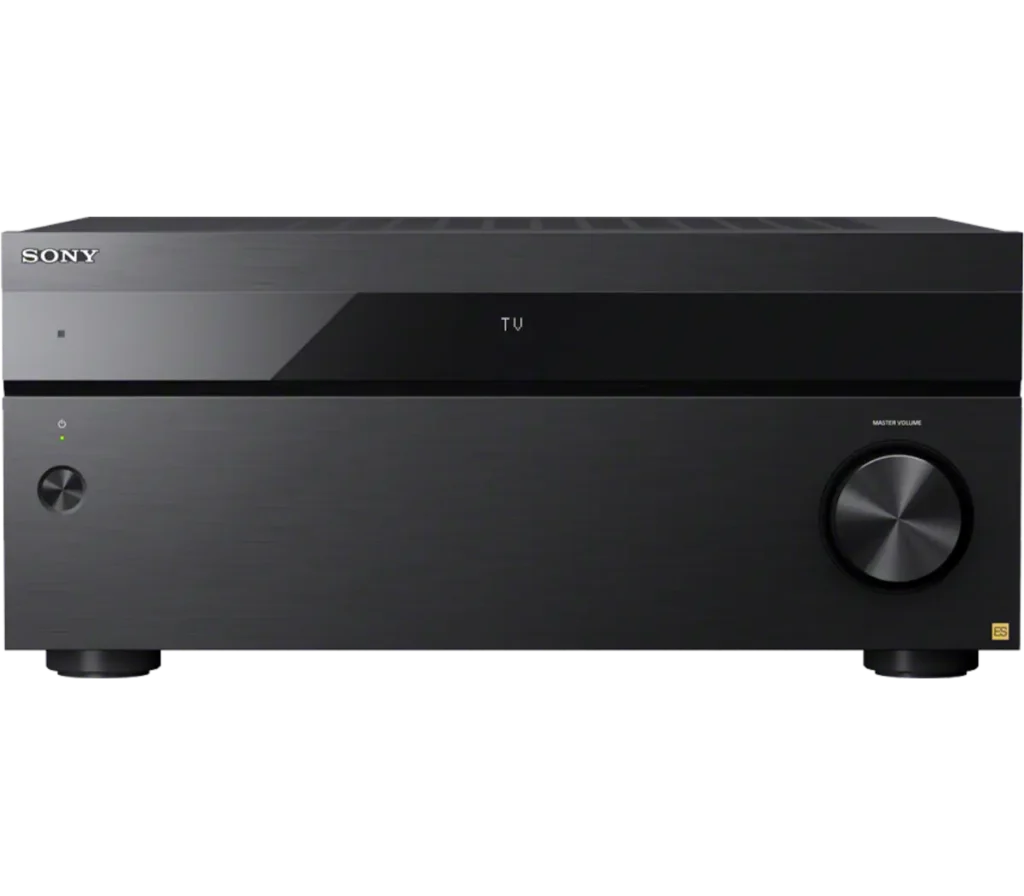
Sony STR-AZ5000ES is an eleven-channel receiver for a substantially planned cinema system. It adds a full main-channel pre-out arrangement to the ES family’s calibration, spatial processing and installation controls. The original listening evidence is positive, but the useful buying distinction is the complete configuration: a large speaker layout, possible external amplification and Sony integration. This review concerns the North American model, with local electrical compatibility and service to be verified. It does not assume that every input shares the highest video capability or every brand-linked feature works without extra equipment.
Research-based review. This assessment draws on manufacturer documentation and the original published evaluations linked below. Audio Review has not performed a hands-on test of this model.
The original trial favours involving cinema playback
CE Pro’s original evaluation finds engaging music, clear dialogue and strong film dynamics. It regards source switching as smooth, while noting a busy remote and room for clearer calibration guidance. Those findings support an audition with the intended sources rather than an assumption of effortless operation for everyone.
Choose a film passage that combines dialogue with a dense soundtrack, then a quieter scene with subtle movement. Listen from the normal seat at a sensible level. Compare the preferred processing with a simpler mode without changing speaker placement. For music, use familiar recordings rather than only surround demonstrations. The receiver’s capacity is useful when the supporting speakers and room allow it to communicate the scene naturally. An impressive effect sequence should not hide awkward daily control or uncertain input behaviour. The strongest buying evidence is a complete system that sounds convincing and can be operated repeatedly by its intended owners, including changing sources and returning to ordinary television viewing.
Eleven channels make four physical heights a realistic plan
The internal amplification can support a conventional seven-speaker bed with four heights within the documented assignments. It is a meaningful step beyond the smaller ES layouts, provided the room can accommodate the extra speakers sensibly.
Map the intended positions before ordering cables or hardware. Check seating distance, the available ceiling or height-speaker locations and the likely paths for wiring. More speakers are not automatically better if their positions are compromised. A dedicated room may make full use of the channel count, while an ordinary living room can favour a simpler arrangement. If additional zones are also planned, account for their amplifier assignments in the same diagram. Do not count every possible configuration as simultaneous capacity. The receiver should serve a clear installation rather than encourage purchases simply because unused terminals are available. A well-planned eleven-channel system can justify the model; an indefinite aspiration to expand may be a weaker reason than improving the existing speakers or room first.
Main-channel pre-outs add a different kind of flexibility
Unlike the smaller AZ3000ES, this model provides a full set of main-channel pre-outs. These offer a route to suitable external power amplifiers, but do not by themselves establish extra processed channels beyond the supported speaker patterns.
Distinguish two upgrade goals: increasing amplifier capability for existing channels and increasing the number of separately processed speaker positions. The appropriate outputs may solve the first without changing the second. If an external amplifier is already owned, verify the input requirements, gain relationship and intended assignment before connecting it. If one is merely a future possibility, price that plan against alternatives before paying a premium now. The internal amplification may already meet a suitable room and speaker requirement. Avoid buying external hardware solely because the sockets exist. The useful facility is choice within a correctly understood system. A stable, well-matched setup that remains simple to operate is more valuable than a collection of extra boxes with no clearly demonstrated benefit.
Dialogue features should solve a specific screen problem
The higher ES models support documented dual-centre arrangements and compatible TV-centre integration. These are particular configuration options rather than permission to connect arbitrary speakers together or assume every Sony television provides the same facility.
Identify the exact display and the intended dialogue location. A screen-centred impression can be helpful when a conventional centre speaker must sit far below a large image. However, adding a second centre should follow the approved receiver assignment, with suitable placement and calibration. Do not wire two speakers in parallel as a substitute for the documented arrangement. Compare dialogue across several seats and listen for consistent tone as well as apparent height. A feature that improves the main seat may not produce the same result everywhere. If ordinary centre placement already works well, the extra options may have little practical value. Judge them as solutions to a real installation constraint rather than a reason to make an already effective speaker system unnecessarily complex.
HDMI and network claims need a source-by-source check
Seven HDMI inputs do not mean seven high-bandwidth inputs. The documented high-rate route applies to four of them. Network integration likewise needs the appropriate service, source and software arrangement rather than simply a familiar logo.
Assign consoles and other demanding video sources to suitable sockets, then verify the actual frame rate and audio output through the display and source menus. Test standby recovery and repeated input changes with the normal cable lengths. For casting or music control, try the intended phone and application over a realistic session. A successful short demonstration from another device cannot establish every daily route. If Sonos is part of the plan, include the separate required hardware and test wake-up, input switching and volume behaviour together. Features can be valuable when these checks confirm a useful complete arrangement. They should carry less weight when they are theoretical possibilities that the owner is unlikely to use or cannot demonstrate with the equipment already in the home.
The installed cost and regional support settle value
The named receiver is a North American ES product. Its substantial physical format, local electrical rating and warranty arrangement deserve attention before an imported price is compared with a supported local alternative. Vinyl also requires a suitable phono-stage route rather than an assumed built-in cartridge input.
Measure the furniture with space for rear plugs and the manufacturer’s ventilation requirements. Plan safe lifting and access before delivery, particularly if it will sit in a rack. Confirm the actual electrical label with the seller; a connector adapter is not a complete compatibility solution. Price any required phono equipment, wireless accessories or control-system work as part of the installation. Then ask which facilities will be used regularly. Eleven amplified channels and main pre-outs can be excellent value for a defined project, while a smaller system may gain more from another purchase. The most persuasive owner has a stable plan that uses the model’s strengths today. It is less convincing when the premium buys an abstract expectation that every future system requirement will somehow be covered.
Alternatives to consider
Marantz CINEMA 40: CINEMA 40 is a relevant supported-market comparison for an ambitious cinema system. Compare amplifier count, processed channels, calibration options and the complete external-amplifier plan before deciding.
Denon AVC-X6800H: AVC-X6800H provides another route to a large speaker installation. Compare the actual layout, bass-management requirements, software costs and local warranty rather than choosing from the largest advertised power figure.
Sony STR-AZ5000ES key specifications
- Market
- North American ES model; verify electrical rating and local service
- Amplified channels
- Eleven
- Example layout
- 7.2.4 with supported assignments
- Main-channel pre-outs
- Full RCA set
- HDMI
- Seven inputs / two outputs; only four high-bandwidth inputs
- Video
- 4K120 / 8K on appropriate sockets and settings
- TV audio
- eARC / ARC on designated output
- Surround
- Dolby Atmos and DTS:X
- Calibration / processing
- DCAC IX / optional 360 Spatial Sound Mapping
- Dialogue options
- Supported dual-centre and compatible TV-centre arrangements
- Phono input
- None
- Sonos
- Separate compatible Sonos hardware required
- Rated power
- 130 W/ch into 8 ohms, 1 kHz, 0.9% THD, two channels driven
Verdict
STR-AZ5000ES is a persuasive regional installation choice for eleven-channel playback with useful main pre-outs and Sony-specific integration. Its original sound evidence is encouraging, while control complexity, HDMI port differences and ownership support require planning. Confirm the complete working arrangement and actual package cost. Choose it when the room and intended use justify its scope, with a clear reason for any external amplification or accessories.
Documentation and original reviews
Sony official North American STR-AZ5000ES product information · Sony official STR-AZ5000ES connection and assignment guide · CE Pro original STR-AZ5000ES setup and listening evaluation
Editorial record
Sources and updates
Product specifications and factual claims were checked against Official Sony STR-AZ5000ES product page ↗. Scores and buying advice follow our category-specific editorial methodology.
- Published
- November 17, 2026
- Last updated
- November 17, 2026