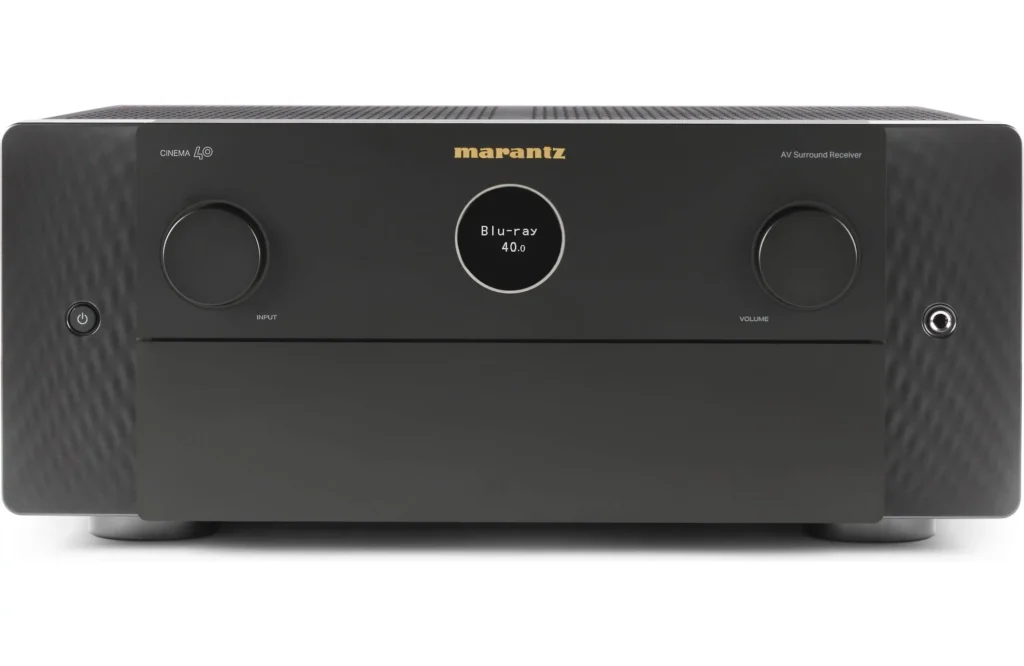
The Marantz CINEMA 40 brings a premium physical design and extensive cinema facilities to a nine-channel amplifier. It is aimed at buyers who want a refined central component without moving to the eleven-channel CINEMA 30. Its value depends on the complete experience: sound preference, practical controls, connection needs and a room plan that makes good use of nine internal power stages.
Marantz CINEMA 40 — Design and construction
The porthole display, shaped front panel and subtle lighting make the CINEMA 40 more visually distinctive than a conventional receiver. The official information identifies a metal front panel and HDAM circuitry, but no toroidal transformer. Do not assume the internal construction is identical to the higher CINEMA 30 simply because the family styling is shared.
AREA DVD’s original examination praises the physical execution and identifies a useful backlit remote. Its photographs and inspection also distinguish the conventional supply arrangement from a toroidal design. That is a useful check against retail descriptions that sometimes apply generic flagship language across an entire range.
From the listening seat, convenient operation is more important than an attractive close-up photograph. Check the remote, on-screen feedback and visibility of the information you normally need. A premium component should make routine source selection and volume adjustment easy in a dark room.
Marantz lists approximately 15.1 kg weight. The supporting shelf and cabinet need suitable capacity, depth for connected leads and proper airflow. A front panel that fits the furniture opening does not establish that the installation has enough cable clearance or ventilation.
Nine channels and expansion
The CINEMA 40 has nine internal amplifier channels and processing up to 11.4 channels. A five-speaker bed with four heights, or seven bed speakers with two heights, can therefore be powered without an additional amplifier. Eleven-speaker use needs suitable external amplification and the correct assignment configuration.
The distinction is easy to miss because there are more connection possibilities than internal power stages. Plan the active layout before connecting everything. Zone speakers, bi-amplification arrangements and extra heights can compete for assignable resources, so a list of available functions is not proof that every combination runs simultaneously.
Four independent subwoofer outputs provide useful bass-integration flexibility. They are line-level connections for suitable powered subwoofers or external amplification, not additional powered loudspeaker channels. Multiple subs should improve coverage or meet output requirements rather than simply occupy every socket.
The rated 125 watts per channel into eight ohms is a two-channel figure under specified frequency and distortion conditions. It should not be described as a simultaneous nine-channel measurement. Speaker sensitivity, listening distance and sensible crossover settings are central to deciding whether the system has sufficient headroom.
Sound quality and setup
AREA DVD’s original listening evaluation describes a cohesive, composed presentation with strong dynamic capability and clear speech during demanding film scenes. Its reviewer also reports a generally comfortable tonal presentation. That supports the CINEMA 40 as a serious cinema candidate without claiming that Audio Review has tested it in the same system.
A buyer should include quiet dialogue and complex action at the same master level in an audition. The system needs to keep voices intelligible when effects become busy, while preserving the intended contrast. Simply demonstrating maximum impact says less about whether a full film remains enjoyable.
Audyssey MultEQ XT32 is included for room correction. Follow the microphone-positioning process carefully, keep the room quiet and inspect the resulting levels and crossovers. A correctly completed measurement session is more useful than repeatedly switching modes to compensate for an uncertain initial setup.
Speaker placement remains fundamental. A centre deep inside furniture or a subwoofer positioned mainly for convenience can limit the result. Correct those issues before assuming that moving to a more expensive amplifier will solve them. The CINEMA 40 supplies useful tools rather than immunity from room acoustics.
Stereo music deserves a separate evaluation if it is important to the owner. Compare direct playback and any preferred processing at similar levels. An enveloping upmixed result can be enjoyable without being the right choice for every album.
Connections and optional correction
Seven HDMI inputs and three outputs make the CINEMA 40 useful for a system with several modern sources. Marantz documents 4K/120 Hz, 8K/60 Hz, eARC, VRR and ALLM support through a compatible chain. The actual combination still depends on source output, cable capability and the display’s selected input mode.
For a television and projector installation, check the output rules in the manual rather than assuming all formats operate independently. A lower-capability display can affect a shared-source arrangement. Planning this before cables are concealed can prevent an awkward installation change later.
HEOS, AirPlay 2 and network playback provide convenient music routes. A moving-magnet phono input also supports an appropriate turntable. Confirm current platform support for any service that is essential to the household rather than treating an old launch list as a permanent guarantee.
Dirac’s current ART announcement includes CINEMA 40, but advanced Dirac facilities require the appropriate optional licences, firmware and measurement setup. Include those costs in the comparison if they are part of the intended system. The supplied Audyssey route remains a legitimate starting point.
An upgrade should address a specific integration objective. More sophisticated software cannot turn a poor loudspeaker location into a universally good one, and a louder target is not automatically a more accurate result. Save the existing settings and compare changes carefully.
Value and long-term ownership
The CINEMA 40 is strongest for someone who wants a premium nine-channel hub and genuinely values its design and operation. It is less persuasive when the real requirement is a basic five-speaker setup and the difference in cost would improve speakers or subwoofer performance more effectively.
Compare it with CINEMA 50 and competing nine-channel amplifiers at current European prices. Shared basic facilities mean the premium should be tied to meaningful differences rather than the model number alone. An authorised discount can change the relationship substantially, so include the exact regional version and support arrangements.
The eleven-channel processing path is useful for a planned later expansion, but it is worth pricing that expansion honestly. A separate amplifier, extra speakers and suitable placement all belong in the future budget. If eleven internal channels are already needed immediately, another model may simplify the system.
For everyday use, establish a reliable source and standby routine that everyone in the household understands. Complex HDMI control chains can behave differently with different televisions and players. Check the real combination before finalising a difficult-to-access installation.
The CINEMA 40 should be bought as a considered centrepiece rather than a cure for every system limitation. With the right room and speakers, its positive sound evidence, flexible architecture and refined presentation make a strong package. Without that match, a smaller investment in the amplifier can leave more room for improvements that matter.
Alternatives to consider
Marantz CINEMA 50: The key comparison for deciding whether the CINEMA 40’s premium construction and connection package justify the additional cost.
Denon AVC-X3800H: A different nine-channel value proposition to compare with the same attention to optional software and external-amplifier costs.
Onkyo TX-RZ50: An alternative whose included calibration package may change the complete purchase calculation.
Marantz CINEMA 40 key specifications
- Powered speaker channels
- 9
- Processing
- Up to 11.4 channels
- Rated output
- 125 W/ch, 8 ohms, 20 Hz–20 kHz, 0.05% THD, two channels
- Subwoofer outputs
- 4 independent line-level outputs
- HDMI
- 7 inputs / 3 outputs; eARC
- Video
- 4K/120 Hz and 8K/60 Hz with compatible equipment
- Calibration
- Audyssey MultEQ XT32; optional licensed Dirac facilities
- Weight
- Approximately 15.1 kg
- Region
- EU amplifier version
Verdict
The CINEMA 40 is a capable premium nine-channel amplifier with strong original-review support for composed cinema sound and a refined physical design. Its expansion and calibration options are useful when planned carefully. Compare it against CINEMA 50 and include optional software costs, choosing the premium for qualities the system and household will actually use.
Primary documentation and independent reviews
Marantz CINEMA 40 official specifications · Marantz official EU audio specification · AREA DVD original construction review · AREA DVD original listening evaluation · Dirac official ART compatibility announcement
Editorial record
Sources and updates
Product specifications and factual claims were checked against Official Marantz CINEMA 40 product page ↗. Scores and buying advice follow our category-specific editorial methodology.
- Published
- November 8, 2026
- Last updated
- November 8, 2026