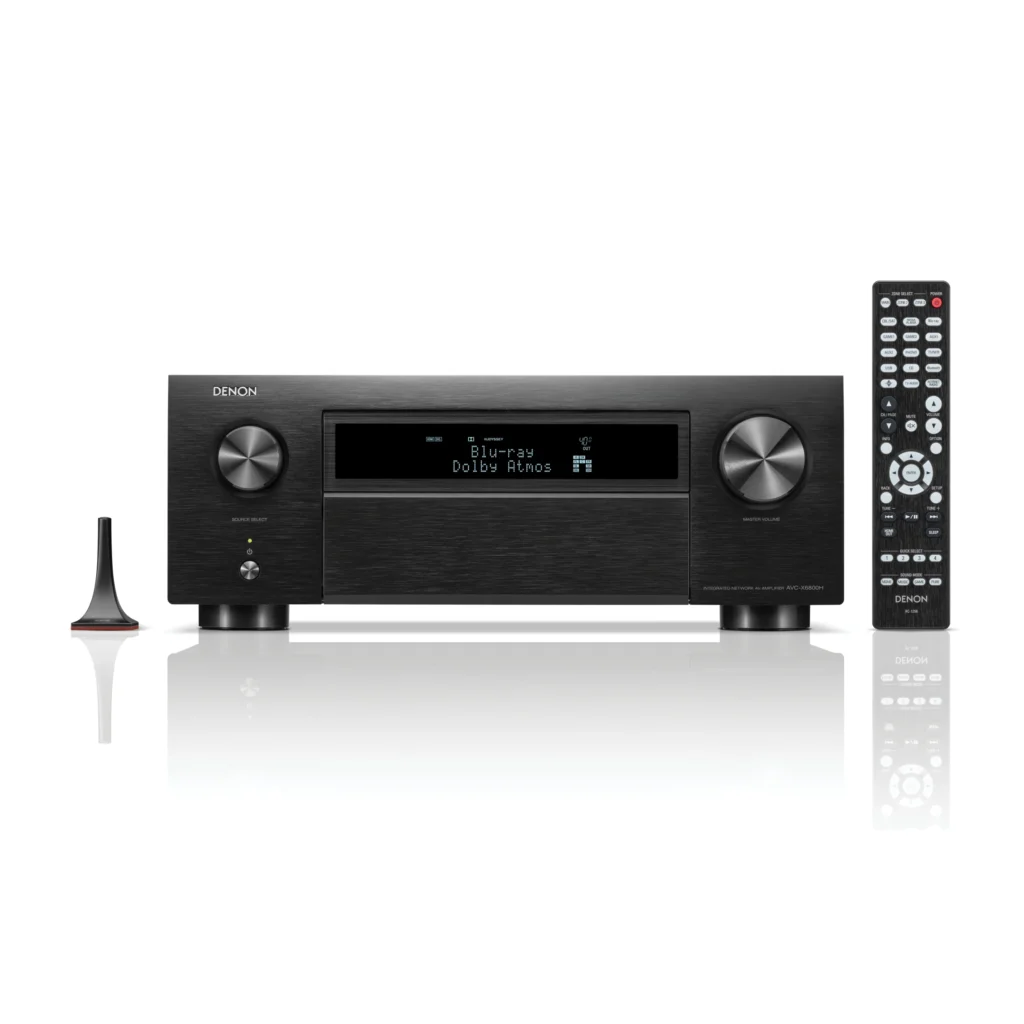
The Denon AVC-X6800H is aimed at a home cinema that has outgrown the channel limits of a typical nine-channel amplifier. Eleven internal power channels make a substantial Atmos layout possible without another power-amplifier box. Its appeal is a combination of scale, flexible connections and an approachable setup process, with cost and installation demands that deserve equal attention.
Denon AVC-X6800H — Eleven channels and a realistic room plan
The X6800H provides eleven powered speaker channels with processing up to 13.4 channels. A seven-speaker bed with four height speakers can therefore run from its internal amplification. Expanding to a thirteen-speaker layout requires appropriate external amplification and correct channel assignment; processing capacity is not the same as the number of internal power stages.
Four independent subwoofer outputs offer flexibility for bass coverage. They feed suitable powered subwoofers or external amplification and do not supply speaker-level power themselves. Multiple subwoofers are most valuable when placement and calibration improve consistency across the seating area, rather than simply increasing the number of large boxes in the room.
Denon’s 140-watt figure is specified into eight ohms across the audio band with two channels driven. It is not a measured eleven-channel continuous output. The meaningful questions are the speakers’ sensitivity, impedance behaviour, listening distance and required level, with bass management reducing demands on the main channels when appropriate.
Before buying, draw the actual speaker positions. An extra pair of channels is useful only when it can create a meaningful spatial separation. Crowding speakers around one small seating position may deliver less benefit than a carefully installed simpler layout.
Sound and system matching
What Hi-Fi?’s original review describes an engaging, rich presentation with convincing scale and cohesive surround movement. It also notes that some rivals sound more direct and finds a different balance in an Arcam comparison. That supports a strong cinema shortlist position while leaving room for personal preference and speaker matching.
The practical lesson is to audition the complete system where possible. A home cinema amplifier does not have an isolated sound independent of the speakers, room and processing settings. A bright centre speaker in a reflective room can make dialogue tiring even when the amplifier receives enthusiastic reviews.
Check quiet scenes as carefully as action sequences. Dialogue should remain easy to follow without repeatedly changing level, and ambient effects should not become exaggerated merely to demonstrate the extra speakers. Clear calibration and sensible channel trims often matter more than a louder first impression.
For music, compare ordinary stereo and any preferred upmixing mode separately. An immersive presentation can be entertaining without replacing the original mix for every album. If two-channel listening is a major priority, include it in the audition rather than assuming strong movie performance answers that question automatically.
Audyssey, Dirac and upgrade costs
Audyssey MultEQ XT32 is included for the initial measurement and correction process. Take the microphone positioning seriously, minimise background noise and keep the measurement area representative of the intended seats. Afterward, inspect crossover and level choices instead of treating automatic setup as a reason to ignore the system configuration.
The X6800H also supports optional Dirac facilities. Dirac’s current announcement explicitly includes the European AVC-X6800H in the ART-compatible group. Availability is not the same as an included licence: the intended Room Correction, Bass Control and ART combination, firmware and measurement equipment belong in the purchase budget.
It is reasonable to start with the included system and correct obvious placement problems before paying for additional software. A deep cancellation caused by room geometry is not automatically solved by a more expensive calibration package. The upgrade should address a specific integration objective rather than serve as a compulsory stage in ownership.
Keep a record of the preferred setup before making major changes. Compare calibration results at similar volume using the same material. A louder or bass-heavier target can initially sound more impressive without necessarily providing better dialogue or more consistent coverage across seats.
HDMI, television audio and music sources
The X6800H has seven HDMI inputs and three outputs, with eARC and support for 4K/120 Hz and 8K/60 Hz signals through a compatible chain. Its extensive provision is useful for a disc player, multiple consoles and other sources without an immediate need for another switch.
For gaming, verify the desired refresh rate, HDR mode and variable-refresh behaviour together. A picture at a lower rate does not prove that the highest intended format is working. Cable capability, the television input mode and the source settings all contribute to the result.
Television-app audio returned over eARC is a different path from a player connected directly to the amplifier. The available format depends on the TV and application. Atmos support in the Denon does not mean every source delivers lossless Atmos or that an optical link carries the same capabilities as eARC.
HEOS, AirPlay 2 and network playback make the X6800H useful beyond movies. A moving-magnet phono input also supports an appropriate turntable without requiring a separate phono stage. Confirm current service availability and firmware rather than relying on an old review’s future-update promise for a particular streaming certification.
Installation and value
The physical installation deserves planning before the box arrives. Check shelf depth with cables attached, load capacity and ventilation. An eleven-channel amplifier should not be squeezed into a sealed cabinet with no airflow simply because its front panel fits the opening. Leave practical access to the rear connections for setup and maintenance.
Its strongest value case is a room that genuinely benefits from eleven internal channels. A buyer who would otherwise add a separate two-channel power amplifier to a nine-channel model can compare the complete cost and convenience. Another buyer who already owns suitable external amplification may find a lower-tier processor-capable model more economical.
The European AVC version should be checked for local mains, warranty and exact model identity. The AVR name used in other regions can include tuner differences, so imported stock should not be judged from the number alone. Support arrangements are especially important for a complex networked component.
The X6800H is a substantial commitment, but its purpose is concrete: it simplifies a large speaker system into one main chassis while preserving an expansion route. It is less persuasive as an upgrade for a small five-channel setup whose real limitations are the room, centre speaker or subwoofer placement.
Alternatives to consider
Denon AVC-X3800H: A less expensive starting point if nine internal channels are enough or suitable external amplification is already available.
Yamaha RX-A4A: A different system philosophy to compare when fewer powered channels and Yamaha’s processing approach better match the room.
Anthem MRX 740 8K: An alternative worth investigating for its calibration approach, with the complete channel and external-amplifier requirements compared carefully.
Denon AVC-X6800H key specifications
- Powered speaker channels
- 11
- Processing
- Up to 13.4 channels
- Subwoofer outputs
- 4 independent line-level outputs
- Rated output
- 140 W/ch, 8 ohms, 20 Hz–20 kHz, 0.05% THD, two channels
- HDMI
- 7 inputs / 3 outputs; eARC
- Video
- 4K/120 Hz and 8K/60 Hz with compatible equipment
- Calibration
- Audyssey MultEQ XT32; optional licensed Dirac facilities
- Region
- EU AVC version
Verdict
The AVC-X6800H is a convincing centrepiece for an eleven-speaker cinema, combining capable multichannel sound reports with extensive HDMI and calibration options. Its value is strongest when the internal channel count prevents a more complicated system. Budget for installation and optional software, and choose it for a real layout rather than unused future capacity.
Primary documentation and independent reviews
Denon AVC-X6800H official specifications · Denon official EU features and power conditions · Dirac official ART compatibility announcement · What Hi-Fi? original X6800H review
Editorial record
Sources and updates
Product specifications and factual claims were checked against Official Denon AVC-X6800H product page ↗. Scores and buying advice follow our category-specific editorial methodology.
- Published
- November 7, 2026
- Last updated
- November 8, 2026