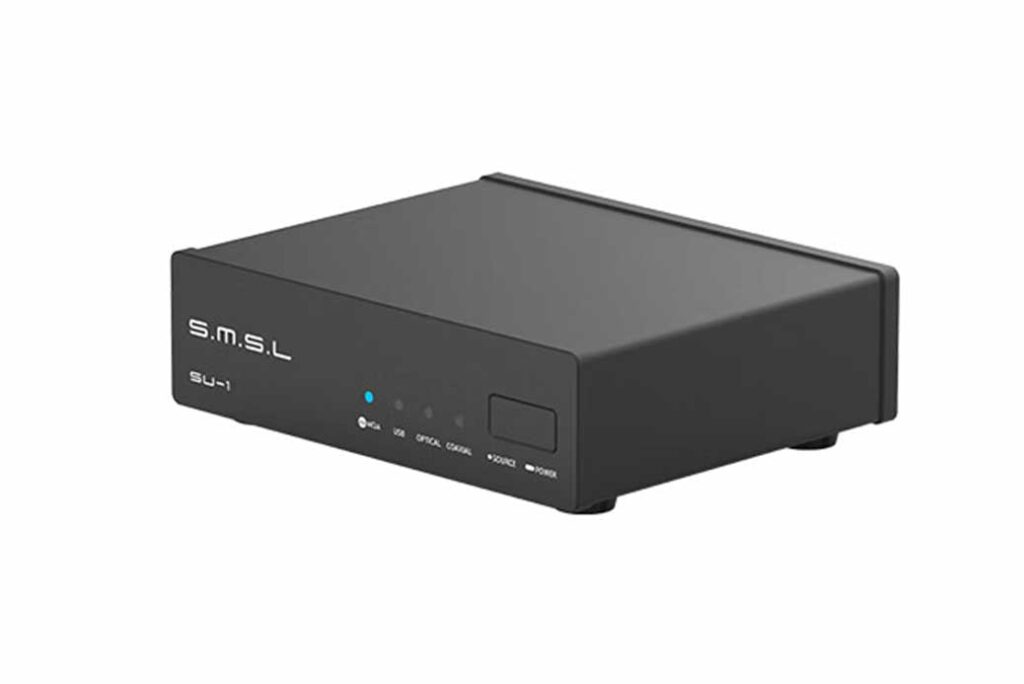
S.M.S.L SU-1 is a compact and inexpensive stereo DAC with USB, optical and coaxial inputs and fixed RCA line output. It is easy to mistake a small converter for a complete headphone accessory, but this model has neither a headphone amplifier nor hardware listening-volume control. This research-based review examines its positive original sound evidence and the system requirements behind its strong budget appeal. The SU-1 is most persuasive when it feeds an amplifier or controlled active-speaker system that already provides the functions it omits.
Research-based review. This assessment draws on manufacturer documentation and the original published evaluations linked below. Audio Review has not performed a hands-on test of this model.
A simple conversion role with positive original evidence
Headfonics’ original evaluation describes clean, neutral reproduction with good dynamics and precise placement, while finding the staging less remarkable than some alternatives. That is encouraging for an inexpensive converter. It is not an Audio Review listening test or proof that every existing DAC needs replacing.
Try it with the actual amplifier and speakers or headphones, keeping playback levels matched. A change in line level can sound like more clarity or stronger bass even when loudness is the main difference. Listen to natural voices, bass lines and quiet ambience rather than only a dramatic test track. A converter can be a good purchase because it provides a needed connection or avoids an audible problem, even when it does not transform the system’s tonal balance. The original evidence supports the SU-1 as a sensible entry point. Its strongest claim is competent conversion at low cost, with a clear role in the chain rather than an exaggerated promise of universal improvement.
Fixed RCA output requires control elsewhere
The official specification identifies nominal 2 Vrms stereo RCA output. The front button handles power and source selection, not listening volume. There is no included remote control or headphone socket.
Connect it to a suitable line input on an amplifier, or to an active-speaker arrangement with appropriate volume control. Do not assume that any powered speaker pair can safely receive a fixed source at a comfortable level without checking its controls. Start low on the downstream device and confirm the complete route before ordinary playback. Computer software volume may affect one source, but that does not automatically control an optical transport or another connected source. A shared system should have a volume routine that remains clear when inputs change. The SU-1 makes most sense when this infrastructure already exists. If it requires another control box and headphone amplifier to satisfy a simple desk need, a combined unit can offer a neater and potentially cheaper finished system.
USB power is still needed for the other digital inputs
USB provides the required power as well as the data route when selected. Optical and coaxial cables do not supply the operating power that the SU-1 needs. A suitable USB power arrangement therefore remains necessary for those sources.
Include that requirement in the installation and package price. Confirm what power accessories the retailer actually supplies rather than relying on a generic product listing. With a computer, test recognition and playback after reconnecting or returning from sleep. When used with a separate USB supply, choose an appropriate supported source of power rather than improvising a voltage because the connector fits. A small converter can simplify a system only if its power cable also has a convenient home. Route cables so their weight does not pull the light case around the desk. Expensive power accessories should not be treated as a mandatory path to better sound without a demonstrated problem. A correct, stable and practical supply is the starting requirement.
Three digital sources do not create a universal input hub
USB, optical and coaxial cover several common digital source types, but there is no analogue input, HDMI ARC or wireless receiving function. The RCA sockets are outputs and cannot accept a turntable or line-level player.
Check the exact connection from each intended source. A television needs a supported digital output format and a workable volume route; an optical connection does not guarantee HDMI-style remote integration. A streamer may provide suitable digital output, but the SU-1 itself does not connect to a music service or home network. A phone requires an appropriate USB-audio connection and supported power arrangement rather than ordinary Bluetooth pairing. The front source button is uncomplicated when the unit is within reach, but less convenient across a room. If remote switching is central to daily use, another converter may be the better choice. The SU-1 is useful precisely because it concentrates on a small set of wired conversion tasks. Asking it to act as a receiver, streamer or all-source preamplifier works against that simplicity.
Format support should not dominate an ordinary listening decision
S.M.S.L lists high USB format ceilings, with different limits for optical and coaxial. The presence of those figures does not mean every input accepts the same file format or that ordinary music requires upsampling to the maximum.
Use a supported playback mode appropriate to the computer or transport, and follow official driver instructions where relevant. Check stable everyday playback before chasing specialist formats. A normal music library can work well without forcing an application to show the highest possible sample rate. The unit’s legacy decoding features should be assessed against files actually owned and used, rather than treated as a reason to subscribe to a service or buy new music. Source indicators show selection, not a comprehensive diagnosis of the complete audio path. If there is no sound, begin with output-device selection, supported format and cable routing. Replacing an amplifier or adding costly accessories is a poor first response to an ordinary configuration issue.
Low cost is attractive when the rest of the system already fits
The small aluminium case is easy to place in a modest desk or hi-fi system. Its simplicity can also be more convenient than a converter with menus that are rarely used. It remains one component in a complete chain, however.
Compare current local prices with warranty support and required cables included. For a used unit, verify the exact model identity and test all needed inputs and both RCA channels. Do not borrow functions from similarly named SU products or a newer variant. A buyer who needs balanced line output, headphones or remote control should include those requirements before choosing by price. A more expensive combined unit may have lower total cost when it removes separate boxes. Conversely, an existing integrated amplifier can make the SU-1’s restrained feature set entirely appropriate. Its value is highest when the conversion task is clear and the omitted features are already handled elsewhere. That practical match is more useful than ranking the unit solely by the converter-chip name.
Alternatives to consider
Schiit Modius E: Consider a different standalone conversion route when the system benefits from its output arrangement. Include the separate amplifier and listening-volume control in either comparison.
S.M.S.L C200: A combined DAC and headphone amplifier can be more convenient when no suitable amplifier is already available. Compare the complete working system rather than the converter price alone.
S.M.S.L SU-1 key specifications
- Role
- Compact stereo DAC with fixed line output
- DAC
- AKM AK4493S
- Digital inputs
- USB-C, optical and coaxial
- Analogue output
- Stereo RCA, nominal 2 Vrms
- Volume / remote
- No hardware listening-volume control or remote
- Headphone amplifier
- Not included
- USB ceiling
- Supported PCM up to 32-bit/768 kHz and DSD512
- Optical / coaxial
- Supported PCM up to 24-bit/192 kHz
- Power
- USB power required, including when using optical or coaxial
- Size / weight
- Approximately 96 × 27 × 78 mm; 195 g
- Not provided
- Balanced line output, Bluetooth or native network playback
Verdict
SU-1 is a convincing research-based budget DAC for a controlled stereo system with amplification already in place. Confirm USB power, the supported source format and downstream listening-volume control. It offers a useful small conversion stage, with its value rooted in simplicity rather than functions such as headphones, wireless playback or remote operation that it does not provide.
Documentation and original reviews
S.M.S.L official SU-1 product · S.M.S.L official SU-1 manual · Headfonics original SU-1 evaluation
Editorial record
Sources and updates
Product specifications and factual claims were checked against Official S.M.S.L SU-1 product page ↗. Scores and buying advice follow our category-specific editorial methodology.
- Published
- November 17, 2026
- Last updated
- November 17, 2026