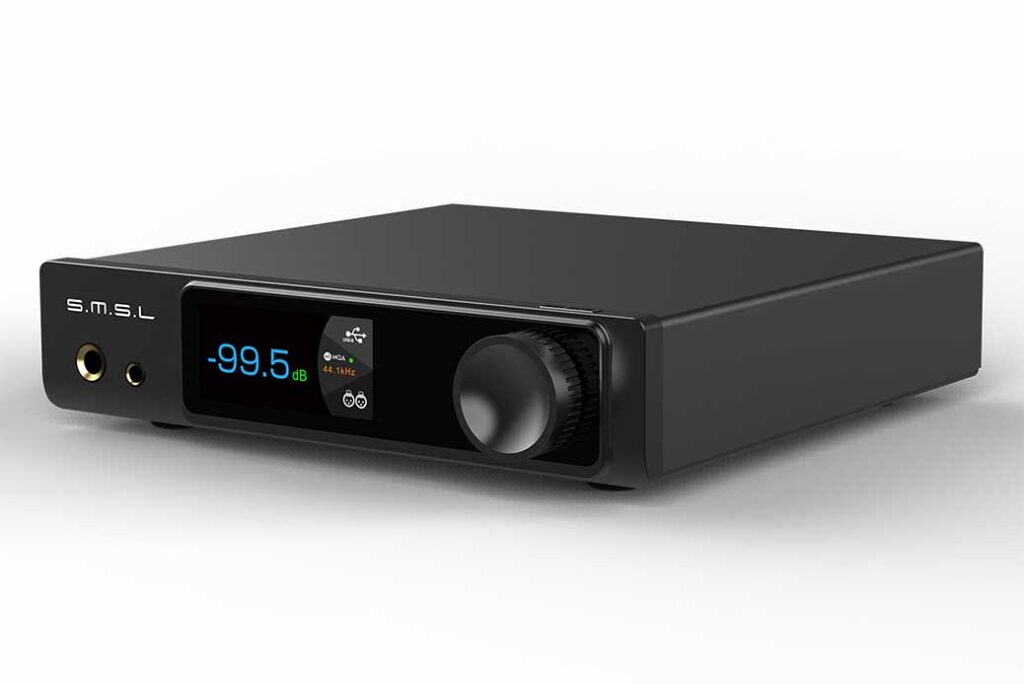
S.M.S.L RAW-MDA1 is a combined desktop DAC and headphone amplifier with enough digital inputs to serve more than one source. Two optical and two coaxial connections are unusually useful for a compact system, while XLR and RCA line outputs extend its role beyond headphones. This research-based review considers the positive original sound evidence and the limits that remain around amplification, screen size and source type. It is a flexible digital hub, rather than a universal analogue preamplifier or network player.
Research-based review. This assessment draws on manufacturer documentation and the original published evaluations linked below. Audio Review has not performed a hands-on test of this model.
Neutral and clear in the original listening evidence
Headfonics’ original evaluation describes a mostly neutral, clear presentation with good vocal detail and controlled bass. Its reservations include screen legibility at a distance and amplifier performance with some headphones. These are the source reviewer’s impressions and pairing results, not Audio Review listening tests.
Audition with the headphone and source that will actually be used. Match playback level and compare quiet material as well as large peaks. Do not turn one reviewer’s difficult pairing into a rule based on impedance alone, but do take it as a reason to test the intended load. Sensitivity, desired level and available voltage all matter. A mostly neutral DAC/amp can be a useful starting point because it does not require a particular musical taste to justify ownership. It still cannot correct poor headphone fit or unsuitable transducer tuning. The evidence supports a serious shortlist position, with the final decision resting on control, noise and the resulting presentation in the buyer’s own system.
The extra digital inputs solve a specific problem
The official manual lists USB, two optical inputs, two coaxial inputs and Bluetooth. That provides a practical way to leave several digital sources connected instead of repeatedly swapping cables.
Map each source to a suitable supported input before purchasing. A disc transport, computer and television may fit, but television playback needs the correct digital format and volume-control arrangement. There is no HDMI ARC connection, so do not assume television power and volume commands work as they would through HDMI. A turntable or another analogue source cannot use these sockets simply by adding a passive cable. If only a laptop is involved, most of the extra switching may remain unused. Conversely, a multi-source desk can benefit from a single control point with fewer external switches. The real value of the connection count is convenience and predictable routing. It should not be confused with simultaneous mixing, recording-interface functions or the ability to play several sources independently at once.
Line-output level must suit the downstream system
RCA and balanced XLR outputs allow connection to an amplifier or appropriate active speakers. The manual provides fixed and variable output operation. Fixed output requires the downstream system to provide suitable listening-level control.
Identify that control before starting playback and begin conservatively. A power amplifier or active speaker with insufficient independent attenuation can produce an unexpectedly high level from a fixed source. Test behaviour after changing modes and restarting the unit, rather than relying on a familiar knob position. When an integrated amplifier handles volume, a conventional fixed-source arrangement may be convenient. A variable source can suit active monitors, provided the entire chain is set up coherently. Balanced XLR wiring is useful when the destination supports it, but it is not a promise that every system becomes audibly better. Compare compatible routes at matched level. Clear output selection and a repeatable everyday routine are more important than choosing the connection with the most impressive nominal voltage.
Headphone sockets and gain need a real pairing check
The front connections accept 6.35 mm and 4.4 mm headphone plugs, with low and high gain available. S.M.S.L states output ratings for particular loads. The presence of a 4.4 mm socket alone should not be used to promise an additional balanced-power tier.
Choose correctly wired cables and start with low gain. Check quiet listening, background hiss with sensitive earphones and the useful adjustment range. A demanding headphone should be assessed with actual music and adequate headroom, not only whether it becomes loud on one track. Maximum output under a stated load is not a complete compatibility recommendation. If a separate amplifier is required, include its cost and cabling in the package comparison. The RAW-MDA1 can also serve as a DAC for such a system, but that changes the reason for buying a combined unit. Its strongest headphone value is when the built-in stage already fits the intended transducers. Avoid paying for unnecessary cable changes merely to occupy a different front socket.
USB modes and sound options should serve stable playback
The manual documents different USB modes, digital filters and sound-colour settings. The latter are processing choices inside the DAC, not physical valve circuitry and not evidence of a built-in tube amplifier.
Establish a normal baseline before experimenting. Use the appropriate host mode and official driver when required, then test ordinary playback, application changes and returning from sleep. Compatibility modes can help with some devices, but they should not become an unconditional promise for every console or operating system. Confirm the exact host and supported format. Sound-colour menu names are not measurements or a guarantee that a preferred setting improves fidelity. Compare at consistent level and keep the setting that is useful, including the standard option if no processing is wanted. The DPLL control described in the manual concerns tolerance of digital input timing; it does not decode an unsupported signal format. Predictable listening is a better goal than changing technical settings without a specific problem to solve.
A compact hub is only useful when the controls remain clear
The colour screen and remote make this more approachable than a converter with minimal status lights, but text size can still matter across a room. The internal mains supply also needs suitable placement and ventilation.
Check readability from the intended seat, leave clearance for the XLR plugs and make sure the front knob is accessible with headphones connected. Bluetooth is a convenient receiving route, with actual codec selection depending on the source. It is not native Wi-Fi streaming or a substitute for a network player. For used equipment, verify the exact model, accessories, required inputs and all intended output modes. Follow only matching official maintenance instructions. Compare current local offers with warranty support included rather than using the original review price as a live guarantee. The RAW-MDA1 makes its clearest case when multiple digital sources, headphones and active speakers benefit from one compact unit. If those roles are unnecessary, a simpler converter may be a better use of the budget.
Alternatives to consider
S.M.S.L DO400: Compare the actual headphone requirement and line-output control. A higher-positioned model should provide a useful benefit in the real chain rather than just a different specification headline.
FiiO K9 AKM: Consider another combined desktop approach when the headphone, source selection and physical control arrangement justify the price and space. Compare finished packages rather than isolated DAC specifications.
S.M.S.L RAW-MDA1 key specifications
- Role
- Desktop DAC and headphone amplifier
- DAC
- Two ESS ES9039Q2M chips
- Inputs
- USB-C, two optical, two coaxial and Bluetooth
- Line outputs
- RCA and balanced XLR
- Headphone sockets
- 6.35 mm and 4.4 mm
- Manufacturer headphone rating
- 1.7 W/channel at 32 ohms; 2.5 W/channel at 16 ohms, stated ratings
- Gain
- Low and high
- Preamp operation
- Fixed or variable output selection
- USB format ceiling
- Supported PCM up to 32-bit/768 kHz and DSD512 in appropriate mode
- Size / weight
- Approximately 189 × 45 × 179 mm; 1.02 kg
- Not provided
- Analogue input, HDMI ARC or native network streaming
Verdict
RAW-MDA1 is a strong research-based option for a digital desktop that needs several inputs and flexible line output. Original evidence supports clear, mostly neutral reproduction. Verify headphone matching, screen legibility and the volume-control route. It is most persuasive as a practical multi-source hub, with no need to invent analogue or network functions it does not provide.
Documentation and original reviews
S.M.S.L official RAW-MDA1 product · S.M.S.L official RAW-MDA1 operating manual · Headfonics original RAW-MDA1 evaluation
Editorial record
Sources and updates
Product specifications and factual claims were checked against Official S.M.S.L RAW-MDA1 product page ↗. Scores and buying advice follow our category-specific editorial methodology.
- Published
- November 17, 2026
- Last updated
- November 17, 2026