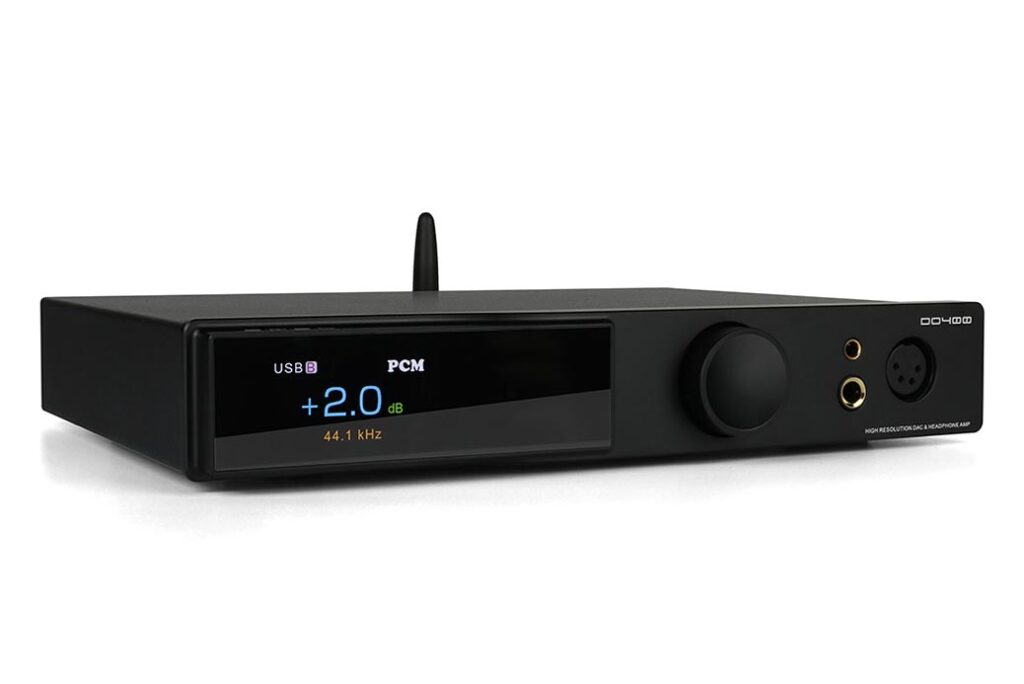
The S.M.S.L DO400 combines digital conversion, headphone amplification and line-level control in one desktop component. It is aimed at the listener who wants to move between headphones and speakers without assembling a separate DAC and amplifier stack. Its unusually broad digital connectivity is useful, provided the intended system fits its boundaries.
S.M.S.L DO400 — Design and controls
The DO400 is best viewed as a control centre for digital sources rather than a miniature integrated speaker amplifier. Its front panel accommodates several headphone cable formats, while the display and remote help when the box sits beyond arm’s reach. That arrangement suits a desk with a computer, headphones and active monitors. It can also work on a nearby shelf, although reaching the headphone sockets and reading the display should be part of the placement decision.
Before regular use, learn the output-selection menu and establish a predictable volume routine. A versatile all-in-one is only convenient if switching between listening modes is clear. Keep a little space around the case and allow for the bend radius of rear cables. Putting another warm component directly on top may save desk area but is a poor substitute for a sensible layout. The front connections are useful precisely because headphones can be changed without disturbing the rest of the system.
Connections: flexibility with an important distinction
The manual lists USB, optical, coaxial, AES, I2S and Bluetooth inputs. Analogue outputs include RCA and XLR line connections plus 6.35 mm, 4.4 mm and four-pin XLR headphone sockets. That is a generous selection for a digital listening station, but there is no analogue source input. A turntable and phono stage cannot be added as though this were a conventional preamplifier with line-input switching.
The I2S connection uses an HDMI-shaped socket, but it is not a television HDMI, ARC or eARC input. A source must offer a compatible I2S output and pin configuration. For most owners, ordinary USB or S/PDIF connections will be simpler and entirely appropriate. AES can be useful with a compatible transport, while optical offers a straightforward stereo path from suitable equipment. There is no need to invent a more elaborate connection merely because the rear panel offers one. Start with the source you actually own and choose the matching interface.
Headphone drive and choosing an output
S.M.S.L quotes 3 W per channel into 32 ohms and 6 W into 16 ohms for headphone output. These are manufacturer specifications, not our measurements, and should not be treated as proof that every difficult headphone is an ideal match. Different headphones require different combinations of voltage and current. Sensitivity, impedance behaviour and the desired listening level all matter more than a single maximum-power headline.
The practical benefit of the front-panel selection is cable compatibility. If a headphone already uses a suitable balanced cable, the matching output is available; a conventional single-ended cable also has a home. Do not assume that buying a new cable is necessary before trying the equipment you have. Start on low gain and raise the level carefully. A higher gain setting is useful when needed, but having the volume control operate in a comfortable range is more valuable than choosing the largest number in a menu.
For sensitive earphones, low-level control and background noise deserve a separate check from maximum power. For demanding full-size models, listen for adequate headroom on quiet recordings without forcing a high average volume. Neither case can be judged from the DAC chip alone. A combined device succeeds when both the converter and amplifier suit the headphone, and the DO400’s broad role is more relevant than its component branding.
Sound quality and the independent assessment
Headfonia’s original review reported a clean, broadly neutral presentation and strong results with several full-size headphones, including planar models. That is encouraging evidence for the DO400’s intended desktop role. It remains a reviewer assessment in a particular chain, rather than a guarantee of identical results with every headphone. Our favourable rating also reflects the integration of the amplifier and the practical connection options, not an assumption that published specifications are our own laboratory results.
A neutral source will not necessarily make an unsuitable headphone enjoyable. If treble balance, comfort or isolation is the real problem, changing those parts of the system can be more effective than replacing the DAC. Assess the DO400 at a consistent level and with optional sound-colour processing disabled initially. That gives a useful reference before exploring its settings. Switching between differently loud outputs without matching levels can create a false impression of improved dynamics or detail.
The sound-colour modes are digital processing choices, including tube-themed options; they do not turn the unit into a valve amplifier. They may be interesting personal preferences, but should not distract from the basic decision about headphone matching and source convenience. The most persuasive case for this product is an integrated, flexible system that performs its normal job well.
Using it with active speakers
The manual provides fixed and variable pre-mode settings. Fixed operation is appropriate when a downstream component supplies the intended volume control; variable operation is useful when the DAC is responsible for level. Check that choice before connecting active speakers or a power amplifier. Begin with low levels at both ends and establish which control will be used daily. It is an easy configuration step with a much larger practical consequence than changing a digital filter.
The specified maximum line levels are 5.2 V XLR and 2.5 V RCA, so compatibility with the next device’s input remains worth checking. Passive speakers cannot connect directly to these outputs. They need a separate power amplifier, and a conventional integrated amplifier may already provide the controls you need. The DO400 can therefore simplify a digital active-speaker desk considerably while adding less value to a system that already has a capable DAC, headphone stage and preamplifier.
Digital formats and buying value
USB decoding reaches PCM 32-bit/768 kHz and DSD512 in the documentation. Those ceilings are useful for file compatibility, but ordinary music does not need to be converted to the largest available number. Keep the computer’s audio routing stable and verify any required driver. Wireless playback is a convenience source rather than a replacement for a full network streaming platform. The DO400 does not independently browse services or a music server.
Its value improves when several of its jobs replace things you would otherwise buy separately. A computer user who needs headphone drive and active-speaker control can make good use of the design. A listener wanting only a small DAC for an existing amplifier may be paying for redundant hardware. Compare current European offers with VAT and support included, rather than using an old dollar launch price as a fixed benchmark. Leave room in the budget for the headphones and speakers themselves: they are still central to the final listening result.
Alternatives to consider
FiiO K17: Compare this if your plan calls for a more elaborate desktop hub. Judge the complete feature set and your actual inputs, rather than headline power alone.
Topping DX5 II: Another published all-in-one option for headphones and line-level use. Check controls, processing features and desk space alongside the price.
S.M.S.L DO400 key specifications
- Role
- DAC, headphone amplifier and digital-source preamp
- Inputs
- USB, optical, coaxial, AES, I2S, Bluetooth
- Headphone sockets
- 6.35 mm, 4.4 mm, four-pin XLR
- Line outputs
- RCA and XLR; fixed or variable
- Rated headphone power
- Manufacturer: 3 W/channel at 32 ohms; 6 W/channel at 16 ohms
- USB decoding
- PCM up to 32-bit/768 kHz; DSD512
Verdict
A strong digital desktop all-in-one with extensive inputs, useful headphone connections and flexible line operation. It is especially appealing for headphones plus active speakers, but its I2S socket is not TV HDMI and it cannot switch analogue sources.
Primary documentation and independent reviews
S.M.S.L official DO400 specifications · S.M.S.L DO400 manual · Headfonia original DO400 listening review
Editorial record
Sources and updates
Product specifications and factual claims were checked against Official S.M.S.L DO400 product page ↗. Scores and buying advice follow our category-specific editorial methodology.
- Published
- November 8, 2026
- Last updated
- November 8, 2026