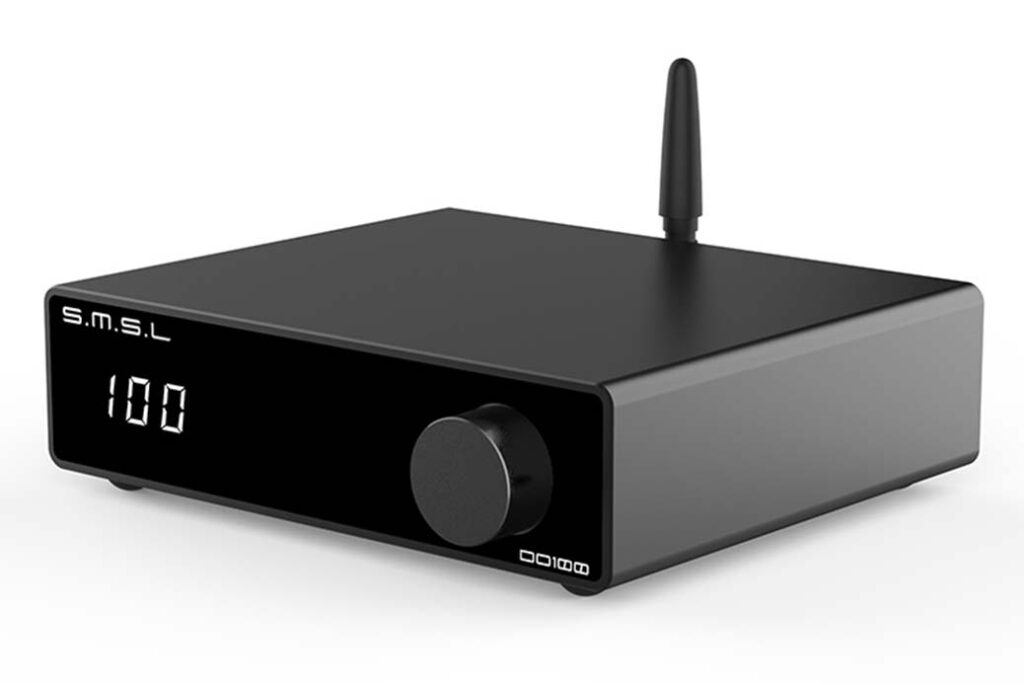
S.M.S.L DO100 is the original compact stereo DAC with dual ESS conversion, digital source switching and RCA and XLR line outputs. It predates the DO100 Pro and should be assessed as a separate model. This research-based review considers positive original performance evidence and the practical advantages of remote operation and variable output. It also explains why a DAC with a volume knob still requires amplification and a deliberate connection plan for headphones or speakers.
Research-based review. This assessment draws on manufacturer documentation and the original published evaluations linked below. Audio Review has not performed a hands-on test of this model.
Clean and detailed in the original listening account
Headfonia’s original evaluation describes clean, detailed and dynamic playback, while noting that the result varied with the connected amplifier and headphones. It also found a brighter balance in one pairing. Those are the original reviewer’s listening impressions, not Audio Review test findings.
Use the account as a reason to compare the DO100 with the equipment actually intended for the system. Match playback level carefully, especially when changing between RCA and XLR routes. A different output level can sound like stronger bass or greater clarity without establishing an improvement in conversion. Listen to voices, percussion and quiet ambience over a realistic session. A DAC should not be expected to solve every tonal preference imposed by headphones or speakers. The available evidence supports the DO100 as a capable and affordable source component. The final judgement should include noise-free operation, suitable control and the actual presentation in the finished system, rather than relying on a dramatic difference reported from somebody else’s complete chain.
Original DO100 identity matters
S.M.S.L identifies the original model with two ES9038Q2M chips. DO100 Pro is a different product, so its specifications, connection claims and support files should not be transferred to this review.
Check the rear label and seller description, particularly when buying used or discounted stock. A generic listing may show a newer product photograph while naming the older unit, or the reverse. Confirm expected accessories and the exact input and output layout before ordering cables. Support material should match the actual hardware and model. Never choose an update file simply because the names are close. The original DO100 can remain a sensible purchase when it meets a practical requirement, but a low clearance price is only useful if the offered product is unambiguous. Accurate identity also makes comparisons fair: the question is whether this specific converter fits the system at its current price, not whether every product carrying DO100 in its name has the same design or performance.
Balanced and single-ended line outputs extend its role
The RCA and XLR outputs provide two line-level connection routes, with output control supporting a digital preamplifier role. The DO100 still does not include a headphone amplifier or passive-speaker power stage.
Connect it to a suitable amplifier or active-speaker system and decide which component controls listening volume. Start conservatively and check behaviour after source changes or a restart. A downstream system with no convenient attenuation requires particular attention to the chosen level arrangement. Balanced XLR wiring can be useful when both components support it correctly, but it does not guarantee a better result in every short domestic connection. Keep comparisons level matched and avoid assuming that a larger nominal voltage is inherently desirable. If more than one destination is connected, verify what remains active during headphone and speaker use. The line facilities are most valuable when they replace awkward switching or fit an existing balanced system. They do not create independent music zones or an analogue input stage.
Multiple digital sources are useful within clear boundaries
USB, optical, coaxial and Bluetooth cover several common source routes. The unit has no analogue input, native network player or HDMI ARC connection. It is a converter for external sources rather than an autonomous music system.
A computer or suitable transport can be straightforward, while a television requires a supported digital output format and a workable volume routine. Optical playback does not promise television remote integration. A turntable needs an analogue path elsewhere even if an external phono stage is already available. Bluetooth is convenient for occasional phone playback, with actual codec use depending on both devices and connection conditions. It should not be described as Wi-Fi service integration or multiroom capability. List the functions that are already covered by the source and amplifier before valuing the DAC’s input count. The DO100 is coherent when it accepts the digital signals the system actually provides. Extra adapters and controls can undermine the simplicity that makes a compact converter appealing in the first place.
Menu options are tools rather than everyday goals
The manual documents selectable USB modes, PCM filters, display brightness and DPLL adjustment. The compact display uses abbreviations, so an initial look at the manual is more useful than guessing what each code means.
Establish a reliable baseline with the intended host and follow official driver requirements where applicable. Test ordinary playback and returning from sleep before experimenting with the highest supported formats. USB and optical connections have different limits; a large headline number is not a universal input specification. The DPLL guidance can help with some timing-related interruptions after format and cabling are checked, but it will not decode an unsupported signal. Filter choices should be compared at consistent level without assuming a more exotic name guarantees an audible improvement. A remote is convenient only if the normal source and volume routine remains understandable. The best configuration is usually one that can be left alone while music plays, with technical settings changed for a specific reason rather than as a ritual.
Installed value includes the separate amplifier
The small case and internal mains supply make the original DO100 easy to integrate into an existing stereo setup. The complete chain still needs appropriate amplification, interconnects and a convenient place for the controls.
Compare current local offers with warranty support and missing accessories included. A low DAC price can lose its advantage if a separate headphone amplifier is needed for a very simple desk. Conversely, someone who already owns a suitable amplifier can make good use of a dedicated converter without replacing functioning equipment. For a used example, test all required inputs, both output channels and remote operation. Leave rear clearance for XLR plugs and keep the installation sensibly ventilated. An older model should be chosen on what it provides now, not on the assumption that every newer converter must sound substantially better. The DO100 is strongest when it fills a clear digital source and line-output role at a fair complete price.
Alternatives to consider
S.M.S.L SU-9 Pro: Compare the extra facilities and complete price with the existing system. A newer conversion platform should bring a useful benefit rather than replace a suitable DAC by default.
Topping E70 Velvet: Consider another standalone approach with the actual amplifier and transducers. Match line levels before drawing conclusions about apparent detail or bass authority.
S.M.S.L DO100 key specifications
- Role
- Original DO100 stereo DAC and digital preamplifier
- DAC architecture
- Two ESS ES9038Q2M chips
- Inputs
- USB, optical, coaxial and Bluetooth
- Analogue outputs
- RCA and balanced XLR line outputs
- Manufacturer nominal level
- RCA 2 Vrms; XLR 4 Vrms
- Headphone amplifier
- Not included
- USB ceiling
- Supported PCM up to 32-bit/768 kHz and DSD512
- Optical / coaxial
- Supported PCM up to 24-bit/192 kHz; DoP64 where supported
- Control
- Front knob, display and remote
- Power / weight
- Internal mains supply; approximately 560 g
- Not provided
- Analogue input, HDMI ARC or native network playback
Verdict
The original DO100 remains a credible research-based standalone DAC with useful source and output flexibility. Confirm exact model identity, external amplification and predictable volume control. Positive original evidence supports an audition, while the strongest value comes from a system that uses its balanced line connections and remote convenience without needing functions outside its design.
Documentation and original reviews
S.M.S.L official original DO100 product · S.M.S.L official original DO100 manual · Headfonia original DO100 setup evaluation · Headfonia original DO100 listening evaluation
Editorial record
Sources and updates
Product specifications and factual claims were checked against Official S.M.S.L DO100 product page ↗. Scores and buying advice follow our category-specific editorial methodology.
- Published
- November 17, 2026
- Last updated
- November 17, 2026